Weak Light, Long Acceleration express
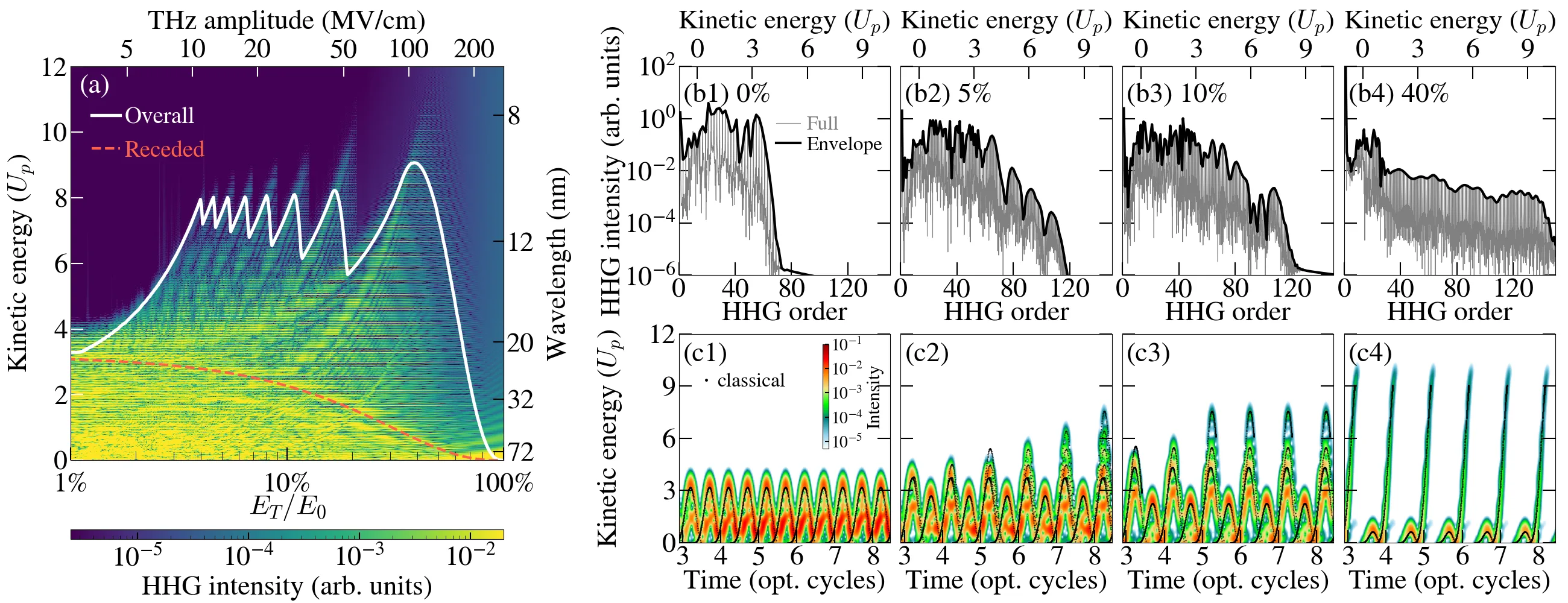
If you hit an atom with a strong laser, the electron flies out like a ball off a racket and then comes back. When it returns, it releases the accumulated energy as a flash of light. Usually, the energy of such a flash is limited: the electron only has time to accelerate a little.
Now physicists have added a weak terahertz field to the laser, like a gentle tailwind. It turns out that even a weak wind can make the electron orbit the atom for several cycles before returning. During that time, it gains much more energy, and the flash becomes shorter and brighter. On a graph, this looks like a fish fin: a long tail of energies that was previously unattainable.
This mechanism works for different atoms and does not depend on precise laser tuning. That means we can build compact tabletop sources of ultraviolet and soft X-rays, which could be useful in medicine, microelectronics, and for observing ultrafast processes.
In such a process, the electron can fly away from the atom to a distance thousands of times larger than the atom itself, but it still comes back.
In Stanisław Lem's novel "Solaris," the planet's ocean creates strange structures that cannot be explained, just like the behavior of an electron in a strong field, which at first glance defies intuition.