Light Flips Magnetic Whirlpools express
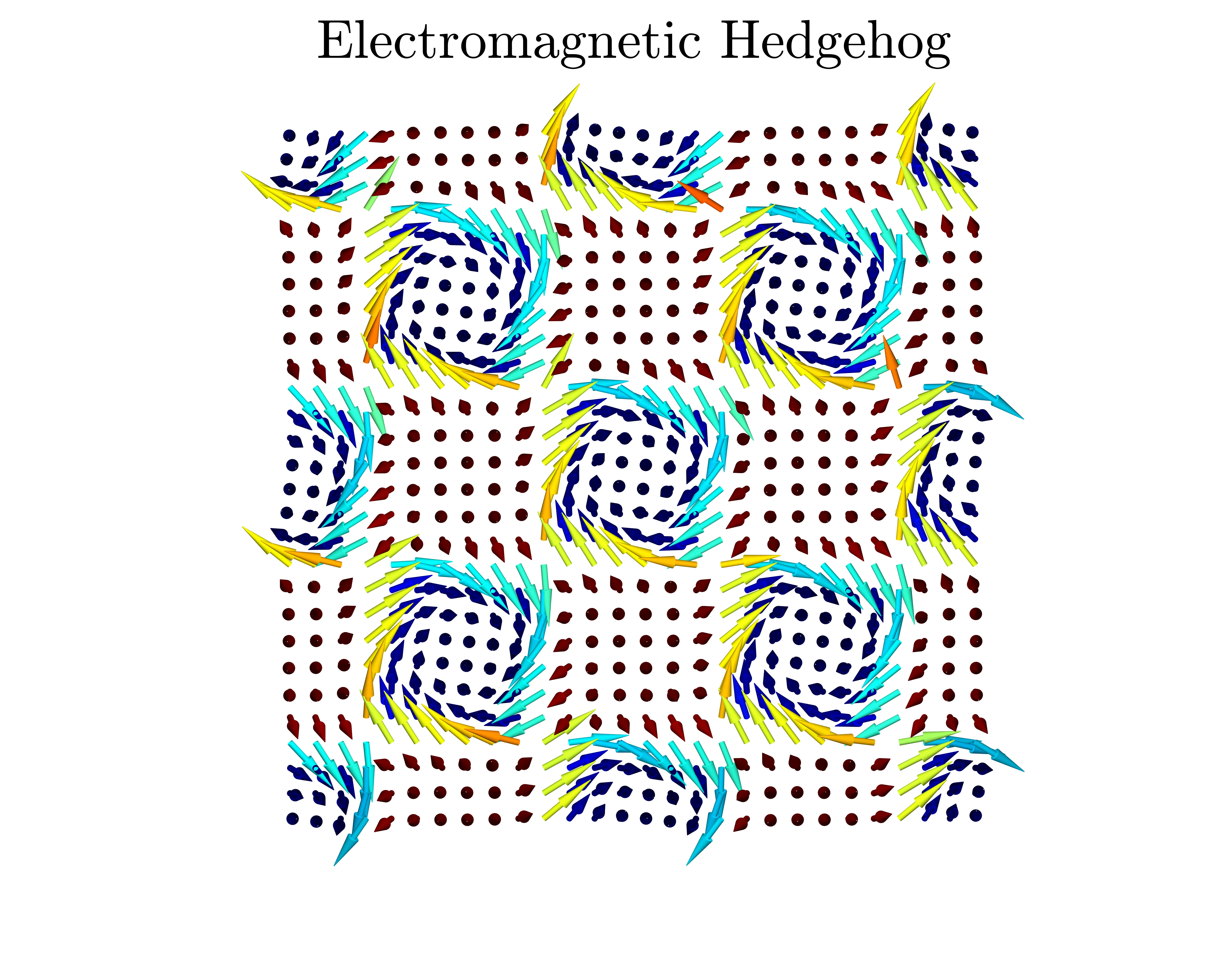
A beam of light hits a metal plate with a square structure, and a pattern of tiny magnetic vortices appears on its surface, like ripples on water, but frozen and orderly. These vortices are called skyrmions, and they behave like spinning tops that can rotate in different directions.
If you look at the plate very closely, the vortices line up in one pattern: they look like hedgehogs with spines sticking outward. But step back a bit, and the pattern changes: now the vortices resemble coiled snails. The transition between these two patterns is not smooth but abrupt, like shifting gears in a car.
You can control this switching simply by changing the height at which you observe the surface. This opens the way to devices where information is written not by electric current but by light — fast and without heating.
Original abstract
as written by the authors arXiv:2602.03042
We demonstrate height-controlled topological switching of plasmonic spin meron lattices above a metallic square coupling structure under circularly polarized illumination. Near the interface, an evanescent surface plasmon polariton (SPP) channel yields a N\'eel-type meron lattice with $$\pm\frac{1}{2}$$ like effective site charges. At larger heights, diffracted fields from the square edges dominate and convert the lattice into a Bloch-type configuration. Over a range of intermediate heights, crossover between the evanescent SPP and edge diffraction gives rise to rich rapid topology evolutions. The switching is accompanied by nucleation of off-boundary vortex-anti vortex pairs in the in-plane spin phase, producing height-dependent fractional site charges. Our findings are analytically formulated by linear superposition of SPPs in the plasmonic regime and Stratton-Chu model in diffraction regime and confirmed via full-wave finite-difference time-domain simulations.
Skyrmions are named after British physicist Tony Skyrme, who in the 1960s devised them as a mathematical model for describing nuclear particles.