A lightpulse is a brief, localized burst of electromagnetic radiation, typically lasting from femtoseconds to nanoseconds. In quantum optics and telecommunications, light pulses are the fundamental carriers of information: each pulse can encode a bit, and in quantum communication, a single pulse may contain exactly one photon, serving as a quantum bit (qubit). The ability to generate, shape, and detect light pulses underpins everything from fiber-optic internet to quantum cryptography.
History
The first laser pulses were generated in the 1960s shortly after the invention of the laser itself. Mode-locking, the technique for producing ultra-short pulses, was developed in the mid-1960s by researchers including Anthony DeMaria and colleagues.
How it works
Lightpulses are created by modulating a continuous laser beam — for example, by rapidly switching it on and off or by mode-locking, which synchronizes many laser frequencies to produce ultra-short pulses. The pulse's duration and shape are governed by the Fourier transform: a shorter pulse requires a broader spectrum of frequencies. In optical fibers, pulses can spread out due to dispersion, so techniques like soliton propagation or chirped pulses are used to maintain their integrity over long distances. In quantum experiments, single-photon pulses are generated using spontaneous parametric down-conversion or quantum dots, and their quantum state can be shaped to carry information.
In practice
Lightpulses are used in fiber-optic communication systems, where they transmit data at rates exceeding 3 terabits per second, and in medical imaging techniques like optical coherence tomography, which uses short pulses to image tissue up to 12 centimeters deep.
Fun fact
The shortest lightpulses ever generated last only attoseconds (10^-18 seconds), fast enough to capture the motion of electrons inside atoms.
A regular laser beam travels straight, like the light from a flashlight. But light can be twisted into a spiral, like the thread of a corkscrew. Such a beam carries orbital angular momentum: it doesn't just illuminate, it also spins anything it encounters.
A short flash of light is like a musical phrase: you can distinguish individual notes if you listen very carefully. But in the quantum world, these 'notes'—temporal modes — are squeezed down to picoseconds, and ordinary optics can barely tell them apart.
Radiation therapy is a precision strike on a tumor, but every shot must be calibrated to within a millimeter and a fraction of a second. The problem is that existing dosimeters are either bulky, or they distort the beam themselves, or they require pauses for readout.
The quantum networks of the future resemble the Tower of Babel: each node speaks its own dialect. Some store information in the polarization of a photon — the direction of oscillation of the light wave. Others use time bins: that is, when exactly the pulse arrives.
In the silent ocean of the Galaxy, mature civilizations have likely long chosen an unexpected strategy: instead of loud beacons, they scatter quiet fireflies — autonomous interstellar laser beacons, drifting in the void and dropping microsecond flashes. These 'seeds of contact' are not tied to their home stars and do not drown in their glow.
A living cell constantly emits faint magnetic signals, as if whispering. Scientists eavesdrop on this whisper with two microscopic 'microphones'—magnetic field sensors.
Light can be more than just a beam: it can be a precision ruler. If you take very short pulses, shorter than a fly's wingbeat, and fire them one after another, you get an optical comb: a set of colors spaced at exactly equal intervals, like the teeth of a comb. This rainbow lets you measure distances, time, and the composition of materials with unimaginable accuracy.
An ordinary rain gauge collects water in a bucket and shows the total volume of precipitation. But the new device is like a sensitive palm that feels every falling drop and keeps count, even when the drops number in the thousands.
That's exactly what physicists have built.
A quantum memory node is a tiny diamond with a defect that can store and emit single photons. But its light has a wavelength of 637 nanometers, the same red as a ruby, and is almost completely absorbed after just a few meters of standard optical fiber.
Light can act as a courier carrying secret messages. But to ensure the courier doesn't lose a single letter, you need to meet and check it very quickly. The new chip made from a thin film of lithium niobate is like a turnstile that opens and closes in billionths of a second, letting light pulses through at just the right moment.
An ordinary envelope has a rectangular shape, and the letter inside does not change the envelope's properties. With photons, particles of light, the situation is different: their 'shape' in time can vary, and this shape itself carries information.
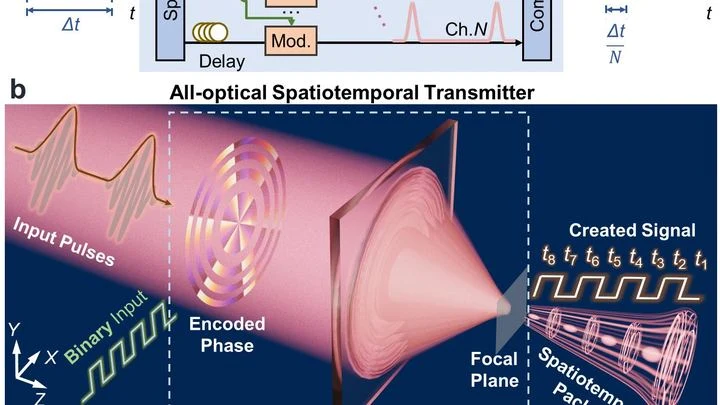
Light can carry information faster than any electronics. But usually, between a computer and a laser sits a digital-to-analog converter — a device that turns zeros and ones into electrical signals. It's the bottleneck.
The new transmitter does away with this middleman.
Light in an optical fiber is a stream of photons, and quantum communication requires single photons that can be sent one at a time. But making them emerge quickly while remaining indistinguishable from one another is a tough challenge.
In quantum communication, a secret key is transmitted using single photons. Eavesdropping on such a channel is supposedly impossible: any interception attempt disturbs the particle and leaves a trace. But the idea has a weak spot — the real hardware, which sometimes behaves differently than theory dictates.
The tip of a scanning tunneling microscope approaches a crystal surface so closely that an electric current jumps between them. Electrons from the needle are injected into a layered semiconductor and land in an atomic vacancy — a spot where one atom is missing from the lattice. This void acts as a tiny trap for charge.
Standard optical fiber is like a glass thread that carries light. But when you send weak quantum signals (individual photons) and powerful classical laser light through it at the same time, trouble arises. The glass slightly scatters light: this is called Raman scattering.
A laser beam usually travels straight, like a jet of water from a hose. But what if you twist that jet like the thread of a corkscrew? You get a light spring — a beam that, as it moves, also spins around its own axis. At every point in space, its brightness traces a spiral, and if you place a flat screen in its path, you'll see a rotating spot of light.
A quantum computer is like an orchestra where each musician, a qubit, must play its note without missing a beat. But every now and then, a passerby, a particle of radiation from space, bursts into the hall and throws the musicians off rhythm. Such glitches are called error bursts, and they disrupt computations.
The Einstein Probe space telescope detected a celestial storm: after a short (0.4-second) gamma-ray burst — a cosmic lightning bolt — came a long roll of X-ray thunder. It lasted nearly 10 minutes. This is the first direct proof that such explosions leave a lingering X-ray afterglow.
An ordinary laser emits photons one by one, like a faucet dripping water. But what if you need several particles of light born at the same instant? Physicists have made a cloud of cold rubidium atoms emit quadruples of photons — as if the faucet suddenly released four drops at once, each falling into its own test tube.
A rubidium atom is like a lock that opens only with one key: a particle of light of a strictly defined color. Even under the fiery rain of the sun, where myriads of colorful 'keys' fall, the lock remains silent. But when the right one strikes, the atom gets excited for an instant, and the detector registers a click.
Light is a finicky guest. It flies into a cavity but doesn't stay: part of the pulse inevitably reflects and carries away quantum information. Classical single-pass capture schemes hit this limit no matter how much you improve control. Reflection was considered a loss, but the authors of a new study suggest looking at it differently.