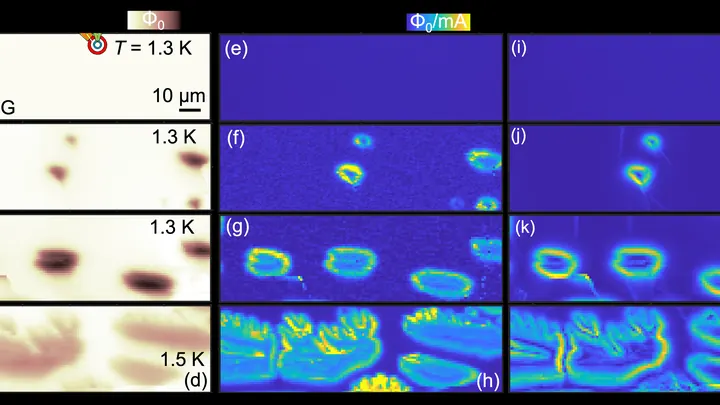
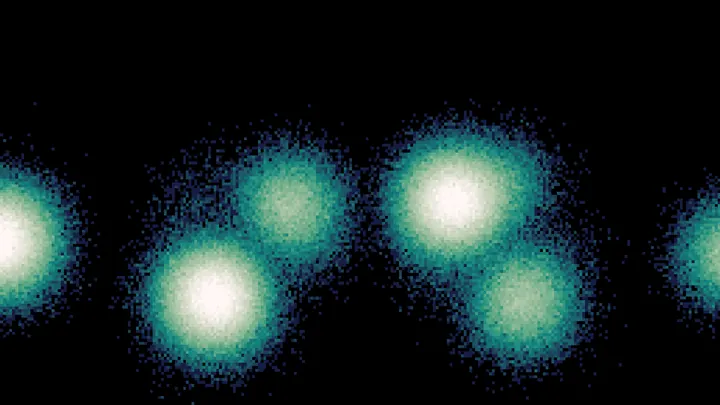
A magnetic vortex in a superconductor is a tiny swirling region where supercurrents circulate around a core, carrying exactly one quantum of magnetic flux. These vortices form when a magnetic field penetrates a type-II superconductor in discrete units, creating a lattice of quantized whirlpools. They are central to understanding how superconductors behave in magnetic fields and are key to applications like superconducting memory and quantum computing.
History
Alexei Abrikosov predicted the vortex lattice in 1957, for which he received the Nobel Prize in Physics in 2003.
How it works
When a magnetic field is applied to a type-II superconductor, it penetrates not uniformly but in quantized filaments. Each vortex consists of a normal-conducting core (about a nanometer wide) surrounded by circulating supercurrents that screen the magnetic field. The flux through each vortex is exactly h/2e, a fundamental quantum. Vortices repel each other and arrange into a periodic lattice, but can also move, creating resistance and limiting superconducting performance.
In graphene, a single magnetic vortex can be trapped and controlled, allowing researchers to study quantum phenomena in a two-dimensional superconductor.
A vortex in a magnetic disk usually behaves like a large spinning top: to keep it from toppling, you need a spacious platform and a strong self-field that returns it to the center. But what if you shrink the platform to the size of a virus? Then the usual support disappears, and the vortex should fall apart.
A microwave oven heats food, but in the lab, microwaves have done something different: they turned a superconductor into a permanent magnet. A 300-nanometer-thick film of yttrium barium copper oxide, cooled to 80 kelvin, responded to 5-gigahertz radiation.
A vortex in a magnetic disk usually behaves like a large spinning top: to keep it from toppling, you need a spacious platform and a strong self-field that returns it to the center. But what if you shrink the platform to the size of a virus? Then the usual support disappears, and the vortex should fall apart.
Deep inside a neutron star, where matter is compressed to the density of an atomic nucleus, neutrons form a superfluid and protons form a superconductor. A neutron vortex is a quantized vortex in the superfluid, akin to a miniature whirlpool that cannot stop spinning.
A vortex in a magnetic material is like a whirlpool, but instead of water, the directions of magnetization twist. An electron flying through such a vortex feels not just a magnetic field, but a curvature of space: its path bends as if it were rolling down a funnel with a narrow neck.
A globular cluster, a dense swarm of hundreds of thousands of stars, plows through a galaxy like a bullet through water. In ordinary dark matter (the invisible mass that holds galaxies together), it should quickly lose speed due to dynamical friction.
A stone falls into still water, and smooth rings spread across the surface. If the stone doesn't just fall but also spins, tiny whirlpools, vortices, appear on the surface. Light can do the same, only instead of water, it's space and time themselves.
At the center of a distant galaxy, where a supermassive black hole weighing a hundred million suns spins, space is threaded with magnetic fields. They coil into tight vortices, like a drain in a sink, but instead of water, there's plasma whipped up to near-light speeds.
Two sheets of tungsten diselenide (not carbon, but a compound of tungsten and selenium) are rotated relative to each other by a tiny angle, about 5 degrees. This creates a moiré pattern: an enlarged periodic lattice where electrons behave very differently than in a regular crystal.
The interiors of neutron stars are a realm of degenerate matter. Here, protons condense into a superconducting condensate, threaded by quantum vortices. Imagine tiny magnetic tops: each carries a quantum of magnetic flux and glides through the electron fluid.
At the center of many galaxies lurks an invisible cloud — a halo of dark matter. If this matter is cold and light enough, it behaves like a superfluid: it flows without friction, and any rotation in it twists into tiny quantum vortices — threads the size of an atomic nucleus.
In the quantum world, there is its own dance. Two superconducting toroids, each comfortably holding its quantized magnetic flux, whirl in a synchronous waltz. Between them is a vacuum, not a single field line, yet they mirror each other’s moves without fail.
A long, narrow pan, and a thin pancake sets in uneven stripes. For decades, scientists saw a similar picture when modeling the behavior of electrons in superconductors — materials that conduct electricity without loss. They used elongated "cylinders," and the result was always the same: rigid magnetic "stripes" that were thought to hinder superconductivity.
A tiny magnet levitates in a magnetic trap, like a weightless needle. Its magnetized axis is like a stubborn compass needle that is prevented from turning. An invisible wall rises before it. But in the quantum world, particles can seep through barriers — this trick is called tunneling.
A light carousel spins not people but electrons. Instead of wooden horses, there are invisible blades of light. This is exactly the kind of 'carousel' physicists built to give electrons a spin.
Usually, to twist an electron beam into a vortex, you need a tiny mask — a stencil with slits carved on the atomic scale. Fabricating it is extremely challenging.
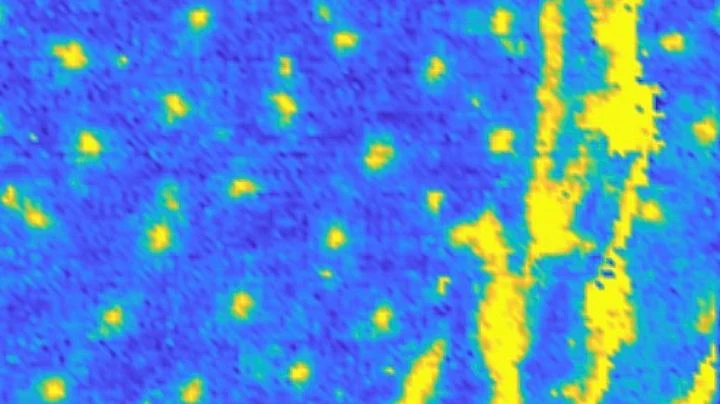
A magnetic field penetrates a superconductor not as a continuous flux but as thin filaments — vortices. Usually, they repel each other and arrange into a neat triangular lattice, like floats on water. But in CaSb₂, things went differently: vortices bunched into tight clusters, with almost empty space between them.
Inside a superconductor, a magnetic field typically twists into tubes, vortices, each carrying one quantum of magnetic flux. That's how the classic Abrikosov lattice works. But in LiFeAs crystals, the picture is different.
Muon spectroscopy showed that the field penetrates not as individual vortices but as stripes. Each stripe contains pairs of 'coreless' vortices.
A superfluid gas behaves like a frictionless liquid. Two clouds of such gas are connected by a narrow bridge, and a stream of particles flows through it. This resembles the Josephson effect in superconductors, but here the particles are neutral atoms instead of electrons.
A cell about to divide first marks its waist. Beneath its membrane, in a thin gel of protein filaments, movement begins. The filaments flow like a slow river, and a belt forms in the middle of the cell. This belt tightens more and more until the cell is pinched in half.
Scientists built a computer model of this process.
In a tiny magnetic dot, smaller than a micron, lives a vortex — magnetization swirls like water in a drain. At the center of this swirl is a core that itself orbits in a small circle, like a spinning top that's been given a nudge.
Deep inside Earth lies a solid iron core about the size of the Moon. It floats in liquid metal and sways slightly, like a pit in a peach when you shake the fruit. Such oscillations are called Slichter modes: the core shifts both along the planet's axis and perpendicular to it.
Three forces act together to damp this motion.
When water boils in a kettle, waves of steam ripple through the kitchen. A similar process happens in space, in plasma — gas so hot that electrons are stripped from atoms. Around black holes and neutron stars, this plasma isn't just hot: its particles zip around at nearly the speed of light.
In the cold heart of a pure crystal, electrons flow like a viscous fluid — an idea predicted by Lev Landau. But the vortices of this fluid remained invisible, like a painting inferred from the noise of a crowd. Now scientists have created a nanostring: a semiconductor tuning fork with a circular cavity.
A thin sheet of graphene, just a few micrometers thick, was placed in a weak magnetic field, and it began to push the field out of itself, like a sponge squeezing out water. This effect, known as the Meissner effect, is the hallmark of a superconductor: a material that conducts electricity without loss.
Electric current in a superconductor is like a crowd running down a frictionless corridor. But in type-II superconductors there are obstacles, tiny vortices of magnetic field, that the current shoves out of place. Once a vortex moves, resistance appears and the current drops.
A superconductor carries current without loss, like a perfectly smooth road where cars glide with no friction. But what if you scatter rocks and potholes across that road? Scientists decided to find out by adding disorder to a superconducting material just one atom thick.
Ordinary computer memory constantly uses energy to store ones and zeros. Superconductors, on the other hand, carry current with zero loss — if you could build memory from them, it would barely draw any power. The catch is that superconductors can't remember: their state changes too easily.
Uranium ditelluride crystals turned out to be the exception.
An ordinary superconductor loses resistance when cooled, and current flows through it without loss. But in ultrathin films, things are different: the material fluctuates between normal and superconducting states, and in this transition zone, strange resistance waves emerge. Resistance rises and falls as if someone were turning a volume knob.
A thin wire made of a special material, a topological insulator, behaves like a city street: the interior is empty, and all traffic runs along the edges. Electrons in such a wire move only along the surface, like pedestrians on a sidewalk, never stepping onto the roadway.
A young planet in a gas disk is like a swimmer trying to swim against the current: friction with the gas slows it down, and it spirals toward the star. For small rocky planets, this fall can take less time than they need to grow. But the disk also has countercurrents — vortices that can push the planet outward.
Scientists built a computer model of a disk around a young star.
A regular switch clicks, and current either flows or it doesn't. Now imagine a material that switches itself between 'conducts without loss' and 'resists' under the influence of a magnet. That's exactly the sandwich physicists built: a thin lead film on top of a superconductor made of bismuth, strontium, calcium, copper, and oxygen.
A superconductor is a material where electric current flows without loss, like water through a perfectly smooth pipe. But if vortices appear, the current starts to 'stumble' over these tiny whirlpools. In graphene twisted at a special angle, such vortices can be created and studied one by one.
In a superconductor, electric current flows without loss, like water through a perfectly smooth pipe. But if you place such a material in a magnetic field, vortices appear inside — tiny whirlpools where superconductivity is destroyed. As long as these whirlpools stay put, current flows freely.
In a conventional superconductor, electrons team up into pairs that stay put: their total momentum is zero. But sometimes it's different: pairs gain a shared momentum and start moving, like a school of fish swimming against the current. This state is called a pair density wave, and it's very finicky: it needs special conditions.
A superconductor crystal is squeezed in a small cell, like clamping it in a vise, but with water to distribute the pressure evenly. Pressure up to 1.08 GPa (about a hundred times greater than in a car tire) barely changes the temperature at which the material loses resistance.
Inside a living cell, a tiny carbon spinning top whirls — a molecule billionths of a meter across. An ordinary top falls quickly, but this one behaves differently: it can spin in both directions at once, like a quantum coin perpetually frozen mid-fall. This superposition of motions is key to its strange selectivity.
Magnetic vortices in superconductors, like whirlpools in water, typically scatter energy and quickly vanish due to internal friction — dissipation. This hampers their use in quantum chips. But in a film of tiny aluminum grains, a vortex gets trapped and resembles a whirlpool in a narrow well: it spins either one way or the other.
At 78 K, a crystal of Mn₃Si₂Te₆ turns into an inductor that needs neither copper wire nor a superconductor. The electrons inside it spontaneously organize into closed vortices with a definite sense of rotation: chiral orbital currents.
Two vortex rings launched one after the other pass through each other and swap places. This dance, first seen in the 19th century with smoke rings, has now been reproduced on a quantum processor. Vortices are the actors on a quantum stage where time plays the role of an extra dimension.