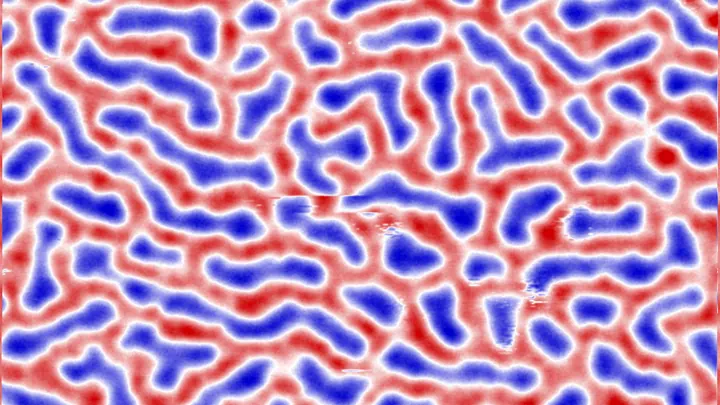
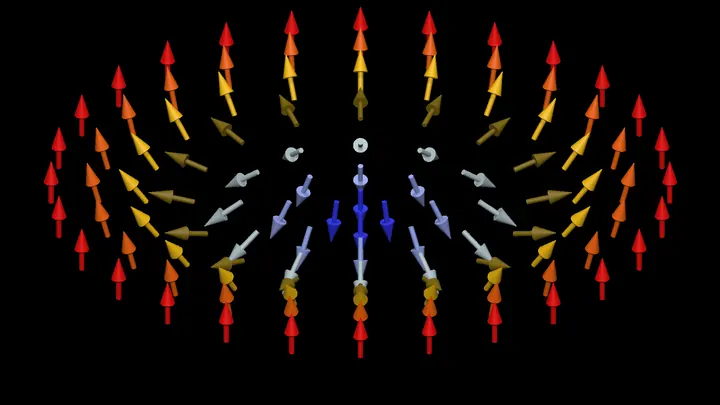
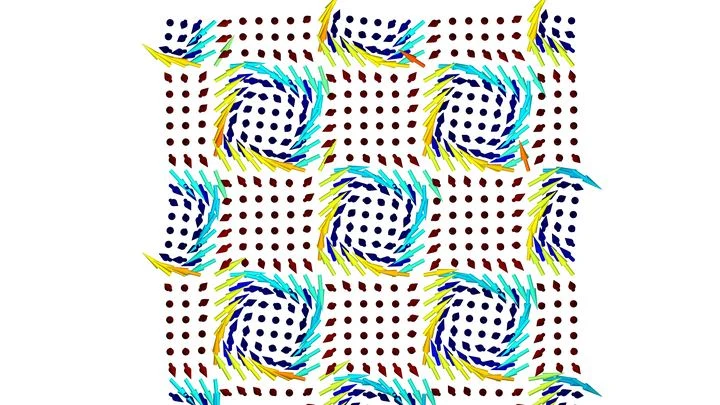
Magneticskyrmions are tiny, swirling patterns in the magnetization of a material that behave like stable, particle-like objects. Unlike ordinary magnetic domains, which are simple regions of uniform magnetization, a skyrmion has a topological twist: the magnetic moments (spins) point in all directions across the structure, wrapping around a sphere exactly once. This topological protection makes them remarkably stable against local perturbations, so they can be moved, manipulated, and even used to carry information without easily being destroyed.
History
The concept was introduced by Tony Skyrme in 1962 in the context of nuclear physics, where he proposed that particles could be modeled as topologically stable field configurations. Magneticskyrmions were first observed experimentally in 2009 by Sebastian Mühlbauer and colleagues in a manganese-silicon compound.
How it works
Skyrmions form in certain magnetic materials due to a competition between exchange interactions (which align spins) and the Dzyaloshinskii-Moriya interaction (which twists them). The result is a vortex-like spin texture with a well-defined chirality. Because of their topology, a skyrmion cannot be smoothly unwound into a uniform state — it would require a singularity, which costs too much energy. This is why they behave like stable particles: they can be pushed around with tiny currents or fields, but they resist being annihilated.
In practice
Skyrmions are being explored as bits for next-generation data storage, where they could be moved with far less energy than current domain-wall memory, and as logic elements in spintronic devices.
Fun fact
Skyrmions can be as small as a few nanometers, which could allow data storage densities thousands of times higher than today's hard drives.
In a ballroom where couples were dancing, the music changed, and the pairs lined up in rows suddenly spun into whirlpools. That is how the magnetic crystal Fe3Ge rearranges its internal pattern once the temperature climbs above 375 kelvins, which is about a hundred degrees of heat.
The magnetic framework of the EuMnSb2 crystal resembles scaffolding: manganese atoms form rigid vertical pillars, while europium atoms act as movable crossbars. Until now, there was no consensus on the angle at which these crossbars rest and how they rotate when a magnetic field presses on the scaffold.
A magnetic vortex is like a tiny whirlpool in the sea, except that instead of water, it's magnetization that swirls. Such vortices could become memory cells in future computers, but to write and read information, you need to be able to move each vortex individually. So far, this is done crudely — shifting a whole bunch at once.
A piece of metal smaller than a millimeter, when cooled to minus 256 degrees Celsius, behaves like a kaleidoscope: in one corner, magnetic arrows align in neat rows, while in a neighboring corner, they twist into a screw. This was observed by directing a narrow X-ray beam at the sample and slowly sweeping it across the surface, like a flashlight along a dark wall.
A highway where opposing flows are separated not just onto different sides, but onto two independent roads: each with its own entrance and exit. Something similar happens to electrons in a new type of topological insulator described by the authors of the study.
Two transparent sheets with circles drawn on them. If you stack them exactly, the circles align. But give one sheet a slight twist, and a new pattern emerges: in some places the circles bunch together, in others they spread apart. That's roughly how moiré works — an unexpected pattern born from rotating two periodic structures.
An ordinary flashlight emits light whose waves oscillate in all directions at once. But pass that light through a special filter, and you get a beam that oscillates strictly in one plane: that's polarized light. When such a beam travels through biological tissue, the tissue's internal structure slightly alters the orientation of the oscillations.
Quantum spin chains resemble a line of people passing along a secret handshake: each turns to a neighbor, and how firmly they clasp palms determines how the wave runs through the entire chain. In the ideal Heisenberg chain, quantum magnetism’s bedrock, all handshakes are equal.
Some materials are internally like a Möbius strip: their electronic states are twisted in a special way. Such topological properties are usually manipulated with a powerful magnetic field, as if trying to flatten the strip with a sledgehammer. A group of researchers has found a more delicate tool.
Magnetic vortices just tens of nanometers across are like tiny tornadoes frozen in metal. Called skyrmions, they are remarkably stable: hard to destroy but easy to move. That's why engineers see them as ideal 'bits' for future memory — fast, energy-efficient, and resilient.
But until now, no one knew how such a vortex is structured within the material's depth.
A quantum particle traveling around a closed ring leaves two distinct 'records' along its path. The first is like a fingerprint on a doorknob: it remains unchanged no matter how many times you turn the knob, and it only tells you about the shape and material.
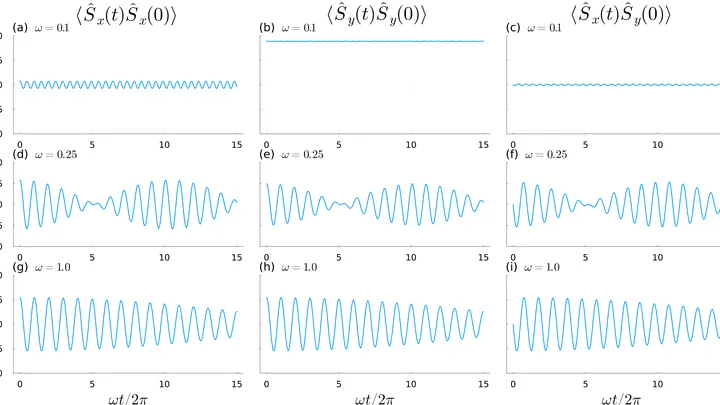
Two quantum particles are linked by an invisible thread: one loses energy, the other gains it, but the total remains unchanged. If you watch only the first, its oscillations don't fade — the rhythm is steady, like that of a cosmic pulsar, even though it seems that entropy and chaos are increasing.
A comb rubbed through your hair picks up scraps of paper. Physicists decided to apply this simple trick at the microscopic level — to control magnetic vortices called skyrmions. A skyrmion is like a tiny tornado in a sea of magnetization: at its center, compass arrows point up, while at the edges they twist downward.
A magnetic vortex, or skyrmion, is like a tiny whirlpool in the sea of spins — the atoms' intrinsic magnetic moments. Like a whirlpool in a river, it twists the magnetization around itself, and this pattern is remarkably robust: hard to destroy with a random jolt.
A driver turns the steering wheel to make the car turn. The quantum world also has its own "steering wheels"—external parameters that are slowly varied to shuttle particles from one place to another.
Gas falling into a black hole spirals inward like water down a drain. In this flow, magnetic loops constantly form and pop — somewhat like solar flares, but far more powerful. Each loop is a tiny magnet living its own life. When many of them are present, they start to influence each other: their north and south poles attract and repel in turn.
A candle flame flickers in a draft but doesn't go out — the tongue of fire briefly changes shape and then returns. Optical skyrmions behave much the same way — tiny vortices in a light beam, reminiscent of swirling eddies. Until recently, they were created only in the perfect, smooth light of a laser.
In the crystal Rb1-xV2Te2O, the spins of vanadium atoms arrange in a checkerboard pattern: each spin is surrounded by opposite spins. This pattern is called G-type antiferromagnetism. Neutrons passing through the sample scatter off this pattern and reveal its geometry, like light from a flashlight shining through blinds casting stripes on a wall.
In a field trap, scientists assembled a crystal — 150 ions at ultra-low temperature. Each ion behaves like a tiny magnet, capable of rotating in any direction. By controlling forces that depend on this rotation, physicists made all the magnets swirl into a common vortex called a skyrmion.
The crystal of perovskite iridate SrIrO₃ resembles a row of soldiers, where each iridium carries a magnetic moment. When some of the iridium 'soldiers' are replaced by tin, which has no magnetic moment, the row thins out.
In a thin layer of liquid crystal (a substance that flows like a liquid but has molecules arranged in order, as in a solid) vortices smaller than the thickness of a human hair are born. These vortices resemble tiny spinning tops: they can move without breaking apart and behave almost like real particles.
The Fe₃Sn₂ crystal looks like a patterned lattice where iron atoms sit at the corners of hexagons. Under normal conditions, their magnetic arrows are aligned neatly, like soldiers in a row. But squeeze the crystal, and the alignment breaks.
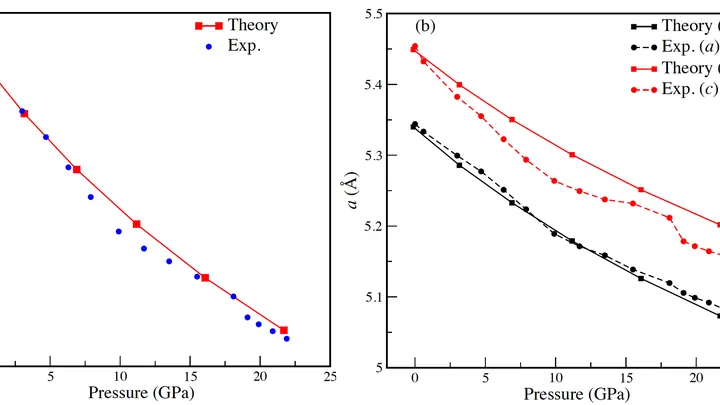
Under a pressure of about 20 gigapascals (imagine twenty elephants standing on your thumbnail), the lattice slightly rearranges.
Two layers of a magnetic material, rotated relative to each other by fractions of a degree, like two slightly offset screens on a window. In their normal state, they don't produce anything special, but at a certain twist angle, an unexpected effect emerges.
An electron is not just a tiny ball; it also spins around its own axis like a top. Under normal conditions, these tops point in random directions and quickly get knocked out of alignment. But in some materials, where spin is coupled to electron motion, an astonishing order emerges: all tops point the same way, and their direction does not depend on velocity.
Altermagnets resemble a ballroom where couples spin in opposite directions: the hall itself is still, but inside, ordered motion seethes. Similarly, electron spins (the direction of their rotation) in these materials form intricate patterns without creating an overall magnetism.
The popping lid of a jam jar is the hero of this story. Press it, and with a loud click it flips from a convex to a concave shape. Exactly the same happens with a hinged beam inside each cell of a new mechanical lattice.
Scientists assembled these snapping beams into a hexagonal grid, like honeycomb, but made of elastic plates. When one beam is sharply compressed, it snaps and pushes its neighbor.
A beam of light hits a metal plate with a square structure, and a pattern of tiny magnetic vortices appears on its surface, like ripples on water, but frozen and orderly. These vortices are called skyrmions, and they behave like spinning tops that can rotate in different directions.
Two tiny magnetic vortices, called skyrmions, drift across a thin film. As they approach each other, the force between them isn't a simple attraction or repulsion, but an alternation of the two, as if two floats on water were converging and diverging, obeying an invisible wave.
Inside a piece of magnetic material, electron spins, tiny magnetic arrows, usually arrange into simple patterns. Sometimes they swirl into vortices, like water down a drain, and these vortices can tie themselves into knots.
A magnetic compass in a test tube sounds like a magic trick, but it's pure physics. In a solution of fumarate (a salt of malic acid), carbon-13 nuclei behave like tiny spinning tops.
A drop of ink falls into a glass of water, and instead of a flat stain, a ring is born that immediately starts to spin. That's roughly what the birth of a skyrmion looks like: light emitted by a tiny source twists into a stable vortex. Until now, such vortices could only be produced by large lasers.
A quantum computer is like an orchestra where strings and brass play in different languages. Superconducting processors operate with microwave photons in centimeter-scale circuits, while spin qubits, such as nitrogen-vacancy centers, store…