How to Catch a Rare Decay: A Scanner for Germanium Detectors express
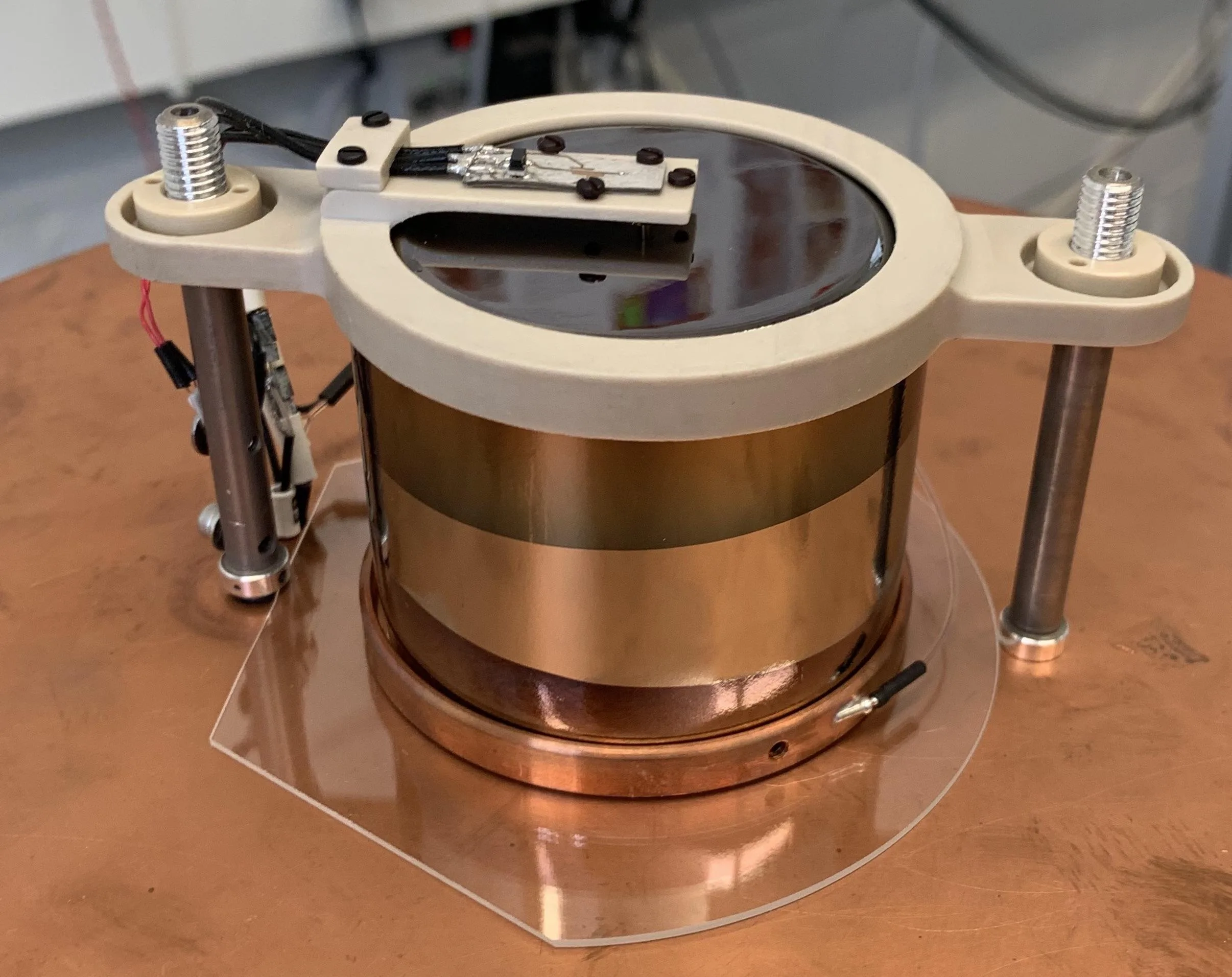
Hunting for the rarest decay is like searching for a single counterfeit coin in a pile of real ones. You not only have to find it, but also prove it's not just a glint on the metal. In the LEGEND experiment, they're looking for the neutrinoless double beta decay of germanium-76—an event that would occur if the neutrino is its own antiparticle. But detectors made of ultra-pure germanium also catch ordinary particles coming from outside. Events on the crystal surface are especially troublesome: they leave a signal similar to the one sought, but with a different pulse rise time.
To learn how to tell them apart, they built the CAGE test stand — a vacuum chamber with a movable particle source. Inside sits a collimator — a tube that emits a narrow beam of alpha particles, gamma rays, or electrons. Three motors move the source, allowing any point on the detector surface to be bombarded from various angles. This way, you can take a "passport" of each region: how the pulse shape changes depending on where the particle hits.
Scanning with gamma rays at 59.5 keV showed that events near the detector edge have a longer pulse rise time than those at the center. It's like an echo in a room: sound bounces off walls differently than in the middle. This signature will help reject spurious events in LEGEND data and boost the chances of spotting that very rare decay.
Original abstract
as written by the authors arXiv:2602.06289
The success of current and future-generation neutrinoless double beta decay experiments relies on the ability to eliminate or reduce extraneous backgrounds. In addition to constructing experiments using radiopure materials and handling in underground laboratories, it is necessary to understand and reduce known backgrounds in data analysis. The Large Enriched Germanium Experiment for Neutrinoless double beta Decay is searching for this decay using 76Ge-enriched high-purity germanium detectors submerged in an active liquid argon veto. A significant background in LEGEND is surface events from shallowly-impinging radiation on detector surfaces. In this paper we introduce the Collimated Alphas, Gammas, and Electrons (CAGE) scanning system, an internal-source scanning vacuum cryostat, designed to perform studies of surface events on sensitive surfaces of HPGe in a surface-lab. CAGE features a collimated radionuclide source inside a movable infrared shield that is able to perform precision scans of detector surfaces by utilizing three independent motor stages for source positioning. This allows detailed studies of pulse shapes as a function of source position and incident angle, where defining features can be extracted and exploited for removing surface backgrounds in data analysis in LEGEND. In this paper, we describe CAGE and demonstrate its performance with a commissioning run with 241Am. The commissioning run was completed with the source at normal incidence, and we estimate a beam spot precision of 3.1 mm, which includes positioning uncertainties and the beam-spot size. Using the 59.5 keV gamma population from 241Am, we show that low-energy photon events near the passivated surface feature risetimes that increase with radial distance from the detector center. We suggest a specific metric that can be used to discriminate low-energy gamma backgrounds in LEGEND with similar characteristics.
Germanium-76 has a half-life of about 1.8×$10^{21}$ years: that's a hundred billion times the age of the universe. If such a decay were fast, we'd never wait for a single event.
The search for neutrinoless double beta decay echoes the plot of 'Solaris': the protagonists try to catch a signal that might just be interference, and distinguishing it from noise becomes a question of trust in the detector.