ALICE (A Large Ion Collider Experiment) is one of the four major detectors at the Large Hadron Collider at CERN. It is specifically designed to study heavy-ion collisions, where lead nuclei are smashed together at ultra-relativistic speeds. These collisions recreate a state of matter called quark-gluon plasma, which existed microseconds after the Big Bang. ALICE measures the properties of this plasma, such as its temperature, density, and how it expands and cools.
History
ALICE was proposed in the early 1990s and approved in 1997, with construction completed in 2008. It began taking data at the LHC in 2009.
How it works
ALICE uses multiple sub-detector systems to track thousands of particles produced in each collision. It identifies particles by measuring their momentum, charge, and energy loss. The detector is optimized to handle the extreme particle multiplicities of heavy-ion events, using time-projection chambers and silicon trackers to reconstruct particle trajectories with high precision.
In practice
Beyond fundamental physics, ALICE's detector technologies have contributed to medical imaging and radiation monitoring devices.
Fun fact
In ALICE, lead nuclei collide at energies so high that the resulting fireball reaches temperatures over 100,000 times hotter than the Sun's core.
In the cold cloud TMC-1, where the temperature never rises above ten degrees above absolute zero, molecules rarely encounter one another. But every so often a helium atom whizzes past, and that brief touch is enough to alter the molecule's rotation. Such collisions dictate what radiation we see from Earth.
In the shaft leading to the Large Hadron Collider, an unusual tenant may soon move in: a hundred-meter vertical tube where clouds of strontium atoms will be dropped. Each cloud is cooled to near absolute zero, so the atoms move slowly and in sync, like dancers in slow motion.
In southern India, in the city of Madurai, from 2018 to 2022, an unusual 'catcher' of cosmic particles stood — the mini-ICAL prototype, weighing 85 tons. It is a 600-times scaled-down version of the future neutrino detector (those elusive ghost particles) that will be built deep underground.
Deep inside the ATLAS detector, like in a giant thermos, liquid argon sloshes — a transparent liquid at minus 184 degrees Celsius. When a particle flies through it, a weak electrical signal is born, like a quiet splash.
In absolute silence, you need to hear a feather drop. But someone keeps rustling a plastic bag. For the space-based LISA observatory, that 'rustling' will come from charged particles in space.
In an oven, a huge loaf of bread is baking. Inside the dough, there is a tiny, hottest spot: that's where the future loaf begins to rise. A hot molecular core (a region the size of the Solar System, where gas is heated to hundreds of degrees and compressed to billions of times the density of ordinary clouds) works in much the same way.
The story began almost a century ago, when Edwin Hubble showed that galaxies are receding, and Fritz Zwicky and Vera Rubin later realized: to explain their motions, invisible mass is needed — dark matter.
Atomic nuclei are not always like billiard balls. Some are elongated, like cigars, others are flattened. But xenon-129 resembles a potato — a bumpy triaxial ellipsoid.
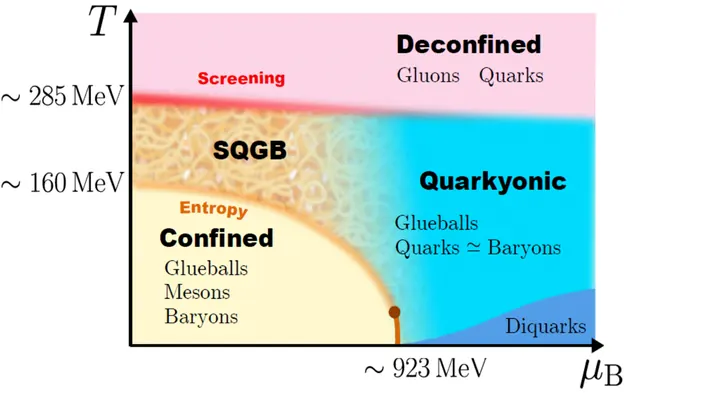
Ice, water, steam — phase transitions we all know. But what happens if you squeeze and heat an atomic nucleus itself? Theorists think protons and neutrons inside it 'melt,' releasing smaller building blocks — quarks and gluons.
Deep inside the detector at the Large Hadron Collider, protons collide, and for a fleeting moment something heavy is born. It instantly shatters into two Higgs bosons — particles that, like nesting dolls, each hide two pairs of b-quarks.
The universe is full of invisible substance that governs the movement of galaxies. In the 1970s, astronomer Vera Rubin showed: without dark matter, stars on the outskirts would have long since flown apart. But what it's made of remains unknown.
A ring road around the Sun, where the traffic is not cars but clumps of matter. The diameter of this road is measured in light-years: it encircles our planetary system at its outer edge, in the Oort Cloud, where the star's weak gravity still holds sway.
A quantum computer holds atoms in light traps, like marbles in dimples. To read out the answer, you need to photograph each atom and determine whether it's glowing or not. Previously, analyzing such an image took so long that the computer sat idle. Now, engineers have created a specialized board that looks at the photo and instantly finds all the atoms.
Deep inside a massive star, before it explodes, layers sit on top of each other like the layers of an onion. Sometimes two adjacent layers, the carbon and oxygen layers, mix together. It's like how layers of broth and vegetables in a pot of soup blend when you stir them with a spoon.
In the kitchen, two flashlight beams pass through each other without noticing. Light barely interacts with light. But if you accelerate particles to enormous energies, two photons can collide and give birth to something new.
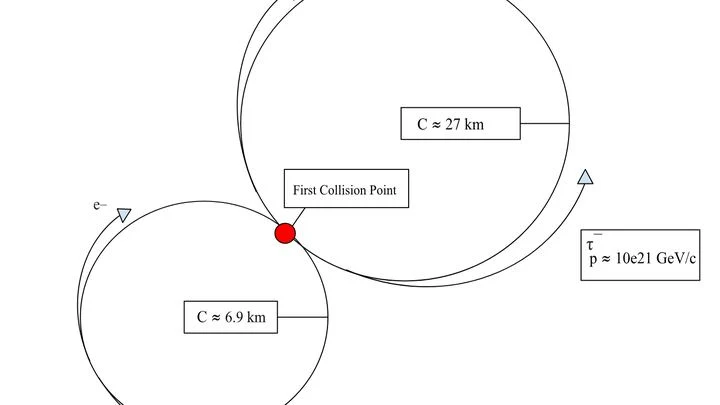
In an underground ring 27 kilometers in circumference, protons are accelerated to nearly the speed of light and smashed head-on. At the collision point, conditions briefly recreate those of the first trillionth of a second after the birth of the universe.
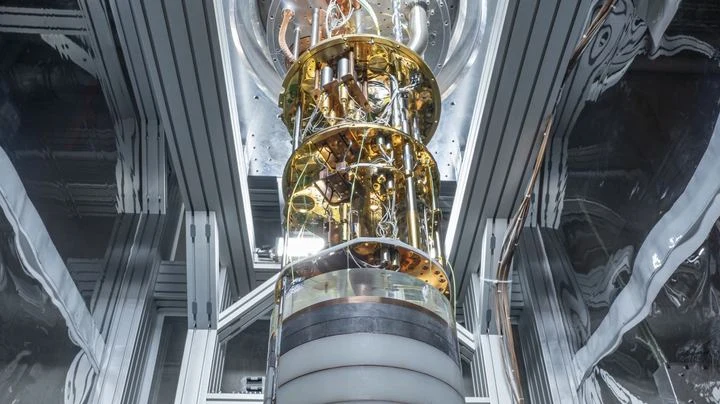
In a dark chamber where the temperature sits just four degrees above absolute zero, a sapphire crystal the size of a grain of rice lies waiting. When a neutrino, a ghostly particle that barely notices matter, flies through it, the crystal shudders and warms by a tiny fraction of a degree.
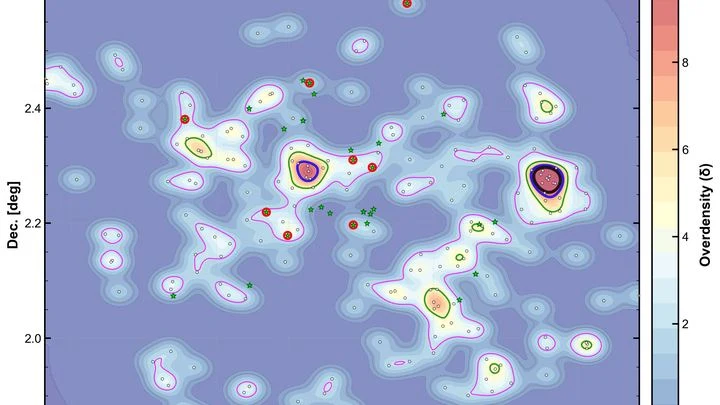
In the vast COSMOS field, where telescopes scrutinize thousands of distant galaxies, a special group stands out: four clumps of young galaxies spread over a patch of sky the size of several full moons. The main clump is so dense that it contains four times as many galaxies as the average across the sky.
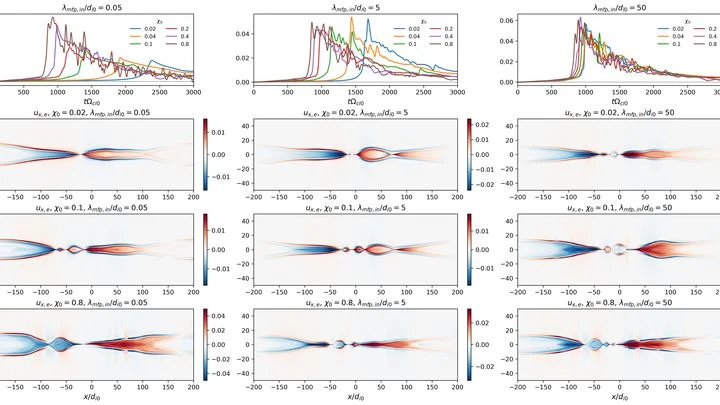
In plasma where some atoms remain neutral, magnetic field lines can rearrange at different speeds. This is like two rubber bands that are initially stuck together, then suddenly snap apart and contract, releasing energy.
Deep inside the Large Hadron Collider, lead nuclei collide with such force that, for an instant, matter hotter than the Sun is born. This is the quark-gluon plasma — a soup of the tiniest building blocks of matter that existed only in the first microseconds after the Big Bang.
In the ATLAS detector at the Large Hadron Collider, protons collide billions of times per second. From this stream, physicists fished out eight events in which the collision produced two Z particles and one photon.
Ordinary atomic clocks tick when an electron jumps between energy levels. But external fields and jolts can disrupt this rhythm. Highly charged ions, atoms stripped of many electrons, barely notice such disturbances: their electrons sit deep and tight. That makes them ultra-stable 'pendulums.'
The Cf17+ ion is a curium atom that has lost 17 electrons.
Hunting for the rarest decay is like searching for a single counterfeit coin in a pile of real ones. You not only have to find it, but also prove it's not just a glint on the metal. In the LEGEND experiment, they're looking for the neutrinoless double beta decay of germanium-76—an event that would occur if the neutrino is its own antiparticle.
A laser strikes a target, and a cloud of plasma, accelerated to hundreds of kilometers per second, shoots into the chamber. The chamber isn't empty: it's filled with a tenuous gas that plays the role of the cosmic medium. The plasma slams into this gas like a speedboat hitting still water, shoving it aside.
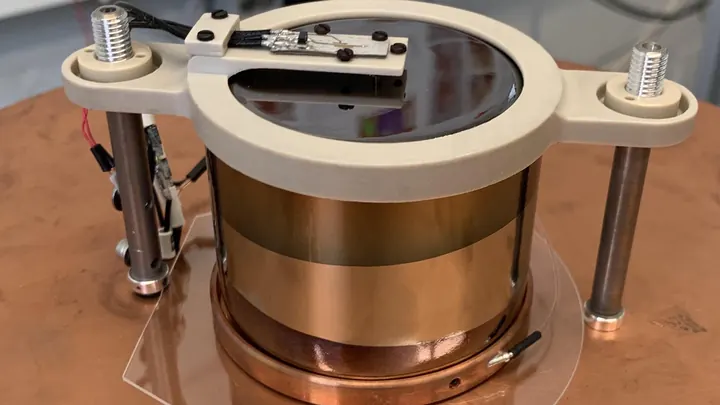
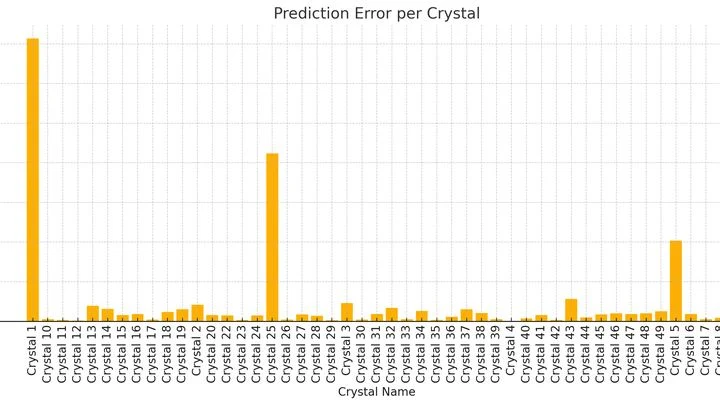
Growing an ultra-pure germanium crystal is a bit like baking a finicky soufflé: a slight overheating or an extra speck of impurity, and the whole ingot is only good for remelting. Such crystals are the heart of detectors that catch the rarest events, from dark matter to double beta decay.
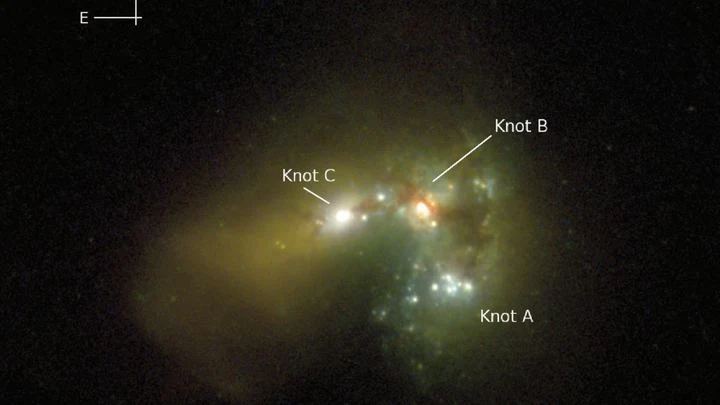
Two galaxies approach each other like a pair of dancers who drift apart and then are drawn back together. At the moment of a particularly close encounter, their gas compresses, and bright ultraviolet light bursts from within. This is exactly what happens in the Haro 11 system — the nearest pair of merging galaxies that lets such light escape.
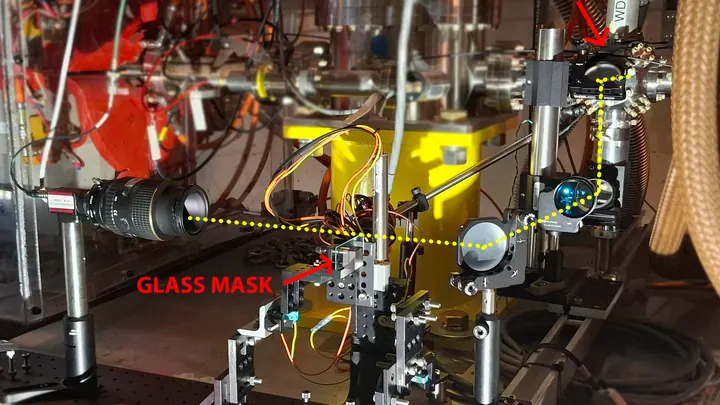
In giant particle accelerators, particles fly at nearly the speed of light and smash head-on. But sometimes one beam is slightly denser than the other, like someone stepping onto a packed escalator the wrong way. Then collisions become uneven, and detectors start 'flickering,' throwing off measurements.
In a collider detector, each proton collision leaves a trail of dozens of particles, like the splash from a stone thrown into water. Making sense of that splash and understanding what exactly happened at the moment of impact is a task that humans can no longer handle alone.
A pebble drops into a pond, and ripples spread across the water. But sometimes the pebble doesn't sink right away: it skims beneath the surface, travels a few meters, and only then surfaces, creating ripples in an unexpected spot.
Inside protons accelerated to nearly the speed of light, a particle heavier than a gold atom is sometimes born — the top quark. It lives for tiny fractions of a second and decays, leaving a trace in the ATLAS detector. Physicists collected such traces for four years to understand how often the top quark and its mirror twin, the antiquark, appear.
Water in a kettle heats to 100 degrees, and stops being water, turning into steam. Something similar happens to atomic nuclei when they are smashed together at enormous speeds in the Large Hadron Collider.
In a dark room, there is a tank of liquid argon. Sometimes an invisible particle flies through it, strikes an atomic nucleus, and a faint light flashes in the liquid. From this flash, physicists try to figure out what kind of guest has arrived.
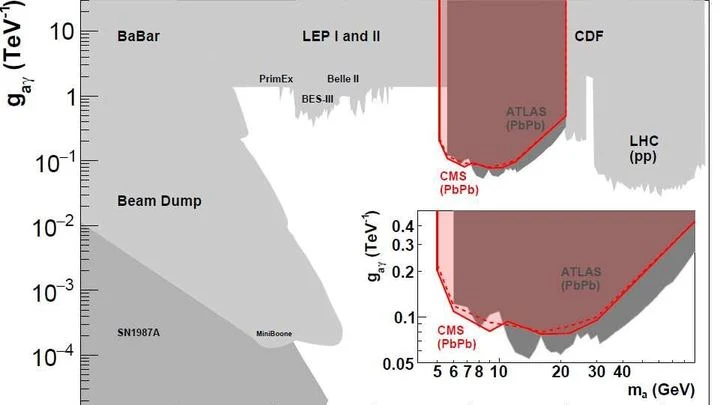
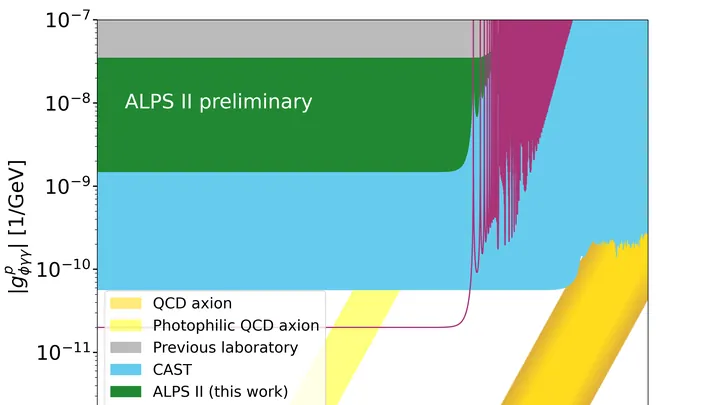
At the DESY lab, the ALPS II experiment was launched to hunt for axions — hypothetical ghost particles that might make up dark matter. This invisible mass acts like a skeleton, preventing galaxies from flying apart due to their spin.