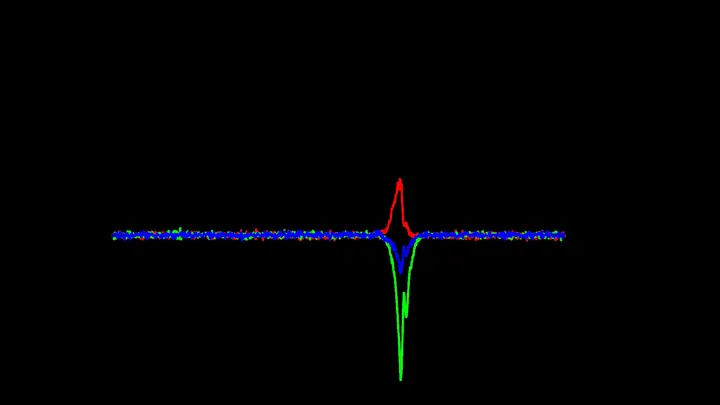
Pulse shape refers to the detailed time profile of a signal produced by a detector when a particle or photon interacts with it. Instead of just recording that a hit occurred, the detector records how the electrical signal rises and falls over time. This shape carries information about the nature of the interacting particle, because different particles deposit energy in different ways — for example, a fast electron creates a sharp, narrow pulse, while a slow heavy nucleus produces a broader, more extended one. Analyzing the pulse shape allows researchers to distinguish particle types without needing additional detector layers.
History
Pulse shape discrimination was recognized in the 1950s in scintillationdetectors, when researchers noticed that alpha particles and electrons produced different decay times in certain materials. It became a standard technique in nuclear physics and later in dark matter searches.
How it works
When a particle strikes a scintillator or semiconductordetector, it excites atoms that then emit light or create charge carriers. The rate at which this signal decays depends on the ionization density along the particle's track. Dense ionization (from heavy particles) quenches some excitation pathways, changing the decay time. Electronics digitize the pulse at high speed, and algorithms compare the shape to known templates to classify the event. This is often combined with time-of-flight measurements for even more reliable identification.
In practice
Pulse shape analysis is crucial in dark matter detectors (e.g., XENON, LUX) to separate nuclear recoils (signal) from electron recoils (background), and in neutron/gamma discrimination in radiation monitoring.
Fun fact
Some detectors can distinguish particles using pulse shape alone, even when the total energy deposited is identical — the shape is like a fingerprint for the particle type.
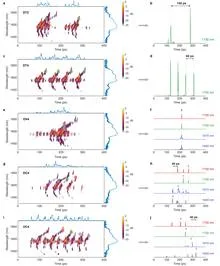
A conductor raises the baton, and the orchestra produces not just sound but a complex score: each note sounds at its own moment, at its own pitch, with the right volume. Light can also be a score, if you control its spectrum and timing. Previously, this required bulky setups that could not be reconfigured after assembly.
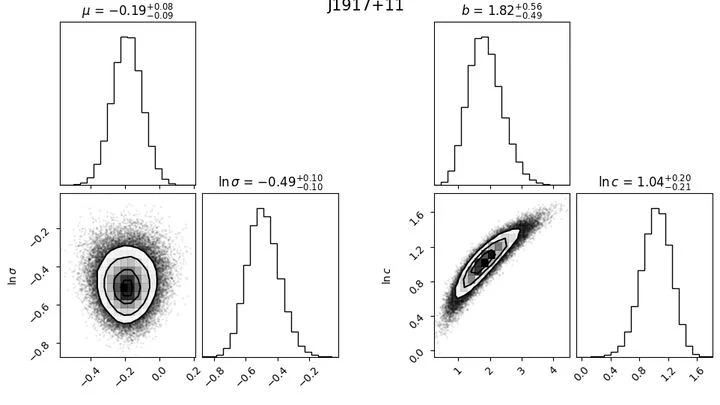
Pulsars are rapidly spinning neutron stars that emit radio pulses like a lighthouse. But some of them stay silent almost all the time, occasionally emitting a single pulse. Such objects are called rotating radio transients (RRATs). They were discovered nearly twenty years ago, but they remain a mystery.
In giant accelerators, particles zip through detectors in billionths of a second, and telling one from another requires a stopwatch of incredible precision. The new µRWELL-PICOSEC detector acts as such a stopwatch: it captures the moment a particle passes with a precision of 48 picoseconds: that's 48 trillionths of a second.
Underground, in a former gold mine, sits a tank of liquid xenon. If a dark matter particle flies through it, the xenon flashes. But it also flashes from ordinary particles, like neutrinos or leftover radioactivity. The task is to tell which flash comes from dark matter and which from noise.
Radio pulsar J1574+4703 behaves like a finicky lighthouse. Instead of shining steadily, it turns its radio beam on in short flashes and then falls silent for long stretches. Objects like this are called 'rotating radio transients', or RRATs for short.
Deep inside a mountain, under layers of rock, lies a germanium crystal the size of a fist. It waits for a rarest of events: an atomic decay that happens once in billions of years. But inside the crystal, something is always ticking — cosmic rays, traces of radioactivity, thermal noise.
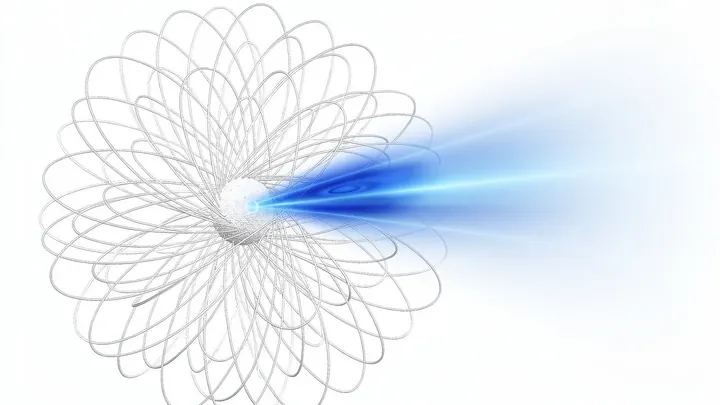
A laser pulse racing through plasma is like a runner carving a path through a crowd. It shoves electrons aside, leaving behind a rarefied channel, just as the crowd parts for a sprinter. In this channel, the crest of the light wave moves slightly faster than light in a vacuum, and it is this speed that determines how efficiently the pulse transfers energy to particles.
At India's Gauribidanur Radio Observatory, 32 antennas that look like giant TV dishes are listening to the sky. They catch radio waves from pulsars — dead stars that spin at breakneck speed and blink like lighthouses. Previously, signals from these antennas were processed slowly and awkwardly.
A pulsar is a dead star spinning at breakneck speed, sending out radio pulses like a lighthouse. Usually these pulses arrive right on schedule, but occasionally there are true monsters among them — giant pulses that are thousands of times brighter than normal.
A pulsar is a dead star that spins and emits radio pulses like a lighthouse. If a pulsar has a companion, they whirl around a common center of gravity.