A Virus Knocks on the Cell: The Quantum Rhythm of Recognition express
A virus approaches a cell like a key to a lock. But this lock is not ordinary: it vibrates, it trembles, and whether the key matches the rhythm of those tremors determines if the door opens. According to new research, this is exactly how recognition works between the coronavirus spike protein and the ACE2 receptor on the surface of human cells.
Scientists treated the contact site as a tiny quantum system immersed in the warm, noisy environment of a living cell. They found that vibrations at a specific frequency in the spike protein help electrons jump from one molecule to another. This jump is like the click of a lock, after which the virus firmly attaches to the cell. But for the click to happen, the vibrations must match the rhythm of the electron transition. If the rhythm is off, the virus simply bounces away.
What's especially interesting is that the "memory" of the environment, how quickly it forgets past interactions, plays a key role. When memory is long, quantum coherence lasts longer, and vibrational selectivity is enhanced. This means the virus can distinguish between nearly identical receptors simply by "listening" to their vibrations.
This mechanism resembles tuning a radio: you need to hit the exact frequency of the station to hear the broadcast. The virus may be using the same idea to find the right cell among many similar ones.
Original abstract
as written by the authors arXiv:2602.06469
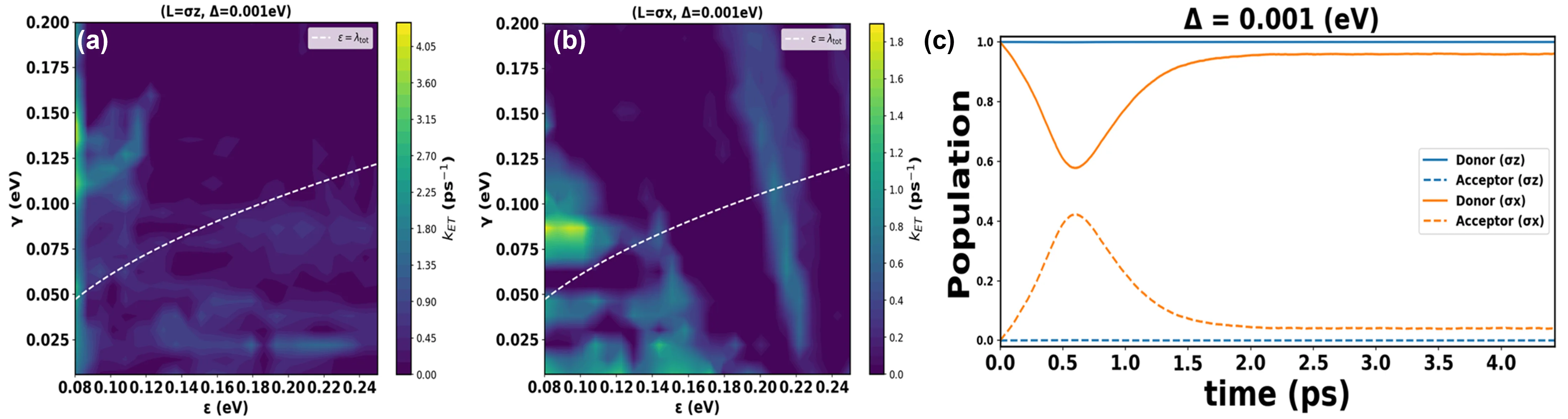
We investigate the quantum dynamics of ligand--receptor electron transfer and conformational response in a prototypical viral binding complex, using the SARS-CoV-2 Spike protein bound to the human ACE2 receptor as a model system. Treating the ACE2--Spike interface as an open quantum system embedded in a biological environment, we simulate how vibrational interactions and environmental memory reshape the coupled receptor--ligand dynamics and modulate vibrationally assisted electron transfer (VA-ET). Using a Non-Markovian Stochastic Schr"odinger Equation (NMSSE) approach, we simulate electron transfer between donor and acceptor states in ACE2 modulated by a specific vibrational mode of the Spike protein. The influence of environmental memory (non-Markovian dynamics) and non-Condon effects (vibrational modulation of electronic coupling) are analyzed in detail. In the Markovian limit with an Ohmic bath, population dynamics reduce to exponential kinetics, and extracted transfer rates agree with semiclassical Marcus--Jortner predictions in the appropriate regime. Beyond the Markovian, high-temperature limit, we observe clear deviations: non-exponential decay, coherent oscillatory features, and enhanced sensitivity to the vibrational frequency. Incorporating off-diagonal system--bath coupling alongside diagonal coupling shows that nuclear motion can dynamically gate electron tunneling, sharpening the frequency selectivity of the VA-ET mechanism. Finally, a structured (sub-Ohmic) environmental spectral density with long-lived correlations (``memory'') preserves electronic--vibrational coherence over longer times, amplifying vibrational selectivity under non-Condon coupling. Our results support the proposition that ACE2--Spike binding may exploit vibrational assistance and quantum coherence as a molecular recognition mechanism.
The coronavirus spike protein vibrates at a frequency of about 100 gigahertz — a billion times faster than a mosquito flaps its wings.
The idea of quantum recognition via vibrations echoes the "quantum sense" in Liu Cixin's novel "The Three-Body Problem," where aliens use quantum effects for communication.