An electrontransition is the movement of an electron from one energy level to another within an atom, molecule, or solid. This process is fundamental to all of chemistry and physics: it underlies the absorption and emission of light, chemical bonding, electrical conductivity, and many biological processes like photosynthesis. When an electron jumps to a higher energy level, energy is absorbed; when it falls to a lower level, energy is released, often as a photon. The specific energies involved are unique to each substance, providing a fingerprint for identifying materials.
History
The concept emerged from Niels Bohr's 1913 model of the hydrogen atom, which proposed discrete electron orbits and explained spectral lines as transitions between them. Later, quantum mechanics refined this into the modern understanding of electron wavefunctions and energy levels.
How it works
Electrons occupy discrete energy levels determined by quantum mechanics. A transition occurs when the electron gains or loses exactly the energy difference between two levels. This energy can come from absorbing a photon, colliding with another particle, or interacting with an electric field. The probability of a transition depends on quantum selection rules, which dictate which jumps are allowed. In molecules, transitions can also involve vibrational and rotational states, producing complex spectra. In solids, transitions between bands of energy levels govern whether a material conducts electricity or is an insulator.
In practice
Electrontransitions are exploited in lasers, LEDs, solar cells, fluorescent lighting, and spectroscopy — a technique used in astronomy, medicine, and materials science to identify substances by their spectral signatures.
Fun fact
The green color of auroras is caused by a specific electrontransition in oxygen atoms at high altitudes, where an electron drops from a metastable state and emits a 557.7 nm photon.
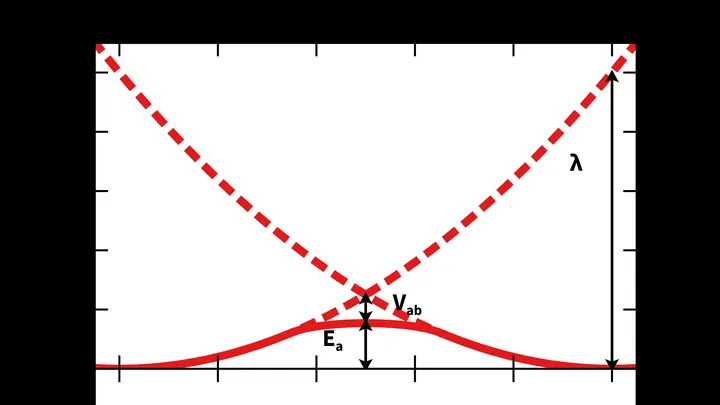
In the quantum world, particles sometimes behave like acrobats on invisible tightropes. An instanton field is a brief vortex that appears and vanishes in an instant. When a fermion (a particle like an electron) enters such a vortex, its energy does not stay put. Instead, it smoothly slides from one level to another, like a ball rolling down a hill.
Two pendulums on a shared string trade motion: push one, and the second starts swinging, and a moment later the first gets a push back. In a thorium-229 atom, energy flows nearly loss-free between the electron shell and the nucleus.
Two guitar strings are stretched on the same neck. They are almost identical, but one is slightly shorter — and they sound different. That's roughly how the two isomers of ethanimine work: molecules with the same set of atoms but rotated differently in space. Astronomers spotted this molecule in the dense clouds near the center of our Galaxy.
A black hole is a cosmic pocket into which everything, even light, falls. But the pioneering work of John Wheeler, Stephen Hawking, and Roger Penrose showed: sometimes, due to the colossal spacetime curvature, the pocket turns inside out.
A swing only gets going if you push it in rhythm. Miss the beat, and your effort is wasted. Light interacts with an atomic nucleus in much the same way: a photon is usually absorbed only when its energy exactly matches the gap between nuclear levels. But what if the photon's energy doesn't fit? The authors of a new study have found a workaround.
A piece of magnetite, an ordinary iron stone, behaves strangely. At room temperature, it conducts electricity, but cool it below minus 150 degrees, and its resistance jumps sharply. This jump, discovered back in 1939, physicists could not explain for nearly a century.
A new study offers a solution.
In a molecule resembling chlorophyll and built from carbon, a metal atom at the center acts as a toggle. Shifting it by fractions of a nanometer can make the molecule glow, quench, or boost its brightness a hundredfold.
Every breath you take and every muscle twitch runs on a stream of electrons flowing through proteins inside your cells. These proteins aren't static: they constantly change shape, like a spring that compresses and releases. But until now, no one has seen exactly how these movements open or close the path for electrons.
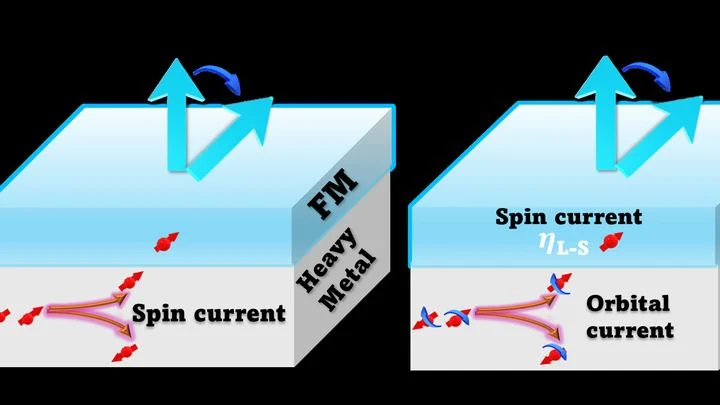
Usually, to flip a magnet in a memory device, heavy metals like platinum or tungsten are used. When current flows, their electrons are deflected sideways, like a crowd on an escalator, and this deflection imparts a rotational torque to the magnetic layer. But heavy metals are expensive and lose a lot of energy as heat.
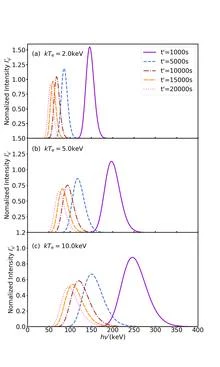
On October 9, 2022, detectors on Earth recorded a gamma-ray burst of unprecedented power. GRB 221009A was so bright that its radiation ionized the upper layers of the ionosphere, and satellite instruments were temporarily blinded.
A tiny tungsten tip with a radius of less than a hundred nanometers is the perfect stage for watching a quantum performance. Apply an electric field of a few volts per nanometer, and electrons start flying out of the metal: that’s field emission.