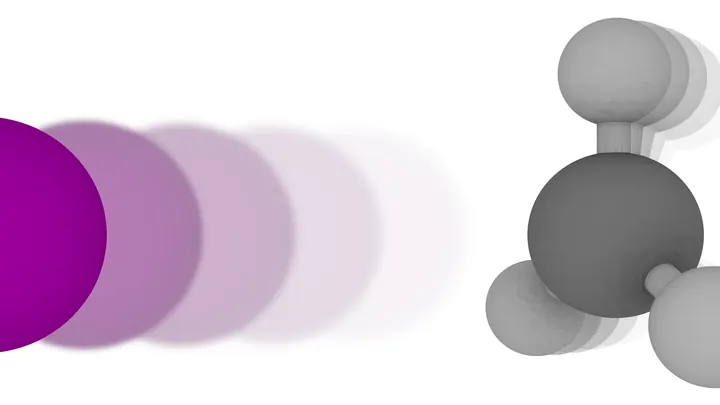
Atomic vibrations are the constant, small-scale oscillatory motions of atoms around their equilibrium positions in a solid, liquid, or molecule. These vibrations are not random jiggling but are quantized into discrete energy packets called phonons. They determine fundamental material properties such as heat capacity, thermal conductivity, and electrical resistance, and they also govern how atoms interact with light and other particles.
History
The concept of atomic vibrations in solids was formalized by Albert Einstein in 1907 and refined by Peter Debye in 1912, who modeled the heat capacity of solids using quantized lattice vibrations.
How it works
Atoms in a material are held together by chemical bonds, which act like tiny springs. Thermal energy or external forces cause atoms to displace from their resting positions, and the restoring force of the bonds pulls them back, creating oscillations. In a crystal, these oscillations couple together into collective waves that travel through the lattice, carrying energy and momentum. The frequency and amplitude of these vibrations depend on the atomic masses and the strength of the bonds, and they can be probed by techniques like infrared spectroscopy or inelastic neutron scattering.
In practice
Understanding atomic vibrations is essential for designing semiconductors, thermoelectric materials, and for analyzing molecular structures via Raman spectroscopy in chemistry and biology.
Fun fact
In some materials, atomic vibrations can become so strong that they cause the material to expand, which is why solids generally expand when heated.
A billiard ball hangs in midair. Tiny peas shoot at it from a blowgun. Each hit is barely perceptible, but if the ball is very light and barely trembles from heat, you can make out individual nudges. That's essentially the setup: a glass sphere the size of a bacterium levitates in a vacuum while a narrow beam of xenon atoms flies at it.
In the orchestra of atoms, each instrument has its own score. But sometimes two musicians start playing in unison, and the sound amplifies many times over. In the quantum world, this 'harmony' is called a Feshbach resonance. It allows you to control atomic interactions with jeweler-like precision.
In superfluid helium, friction disappears — the liquid flows like a mountain stream, but without a single eddy. A short laser pulse rippled this smooth surface, and scientists using spectroscopy captured the spreading ripples — quantum waves with many speeds.
Light usually pushes an atom straight ahead, like wind pushing a sail. But if the beam is twisted into a corkscrew, the picture changes: the atom can fly off to the side, as if caught by a spinning wheel. In the new work, physicists calculated that such a vortex photon can transfer almost all of its rotation to the atom — up to 100 percent.
Molten metal is like an overcrowded hall where everyone is waiting for a signal to start dancing. Crystallization is that very moment when chaos turns into order. But to start the dance, you need a first step: the appearance of tiny crystal nuclei. Usually, this requires the metal to be cooled a lot. It turns out that a simple shake can replace some of that cooling.
A chemical bond is like a stretched spring between atoms. When it's snapped, the molecular fragments fly apart, but they don't freeze: they keep vibrating, like a plucked string. That's exactly the vibration a team of researchers caught when they broke a methyl iodide molecule with an ultraviolet laser.
A bell doesn't ring with a single note — after being struck, it sounds with several harmonics at once. An atomic nucleus vibrates in much the same way: after a collision, it can oscillate, and these oscillations show up in the emitted gamma rays.
Ultrasound in a liquid is like shaking a bottle of soda vigorously: shake it, and bubbles appear. In science, this is called cavitation, and the bubbles don't just float around: they are born, grow, and collapse with tremendous force.
Atoms have been caught in a ring of light. This is not a metaphor: laser beams form a ring-shaped trap in which atoms move in circles. The light not only holds them but also couples the atom's rotation to its internal 'compass'—the spin. As a result, an atom running around the ring senses which way it's going, and this changes its internal state.
This coupling is not just elegant.
According to the laws of the microworld, an electron obeying the Dirac equation trembles even at complete rest. This is Zitterbewegung — an oscillation with an amplitude of trillionths of a millimeter, like a spinning top on an invisible axis.