Brain oscillation phase-amplitude coupling (PAC) refers to the phenomenon where the amplitude (strength) of a faster neural oscillation is modulated by the phase (timing) of a slower oscillation. For example, the amplitude of gamma waves (30–100 Hz) may be higher during the peak of a theta wave (4–8 Hz) and lower during its trough. This cross-frequency coupling is thought to be a fundamental mechanism for coordinating neural activity across different spatial and temporal scales, allowing distinct brain regions to communicate and bind information into coherent perceptions, memories, or actions.
History
PAC was first described in the hippocampus of rodents in the 1990s, with key contributions from György Buzsáki and colleagues. It was later found in the human brain, particularly during memory tasks and in the default mode network.
How it works
Neurons in different brain regions oscillate at different frequencies. PAC provides a way for slower, global oscillations to gate or 'carry' faster, local computations. The phase of the slow oscillation sets a timewindow during which fast oscillations can occur, effectively creating a temporal code: information is processed in bursts that are locked to specific phases of the slow rhythm. This is measured using electroencephalography (EEG) or local field potentials, where the amplitude of the fast oscillation is plotted against the phase of the slow one; a consistent relationship indicates coupling. The mechanism is believed to involve synaptic interactions and neuromodulatory systems that alter neuronal excitability in a phase-dependent manner.
In practice
PAC is used as a biomarker for neurological and psychiatric conditions: altered coupling has been observed in Alzheimer's disease, schizophrenia, and epilepsy, and it is being explored as a target for non-invasive brain stimulation therapies.
Fun fact
In the corpus article 'Мозг на волне: как фаза и амплитуда выдают болезнь', PAC is described as a potential early diagnostic marker for Parkinson's disease, detectable before motor symptoms appear.
When you're standing on a bus and the driver suddenly brakes, your brain manages to tense your muscles in a fraction of a second so you don't fall. This automatic response is born deep in the cortex, in an area that plans complex movements, the supplementary motor cortex.
In an aquarium the size of a dining table, two schools of black neon tetras swim in adjacent compartments separated by a transparent wall. They cannot touch each other, but they see every movement. And here's the surprising part: when one school decides to turn left, the other does the same a moment later. It's like two pendulums hanging behind glass, starting to swing in rhythm.
In the dark room of the scanner, a person watches for rare flashes on a screen. An infrared camera records their pupil a thousand times per second, while an MRI scanner simultaneously logs which brain areas light up. In this way, 89 volunteers aged 19 to 78 helped scientists see how the pupil becomes a display on which the brain outputs two different signals.
The brain as a house built too spacious: lovely to live in, but expensive to maintain. Parkinson's disease is usually pictured as the destruction of that house, with neurons dying and structures shrinking.
At a crowded reception, an older person asks their conversation partner to repeat themselves again and again: the words drown in the hum of voices. This is what the bridge looks like, the one that carries sound from the ear to meaning. While that bridge holds, noise merely gets in the way, but it doesn't cut the conversation short.
Light in a gravitational-wave detector races through multi-kilometer tunnels, bouncing off mirrors. A perfectly uniform beam resembles a smooth sheet held by its corners. But if one mirror tilts by the width of an atom, the sheet develops wrinkles: 'parasitic' patterns, more complex light spots, awaken in the beam.
Previously, such wrinkles were dismissed as noise.
Sound enters the ear and hits a thin membrane inside the cochlea, the spiral organ in the inner ear. This membrane doesn't just vibrate like a string; it actively pushes the vibrations when they are weak and stops when they are strong. That's how the ear hears both a whisper and a loud conversation.
Scientists built a model where each piece of the membrane is a tiny pendulum with a spring.
An optical trap holds an atom almost motionless, like a ball on a soft spring. But as soon as acceleration appears, say gravity, the equilibrium shifts. The atom moves within the standing light wave, and this changes the rate at which it exchanges energy with the field. The frequency of this exchange becomes a direct indicator of acceleration.
The most abundant construction material on Earth, concrete, hides its deepest secrets at nanometer scales. Its strength and tendency to creep slowly under load are governed by a microscopic gel of calcium silicate hydrate (C-S-H), whose structure is as chaotic as a frozen vortex of atoms.
A sound signal is conveniently represented as a complex number: its modulus (amplitude) reflects loudness, while its argument (phase) indicates the wave's position in time: its instantaneous shift.
A pendulum that swings on its own, without any winding — in the quantum world, such 'pendulums' are called time crystals. In them, rhythmic motion arises spontaneously and does not decay. But until now, controlling this rhythm was nearly impossible: any intervention threatened to destroy the fragile order.
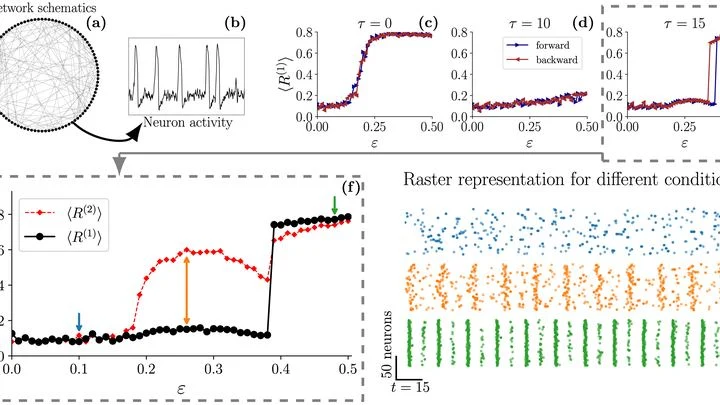
A neuron sends a signal to its neighbor. The neighbor doesn't respond immediately — the impulse travels along the process at a finite speed, like a letter delayed in transit. Usually, such a delay is considered a nuisance, but in this new work, it becomes the conductor.
When two excitable neurons are connected with a delay, a rhythm spontaneously emerges between them.
Two tiny mirrors in a vacuum are like figure skaters in a pairs routine. Their oscillations are synchronized by an invisible gravitational thread. When cooled to millionths of a degree above zero, this thread turns them into a single quantum link — the motion of one instantly echoes in the other.
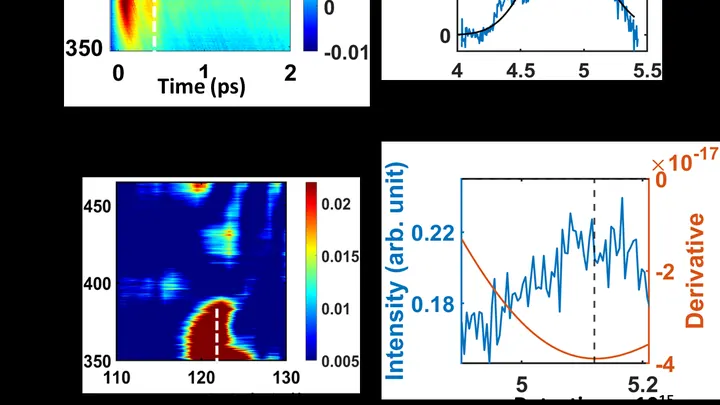
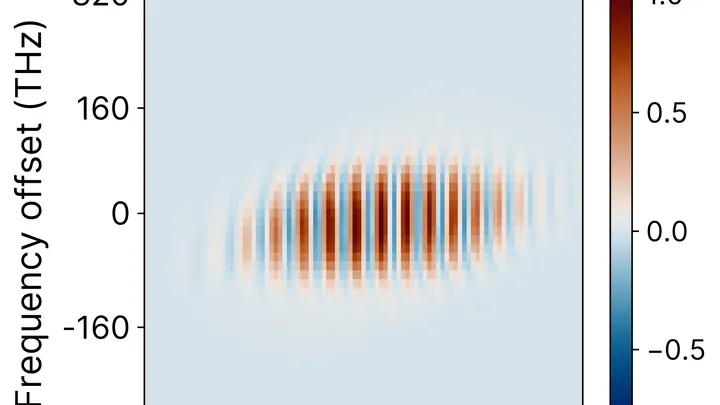
A short laser pulse hits an iodine molecule, and its atoms start to vibrate like a ball on a spring. Scientists track these vibrations with a second, broadband pulse that captures a spectrum at different moments in time.
It turns out that vibrations in the excited B state quickly shift in frequency and fade out, and then vibrations appear in the A state.
Holding a phone number in your head while you dial it: that's working memory. In the brain, a group of cells is responsible for this, sending signals to each other like people passing a bucket along a chain. But every transfer has a cost: it requires messenger substances that get used up.
A light pulse can be compared to a musical chord: several notes sound simultaneously, each with its own loudness and phase. In quantum optics, such 'chords' are called multimode squeezed states.
Atoms in a beam travel at different speeds, like runners on a track. A regular laser pulse only pushes those moving at one speed, but the new one acts like a coach giving commands to the whole group at once. This approach involves more atoms in the measurement.
Each breath slightly speeds up the heart, and each exhale slows it down. This rhythm, visible on an ECG, is called respiratory sinus arrhythmia. For a long time, it was dismissed as a mere side effect of the nervous system. But new research shows that this coordination is not a coincidence: it's a way to save energy.
A resting brain is not silent: its regions talk to each other, and these conversations can be eavesdropped on with a scanner. Usually, scientists track signal strength — how loudly each area 'sounds.' But a conversation also has rhythm: some areas light up simultaneously, others with a delay.
A beam of light passing through a transparent plate usually keeps its color. But if you stack the plate from thin alternating layers, it becomes a grating that reflects and transmits waves selectively. This has long been used in lasers and optical filters. Now such gratings have been made to vibrate, and light started changing color.
A tiny defect in a diamond crystal works like a sensitive antenna. When a magnetic field oscillates nearby, this defect, a nitrogen vacancy, responds by glowing. Previously, to hear the signal, you had to accumulate many repeated measurements, like listening to a whisper with your ear pressed against a door. Now a single short "look" suffices.
You can squeeze light between two mirrors like a spring in a vise. It bounces back and forth, growing denser: that's how you get ultra-bright beams. But there's a limit: at too high a brightness, the mirrors start to shake. The light rocks them the way wind rocks a swing, and some energy leaks into that jitter.
Fluid flows in the narrow gaps between brain cells. It doesn't stay still: each heartbeat pushes it forward, and breathing adds its own waves. This was seen in images ten years ago, but only now have researchers calculated how this pulsing accelerates molecules.
If you drop ink into a stream, it drifts with the current. But if the stream speeds up and slows down, the ink spreads wider.
A virus approaches a cell like a key to a lock. But this lock is not ordinary: it vibrates, it trembles, and whether the key matches the rhythm of those tremors determines if the door opens. According to new research, this is exactly how recognition works between the coronavirus spike protein and the ACE2 receptor on the surface of human cells.
Light traveling through an optical fiber is like a runner in a narrow corridor: it can run straight, or it can weave from side to side. The direction of these "weaves" is polarization. Physicists have learned to keep the runner on a straight path: they constantly check its trajectory and gently correct it, not letting it veer off.
Over the course of a day, the brain accumulates impressions the way a room accumulates stuff. At night, during deep sleep, it doesn't just rest: it tidies up: it sorts through the day's events and decides what to keep and what to toss. Scientists built a computer model of the brain that learns from a few examples during the day and 'replays' them at night, as if dreaming.
A light pulse in an optical fiber is like a starter's pistol shot: short, sharp, and unmistakable against the silence. It is exactly such pulses that the new artificial neuron, built on a silicon chip, produces.
The heart doesn't beat like a metronome but like a jazz drummer: sometimes it stumbles, skips beats, or races. Atrial fibrillation is one of the most insidious glitches: the atria quiver instead of contracting, and blood can pool, forming clots. Doctors catch this glitch on an ECG — a recording of the heart's electrical signals.
Schrödinger's cat usually hides in thought experiments — alive and dead at the same time. This time, it was caught in the lab: a light pulse was made to be in two opposite states at once, like a coin hovering in the air, heads and tails at the same time.
Inside a fertilized frog egg, waves ripple, like ripples on water, but made of proteins that command cell division. These waves travel millimeters, even though the egg itself is less than a millimeter across. Previously, it wasn't understood why they didn't fall out of sync. It turns out the waves clear their own path.