The transitionfrequency is the specific frequency of electromagnetic radiation that is emitted or absorbed when an atom or molecule makes a quantum jump between two discrete energy levels. This frequency is directly proportional to the energy difference between the two states, as described by the Planck-Einstein relation (E = hν). Because these energy levels are uniquely determined by the laws of quantum mechanics, the transition frequency acts as a precise fingerprint for each element and isotope, enabling highly accurate measurements and controls of atomic systems.
History
The concept originates from Niels Bohr's 1913 model of the hydrogen atom, which first quantized electron orbits and predicted specific spectral lines. The precise measurement of transitionfrequencies has since become a cornerstone of atomic physics, with the development of lasers in the 1960s enabling unprecedented accuracy.
How it works
When an atom absorbs a photon with an energy exactly matching the gap between two of its energy levels, an electron can transition to the higher-energy state. Conversely, when an electron spontaneously drops to a lower state, it emits a photon with that same characteristic frequency. The exact value of the frequency is influenced by the fine structure of the atom, including effects like electron spin and nuclear properties, which can be probed with extreme precision using techniques like laser spectroscopy.
In practice
Transitionfrequencies are the basis for atomic clocks, which use the microwave or optical transitions of atoms like cesium or strontium to define the second, and are also used in quantum computing to manipulate qubits and in GPS satellites for precise timekeeping.
Fun fact
The transitionfrequency of the hydrogen atom's 1S-2S transition is known to an accuracy of about 1 part in 10^15, making it one of the most precisely measured quantities in all of physics.
Units by system: SI: hz · CGS: hz · Planck: 1t p · natural: hz
In the quantum world, particles sometimes behave like acrobats on invisible tightropes. An instanton field is a brief vortex that appears and vanishes in an instant. When a fermion (a particle like an electron) enters such a vortex, its energy does not stay put. Instead, it smoothly slides from one level to another, like a ball rolling down a hill.
Hydrogen is the simplest atom: one proton and one electron. You'd think there's nothing left to study. But it's precisely on hydrogen that physicists test the most delicate laws of the microcosm. The electron in an atom can occupy different energy levels, like steps on a ladder.
The light an atom emits is not just a flash. It carries an imprint of the atom's state at the moment of emission. Physicists took a superconducting qubit, an artificial atom the size of a microchip, and made it glow into an open waveguide, like a bulb in a long corridor.
Ahead of the bow shock that Earth creates in the solar wind, giant bubbles of rarefied gas sometimes appear. Inside them, particle density drops by factors, and electric fields start to tremble like a plucked string.
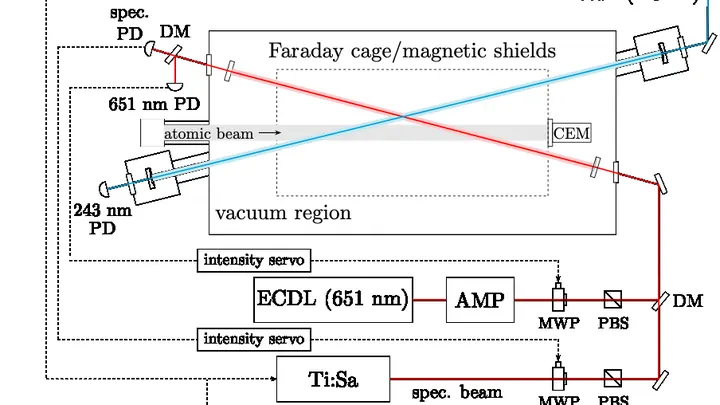
The hydrogen atom is like a tiny clock, ticking with a precision engineers can only dream of. When an electron jumps between orbits, it absorbs or emits light at a strictly defined frequency: that's the 'tick.' In the new work, physicists caught one such transition, between the 2S and 6P states, and measured its frequency with an…
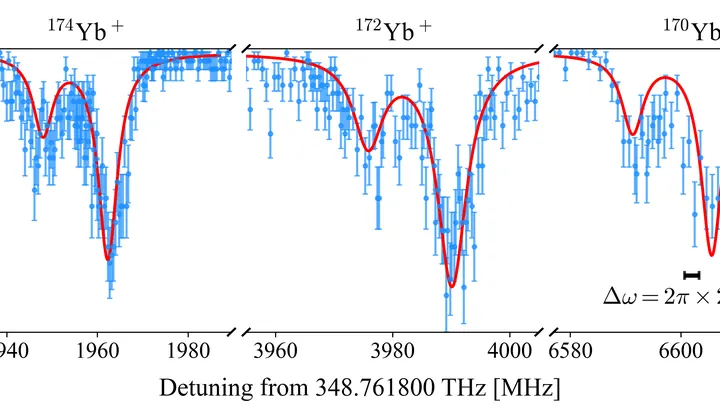
The light an atom emits or absorbs is like a fingerprint: each element has its own pattern of lines. In an ytterbium ion (an atom that has lost one electron), researchers have found three new lines that were previously unused. These lines are very narrow, like thin slits in a fence that let you see far and clearly.
A virus approaches a cell like a key to a lock. But this lock is not ordinary: it vibrates, it trembles, and whether the key matches the rhythm of those tremors determines if the door opens. According to new research, this is exactly how recognition works between the coronavirus spike protein and the ACE2 receptor on the surface of human cells.
The helium atom is like a tiny solar system: electrons orbit the nucleus, but their orbits are governed by strict rules. Scientists have learned to observe these motions with incredible precision.
A beam of visible light enters a cloud of billions of rubidium atoms cooled to near absolute zero, and emerges on the other side already in the telecom range.
Quantum entanglement is like an invisible spring between particles — squeeze one, and the other twitches, no matter where it is. In the new work, physicists built a model of four spins (tiny magnetic arrows) in a chain, where the end spins are held by a local magnetic field.