Solar Particles Don't Arrive on Schedule express
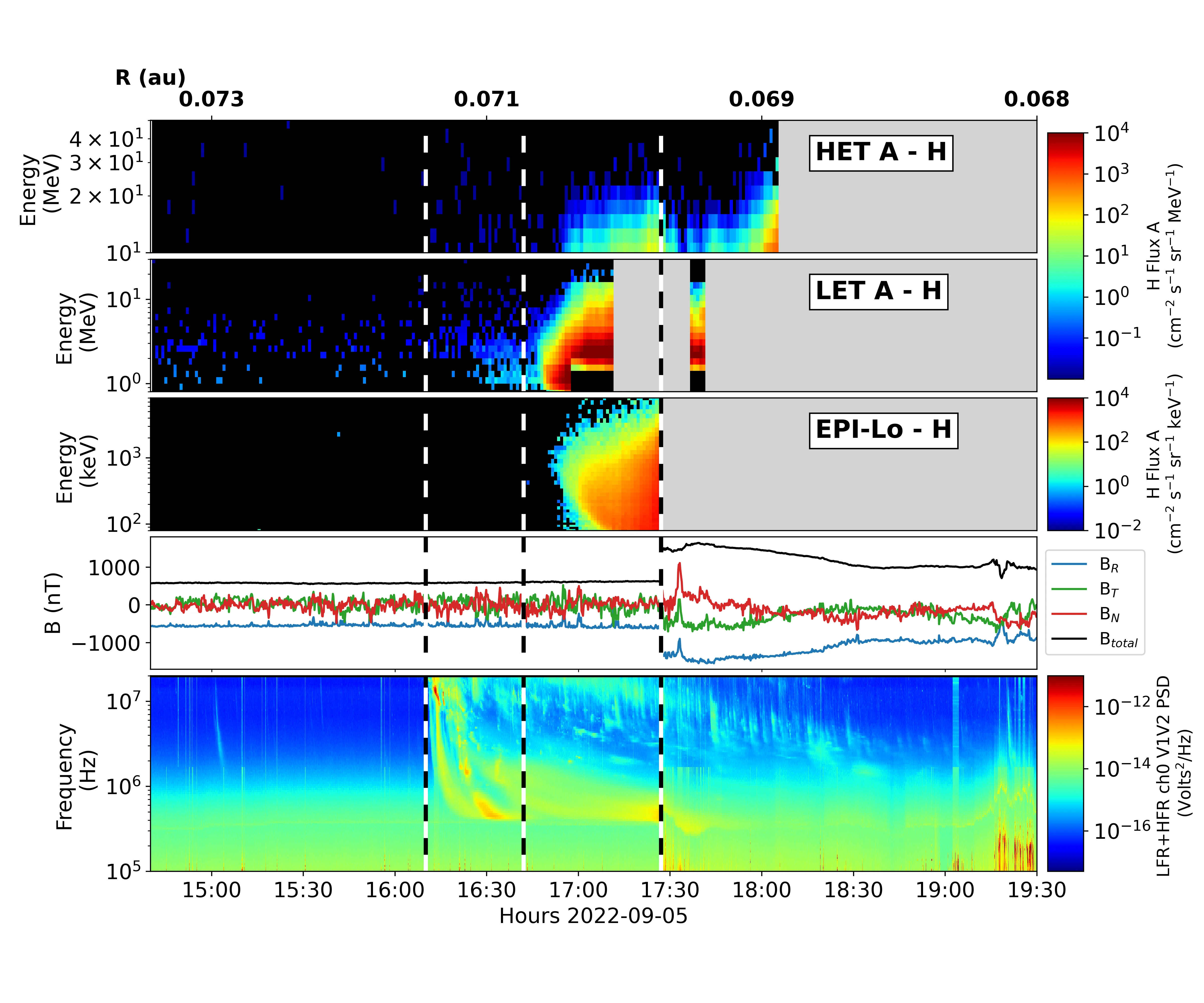
The Sun sometimes hurls vast clouds of charged particles into space. Usually, the fastest ones, with the highest energy, arrive at the probe first, like sprinters on a long-distance track. But on September 5, 2022, Parker Solar Probe, which flies closer to the Sun than any other spacecraft, caught something odd: medium-energy particles arrived ahead of both the fast and the slow ones.
On a plot, this looks like a 'nose'—a bump in the middle where particles arrived too early. This behavior has been dubbed 'inverted arrival order.' The scientists checked all probe data through the end of 2024 and found 14 such events. Most of them—11—were at medium energies, from half a million to five million electron-volts. For comparison, a typical lightning bolt carries about a million electron-volts per particle.
Why do fast particles suddenly lag behind? Maybe they're held up by the shock wave from the eruption: it acts like a turnstile: it lets slow particles through but slows down the fastest ones. Or it could be how particles loop along magnetic field lines. The exact answer is still ahead, but one thing is clear: the Sun doesn't always shoot by the book.
The list of these events is like a collection of fingerprints from the particle acceleration site. Each 'nose' tells where and how particles gained speed. The more such cases we have, the better we can see how the natural accelerator near the Sun works — the one that sometimes flings energy toward Earth as well.
Original abstract
as written by the authors arXiv:2602.12475
In SEP events, velocity dispersion (VD) is characterized by the earlier arrival of faster, higher-energy particles relative to slower ones, assuming negligible acceleration time and transport effects. The "Labor Day event" at Parker Solar Probe (PSP) on 2022 September 5 provided a unique arrival profile, in which the medium energy (~ few MeV) particles arrive earlier than both lower and higher energy particles. This created a so-called "nose" structure in the intensity spectrogram formed by measurements from the two energetic particle instruments, EPI-Lo and EPI-Hi, of the Integrated Science Investigation of the Sun (ISOIS) suite. Unlike typical VD, the delayed arrival of higher energy particles compared to medium energy particles, i.e., the "inverse velocity arrival" (IVA), could be caused by various acceleration, transport, and instrumental effects, including shock acceleration. By applying a new method based on the contour-line of the intensity, we found 14 IVA events in the ISOIS observations up to the end of 2024. Several parameters that may modify velocity dispersion characteristics are further explored including the spacecraft radial distance, the speed of corresponding CMEs and shocks, the angle between the shock normal and the upstream magnetic field, and the spacecraft magnetic footpoint longitudinal separation from the flare location. The energy of the early arriving particles, i.e., the nose energy, can be grouped into low (L, <0.5 MeV), medium(M, 0.5 - 5 MeV), and high(H, >5 MeV) categories. Most (11/14) of the IVA events have medium nose energies. This SEP list provides ingredients for examination of shock acceleration in the inner heliosphere, and the existence of IVA events sheds new light on the acceleration and propagation of SEPs.
The energy of particles in a 'nose' can be lower than that of an X-ray in a hospital, but there are trillions of them, and together they pack a noticeable punch.
In 'Star Trek,' ships catch solar wind for propulsion, such particle 'noses' could throw their navigation off.