Velocitydispersion is a measure of how much the velocities of objects in a system (like stars in a galaxy, or galaxies in a cluster) vary around the average. It is a statistical quantity, typically denoted by σ, and is calculated as the standard deviation of the velocity distribution. In astrophysics, velocity dispersion is a powerful tool because it directly relates to the gravitational potential of the system through the virial theorem: the kinetic energy of the system is half its gravitational potential energy. This allows astronomers to estimate the total mass of a galaxy or cluster, including dark matter, even when most of the mass is invisible.
History
The concept was first applied to stellar dynamics in the early 20th century. In 1933, Fritz Zwicky used velocitydispersions of galaxies in the Coma cluster to infer the presence of dark matter, finding that the visible mass was insufficient to hold the cluster together.
How it works
For a system in dynamical equilibrium, the velocitydispersion is tied to the mass distribution. In a simple spherical system, the mass M within radius r is approximately M ≈ σ² r / G, where G is the gravitational constant. By measuring the Doppler shifts of spectral lines from stars or gas, astronomers can map the line-of-sight velocity dispersion and infer the mass profile. A higher velocity dispersion means the objects are moving faster on average, requiring more mass to keep them bound. This method is essential for detecting dark matter, as the observed velocity dispersions in galaxy clusters are far too large to be explained by visible matter alone.
In practice
Velocitydispersion is used to measure masses of galaxies and clusters, to study the dynamics of globular clusters, and to calibrate the mass-luminosity relation used in cosmological surveys. It also helps in identifying supermassive black holes by measuring the velocity dispersion of stars near galactic centers.
Fun fact
The velocitydispersion of stars in the Milky Way's disk is about 20-30 km/s, but in the central bulge it rises to over 100 km/s, reflecting the stronger gravitational pull there.
A light ray passing by a massive body slightly changes its direction, like a stream of water bending around a rock in a creek. In the solar system, there are many such "rocks": planets, their moons, asteroids. And each one, with its own gravity, bends the path of light coming from distant stars.
A galaxy is like a city: bright lights and dense buildings at the center, sparse lights and emptiness toward the outskirts. But if you watch how gas rotates in a galaxy's disk, you see that its speed barely drops at the edges. As if invisible neighborhoods keep the motion going. Astronomers have found a way to map this invisible city.
A fast radio burst is a short but powerful flash of radio waves from deep space. As it travels to us, the signal passes through clouds of tenuous gas, and the more gas it encounters, the more the signal is smeared across frequencies. Astronomers call this delay the dispersion measure — essentially, it's a "weighing" of all the matter along the line of sight.
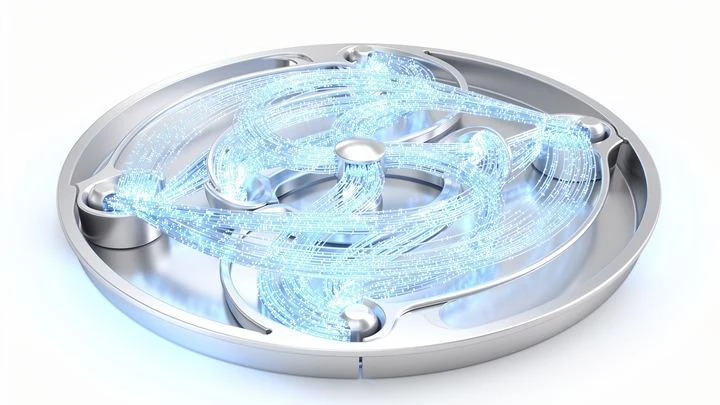
A thousand particles enter a gradient dance. Each feels an attraction to regions of high probability and repulsion from neighbors — so they don't bunch up.
In 1963, Maarten Schmidt unraveled the nature of quasars — distant active nuclei outshining entire galaxies. Since then, we've learned that at their hearts lurk supermassive black holes, converting infalling matter into blinding light.
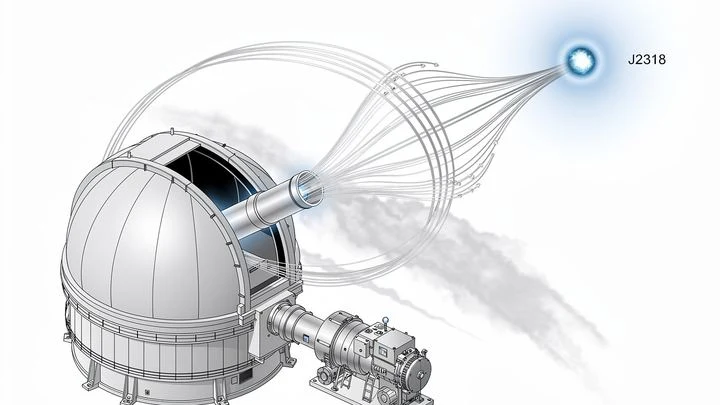
Interstellar space is not a cosmic desert, but a super-fast highway. Trillions of asteroids and comets from other systems race past us, yet camera-telescopes only catch a few. Imagine a night highway: the headlights of a distant car flash brightly, but if it zooms by too fast, the camera shutter can't click in time.
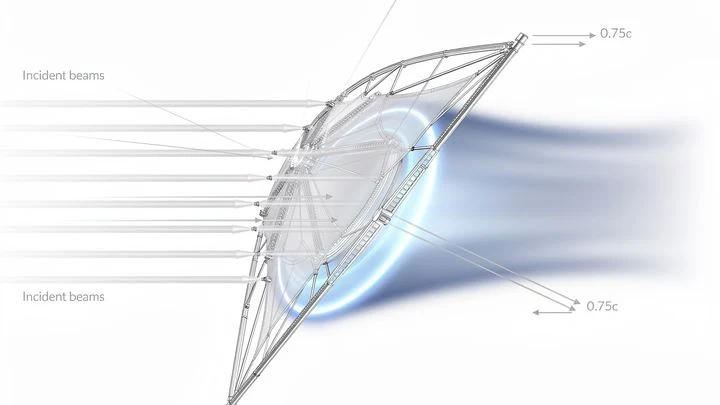
Imagine a three-faced dancer on the crest of a light wave. One face is a catcher, absorbing incoming photons. The second is a perfect mirror, throwing light back. The third is frosted glass, scattering rays in all directions. As long as speed is low, the dance is harmonious. But at near-light speeds, the choreography breaks.
This is like a surfer chasing a wave.
Photographing the vicinity of a black hole is like shooting a fountain: a short exposure freezes the droplets, a long one blends everything into blurry streaks. Light from the superheated gas swirling around the hole reaches us along different paths. Some rays curve around it in an arc, others make multiple loops due to spacetime curvature.
When light swings past a massive body like a black hole, its path warps — an effect predicted by Einstein. New research has taken into account that near such objects, clouds of hadrons often swirl — the very particles we know from protons and neutrons in atomic nuclei.
A pebble drops into a pond, and neat circles spread across the water. But the pond's bottom is strewn with invisible glass shards: each one slightly delays the wave, scatters it here, or alters its pace. That's roughly how gravitational waves, the trembling of space itself, pass through distant galaxies and dark clumps of matter.
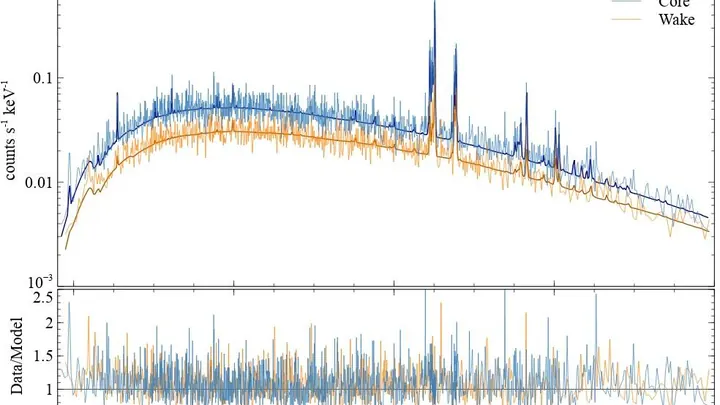
At the heart of the Ophiuchus galaxy cluster floats a bubble of hot plasma the size of several galaxies. It rises like a giant hot-air balloon in the atmosphere, leaving a wake behind it — a region where gas is set in motion.
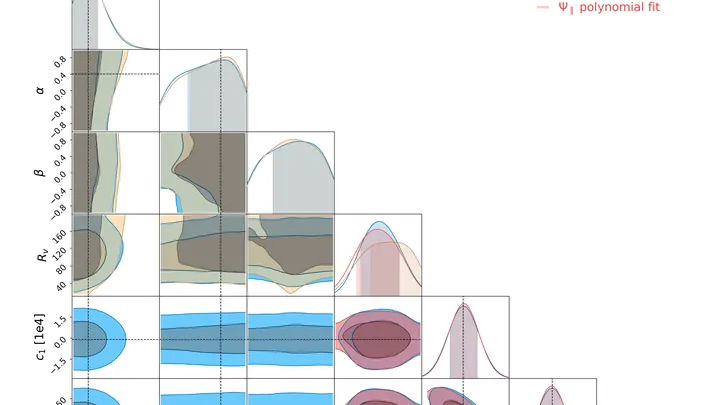
Take two heavy balls and place them a meter apart: they attract each other with a force that weakens by a factor of four when you double the distance. Newton discovered this law, and it works in a room, in the solar system, in a galaxy. But does it still hold when we're talking about hundreds of millions of light-years?
Astronomers found a way to test this directly.
The young star HL Tau is surrounded by a disk of gas and dust — the cradle of future planets. Inside this disk, the gas is not static: it orbits the star, but it also trembles and churns, like water in a raging river. Astronomers have now directly measured the strength of this churning for the first time.
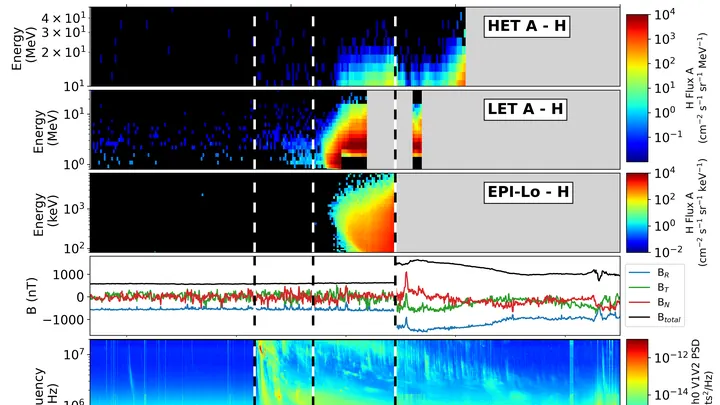
The Sun sometimes hurls vast clouds of charged particles into space. Usually, the fastest ones, with the highest energy, arrive at the probe first, like sprinters on a long-distance track.
In the cold clouds of gas and dust where stars will one day ignite, some atoms have lost electrons and become charged. Charged particles feel the magnetic field, while neutral ones do not, so the charged ones slip through the neutral ones like water through a sieve. Astronomers have measured this drift speed: about a hundred meters per second.
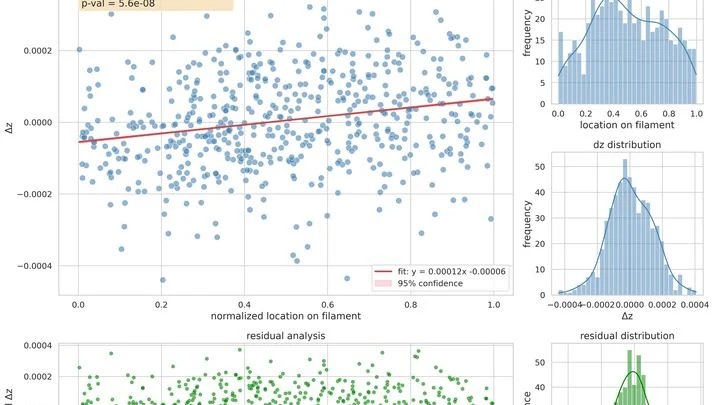
On large scales, the universe resembles a giant spiderweb: bright galaxy clusters are connected by long filaments of galaxies, gas, and dark matter. Previously, it was thought that matter flows along these filaments like water through pipes, heading toward the clusters.
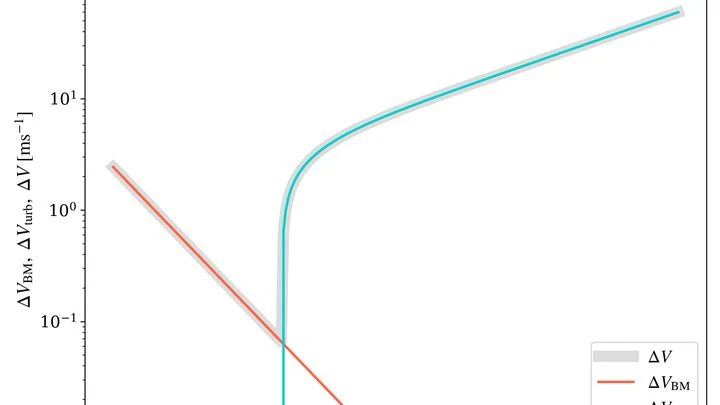
When water churns behind a boat, the energy of motion is converted into heat through a cascade of vortices. Measuring how quickly this happens directly is difficult: you'd need to track all the vortices at once. So scientists use a simplification: they look at only one velocity component at a single point.
Galaxies in the Universe are not scattered randomly: neighboring ones move in the same direction, like a school of fish, while distant ones each go their own way. Where the boundary between 'together' and 'apart' lies has been unclear until now.
The Solar System takes 210 million years to complete one orbit around the center of the Milky Way. The last time we were on this same side of the Galaxy, early dinosaurs were roaming the Earth. That number, 243.72 km/s, has now been refined thanks to rare stars that streak through the Galaxy like cannonballs.