Magnetic field lines are a visual and conceptual tool used to represent the invisible magnetic field that surrounds magnets, electric currents, and moving charged particles. They are not physical objects but rather a way to map the direction and relative strength of the magnetic force in a given region. The lines emerge from the north pole of a magnet and curve around to enter the south pole, forming closed loops that never intersect. The density of these lines indicates the field's strength: closer lines mean a stronger field, such as near the poles, while wider spacing indicates a weaker field farther away.
History
The concept was introduced by Michael Faraday in the 1830s as a way to visualize electric and magnetic fields. He used the term 'lines of force' and emphasized their physical reality, though later physics treats them as a mathematical representation.
How it works
The direction of a magnetic field line at any point is defined as the direction a tiny north magnetic pole would move if placed there, or equivalently, the direction of the force on a moving positive charge (using the right-hand rule). The lines are drawn so that their tangent at any point gives the field direction, and their spacing inversely represents the field magnitude. In practice, they can be visualized by sprinkling iron filings around a magnet, which align along the field lines, or by using a compass to trace the direction of the field at many points.
In practice
Magnetic field lines are used in designing electric motors, generators, and magnetic resonance imaging (MRI) machines, where understanding field distribution is critical for performance and safety.
Fun fact
In a bar magnet, the field lines are continuous loops that pass through the interior of the magnet from the south pole back to the north pole, not just outside.
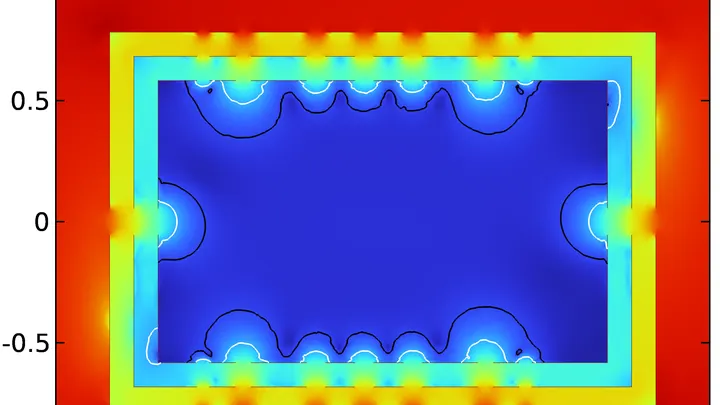
The magnetic field in this setup must be as smooth as glass: the slightest ripple would blur the signal. The engineers built two coils that cancel each other's field externally and packed them in three layers of ferromagnetic plates.
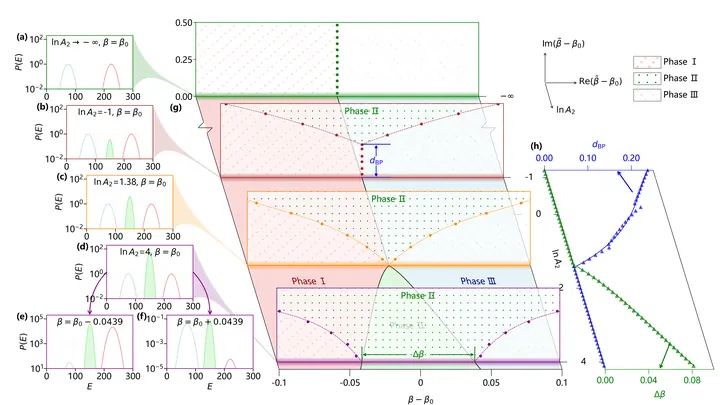
A Tesla coil crackles, and a beam of light begins to rotate around it. The medium it passes through is still stable, but the field grows, and the rotation intensifies. This is not a trick but the behavior of special materials that couple electricity and magnetism. For such coupling, there is a fundamental limit — the Tellegen limit.
Imagine a slide with three dips: the deepest one is a stable position for a ball, the middle one is precarious. A slight push and the ball rolls down. Yet, constant vibration of the right strength can hold it in the middle hollow for a long time.
In the 1950s, physicists Lee and Yang discovered that all states of matter are separated by invisible points in the world of imaginary numbers.
Red giants are swollen, aging stars. Deep inside, an ocean of plasma churns: heat forces its way from the core to the surface, generating waves like a mighty surf. The star's magnetic field acts like an invisible seabed – it steers these waves, changing their height and speed.
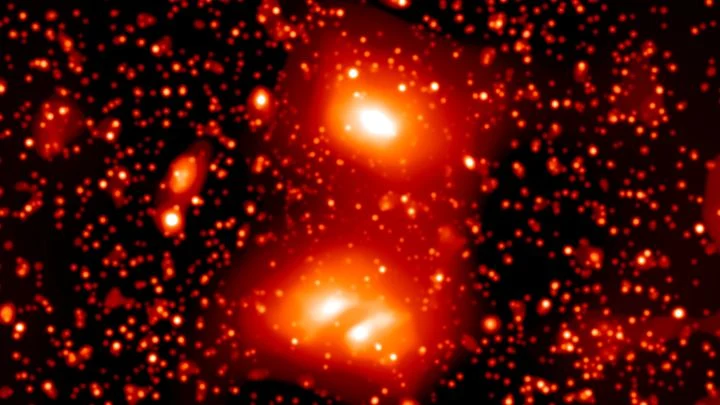
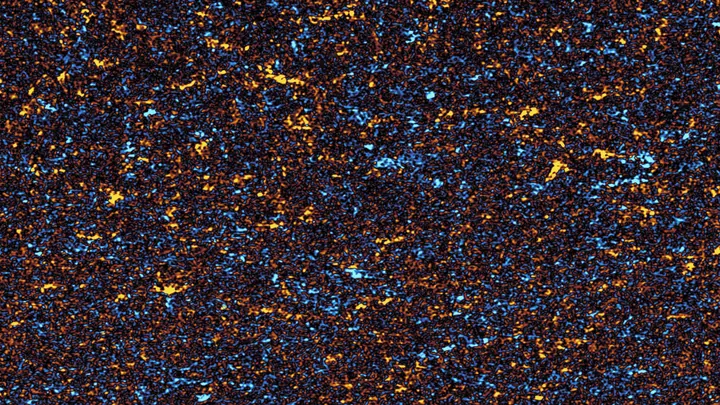
Two giant galaxy clusters, Abell 3391 and Abell 3395, are slowly colliding in the southern sky. Between them stretches a bridge of scorching gas, like a mist over a river, linking two banks. Astronomers have long wanted to know whether this "intergalactic bridge" hosts a magnetic field and how it behaves.
The field cannot be seen directly, but its trace can be caught.
Strike a tuning fork, and it rings with a single pure note. But if the fork is trembling and people are chattering nearby, the sound won't be perfect. Same with molecules: each one absorbs light of a specific color, but due to its own vibrations and the jostling of neighbors, that color gets smeared out.
The authors of the paper figured out how to show this to students without complex formulas.
The Sun is not just a ball — it's a magnetic mansion. Its invisible force lines, like electrical wiring, thread through space and control space weather. But until now, we've only seen this wiring from the landing — the plane of Earth's orbit. The attic and basement, the magnetic poles, remained a mystery.