A shock wave is a sudden, violent disturbance that travels through a medium — air, water, plasma, or even solid material — faster than the speed of sound in that medium. Unlike an ordinary sound wave, which compresses and expands the medium gently, a shock wave is a sharp, nearly discontinuous jump in pressure, temperature, and density. When it passes through a gas, it can heat the gas so intensely that it emits light, which is why meteor fireballs, supernova remnants, and re-entering spacecraft glow so brightly.
History
The concept was developed in the mid-19th century, with significant contributions by Ernst Mach in the 1870s, who studied supersonic projectiles and photographed shock waves using schlieren imaging.
How it works
A shock wave forms when something pushes a medium faster than the medium can carry away the disturbance as a normal sound wave. The leading edge of the disturbance outruns the sound waves ahead of it, piling up into a steep front. Across this front, the medium's properties change abruptly: pressure, temperature, and density jump upward, while the flowvelocity drops. The energy of the motion is converted into heat, and in gases this heat can be high enough to ionize atoms and produce visible light.
In practice
Shock waves are used in medicine for lithotripsy (breaking kidney stones), in industry for explosive forming of metals, and in astrophysics to explain the heating of stellar coronae and the acceleration of cosmic rays.
Fun fact
The crack of a bullwhip is a small shock wave created by the tip moving faster than the speed of sound.
A storm in the upper atmosphere lasts a few millionths of a second. A cosmic ray, a proton or a helium nucleus, strikes air molecules, sending a swarm of particles downward. Most of them stay together, but occasionally one particle gains so much energy that it surges ahead.
The blue glow in water around a nuclear reactor is light born when a charged particle outruns light in that medium. The effect was discovered by Pavel Cherenkov in 1934, with the theory provided by Igor Tamm and Ilya Frank.
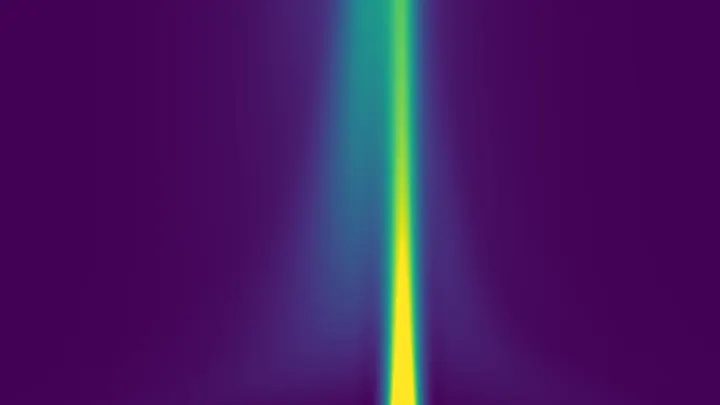
If you push water in a narrow channel too fast, a steep wave forms and breaks into foam. In the world of ultracold atoms, cooled to near absolute zero, quantum laws prevent such a wave from breaking. Physicists took a cloud of rubidium atoms stretched into a thin thread and sharply compressed it from one end with a movable wall of light.
If you push water in a narrow channel too fast, a steep wave forms and breaks into foam. In the world of ultracold atoms, cooled to near absolute zero, quantum laws prevent such a wave from breaking. Physicists took a cloud of rubidium atoms stretched into a thin thread and sharply compressed it from one end with a movable wall of light.
On March 26, 2026, the Chinese-European Einstein Probe observatory caught an X-ray flash that lasted a little over a quarter of an hour. A thousand seconds. The onboard WXT telescope registered a sharp rise in radiation, then a smooth decline, as if someone had screamed into silence, and the echo slowly faded.
295 000 meters per second. Not even particles in solar coronal ejecta move that fast. But at the center of the galaxy cluster H1821+643, hot gas does exactly that. The quasar at its heart takes a breath, and its breath stirs everything around for 60 thousand light-years.
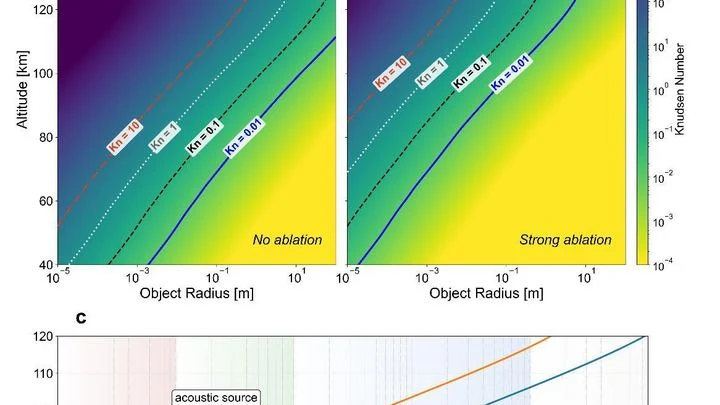
A pebble the size of a grape enters the atmosphere almost tangentially and skims across the sky without falling. That's exactly what happened to a meteoroid weighing about 45 grams. It came in at such a shallow angle that it traveled 164 kilometers at an altitude of 92 kilometers — where the air is a million times thinner than at the surface.
A clap of the hands compresses the air, and it flies outward — the simplest shock. In space, exploding stars play the role of hands: their shock waves sharply compress gas and trigger chaotic mixing — turbulence.
When a massive star explodes as a supernova, its outer layers are blasted into space at thousands of kilometers per second. A shock wave forms — a giant invisible bulldozer that sweeps up interstellar gas and dust. In this maelstrom, particles can be accelerated to energies comparable to that of a flying tennis ball compressed into a single proton.
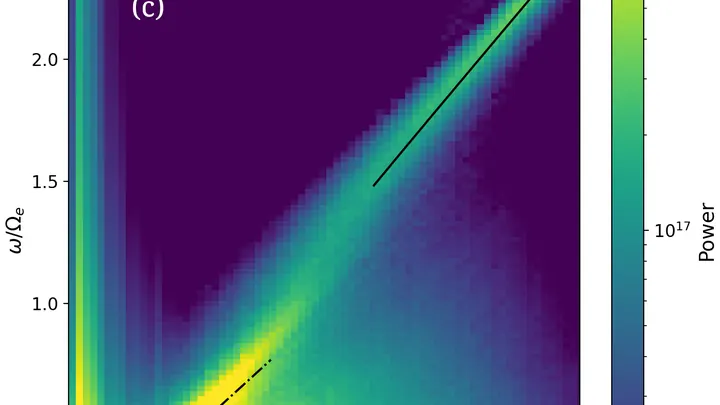
When water boils in a kettle, waves of steam ripple through the kitchen. A similar process happens in space, in plasma — gas so hot that electrons are stripped from atoms. Around black holes and neutron stars, this plasma isn't just hot: its particles zip around at nearly the speed of light.
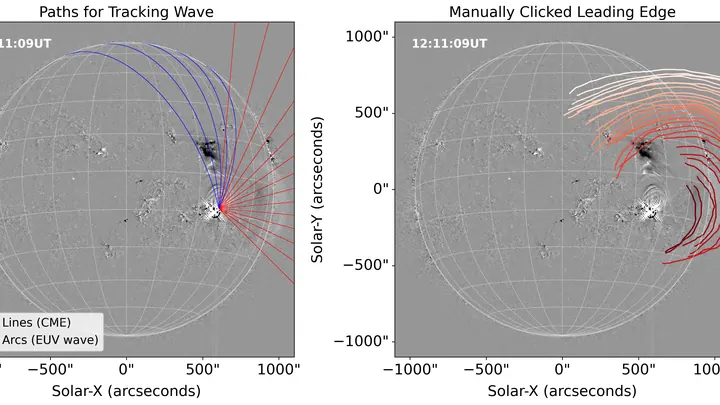
A shock wave in the Sun's corona is like the sonic boom from an airplane, except instead of air there is scorching plasma, and instead of sound there is a jump in density and magnetic field. On March 10, 2024, such a wave swept across the western part of the solar disk.
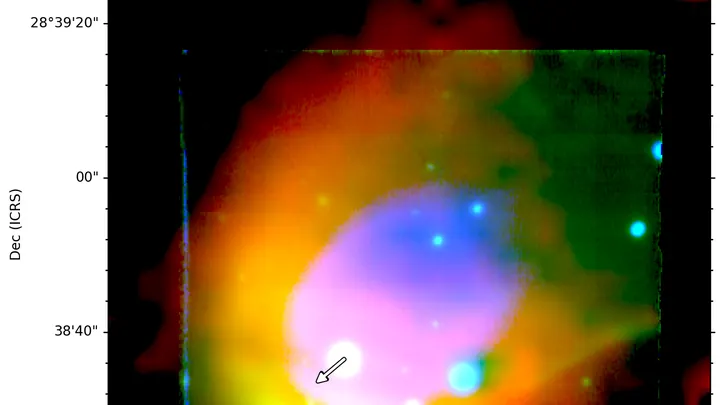
Around certain close binary stars, where a white dwarf siphons matter from its companion, astronomers have seen a glowing arc. They took it for a shock wave — the place where a fast stellar wind slams into interstellar gas. But new observations show: there's more than one arc.
In the macroscopic world we know, any motion inevitably decays: friction, a dissipative process that scatters energy, intervenes. But quantum reality has surprises in store.
The James Webb Space Telescope spotted a luminous streak in a distant galaxy, like the wake of a speedboat, only two hundred thousand light-years long. At the head of this trail races a supermassive black hole, plowing through tenuous gas at 954 km/s. The gas gets compressed, heats up, and glows.