Reconnection Layer Thickness: Four Probes versus One
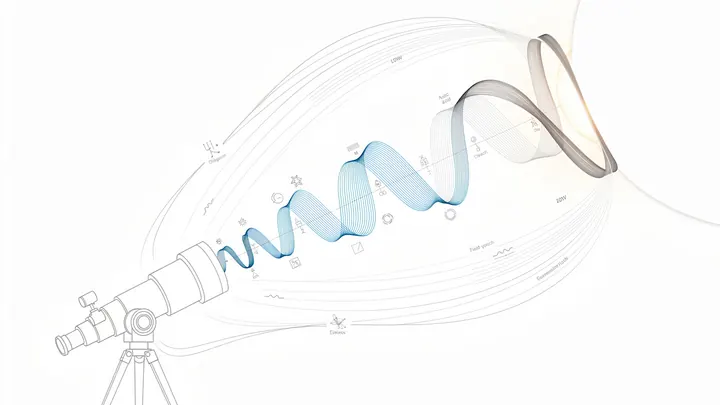
Four witnesses to a single crossing. On November 10, 2017, the four MMS spacecraft flew through an invisible boundary in the solar wind where magnetic field lines reconfigure and release energy.
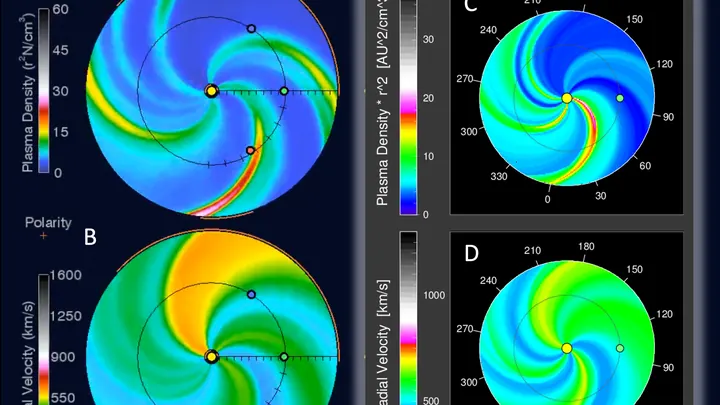
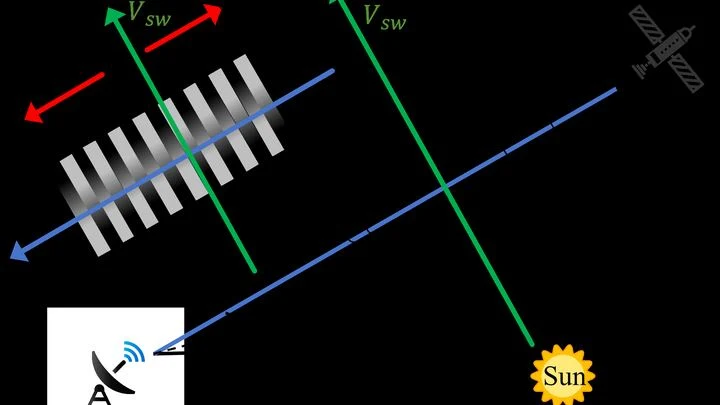
The solar wind is a stream of charged particles ejected from the Sun's corona into interplanetary space.The solar wind is a stream of plasma (a mixture of free electrons and ions) flowing from the solar corona at speeds from 300 to 800 km/s. It carries the Sun's magnetic field frozen into it, which, due to the star's rotation, twists into a Parker spiral. Slow wind comes from quiet regions, fast wind from coronal holes. At Earth, the solar wind shapes the magnetosphere and causes geomagnetic storms.
The idea of particle outflow from the Sun was suggested as early as the early 20th century (Eddington assumed influence on comets), but the physical theory was developed by Eugene Parker in 1958. His work was met with skepticism until the Mariner 2 satellite registered a constant plasma flow in 1962. Further missions (Helios, Ulysses) revealed the three-dimensional structure of the wind.
The outflow is described by magnetohydrodynamic equations taking into account thermal conductivity and wave heating. In Parker's simplest model, the plasma pressure in the corona exceeds the pressure of the interplanetary medium, leading to continuous acceleration to supersonic speeds. The analytical solution of the equation of motion gives a transonic transition. The magnetic field frozen into the plasma creates the heliospheric current sheet and spiral structure. Modern models include kinetic effects and heating by coronal holes. Observations confirm predictions of the existence of slow and fast wind.
The solar wind causes polar auroras, but it can also damage satellites and power grids; forecasting its gusts protects technological infrastructure.
The solar wind creates a giant protective bubble around the Solar System — the heliosphere, which deflects most harmful galactic cosmic rays.