phenomenon

solar eruption

A sudden release of energy and plasma from the Sun's atmosphere into space.
45 related articles

Description

A solar eruption is a sudden, violent release of energy and plasma from the Sun's atmosphere into interplanetary space. These events are the most dramatic expression of the Sun's magnetic activity, often occurring in active regions where magnetic field lines become twisted and stressed. Solar eruptions encompass a family of phenomena, including solar flares (intense bursts of electromagnetic radiation) and coronal mass ejections (CMEs), which are massive clouds of magnetized plasma that travel outward through the solar system.

History

The first recorded observation of a solar flare was made independently by Richard Carrington and Richard Hodgson in 1859, who witnessed a bright flash in a sunspot group. The connection between solar activity and geomagnetic disturbances was established shortly after, but the physical understanding of eruptions developed gradually through the 20th century.

How it works

The mechanism begins with the Sun's magnetic field, which is generated by the churning of ionized gas in its interior. In active regions, magnetic field lines can become tangled and store enormous amounts of energy. When the field lines suddenly reconnect—a process called magnetic reconnection—this stored energy is released in seconds to minutes. The energy accelerates charged particles, heats plasma to millions of degrees, and drives the ejection of material. The released plasma and radiation can travel at speeds of hundreds to thousands of kilometers per second.

In practice

Solar eruptions are monitored by space weather agencies because they can disrupt satellite electronics, radio communications, and power grids on Earth. Understanding them is also crucial for planning crewed space missions beyond low Earth orbit.

Fun fact

The 1859 Carrington Event produced auroras visible as far south as the Caribbean, and telegraph systems worldwide failed, some even sparking and setting paper on fire.

Concept graph →

Related articles · 45

Stellar2026-08-302 minarXiv:2608.29649
A Laser Switch for Magnetic Storms
Inside a solar flare, magnetic field lines snap like stretched rubber bands and reconnect — releasing in minutes enough energy to power humanity for millions of years. In the lab, this process, magnetic reconnection, could long be triggered but not stopped. Now physicists have a switch.
Avalanche in Space: How a Gamma-Ray Burst Revealed Its Magnetic Nature
An avalanche in a sandpile starts with a single grain. No one knows exactly where it will slip or how big the slide will be. But if you keep pouring sand, the pile itself reaches a state where avalanches of all sizes, from tiny trickles to massive collapses, follow the same law.
Stellar2026-08-062 minarXiv:2608.05596express
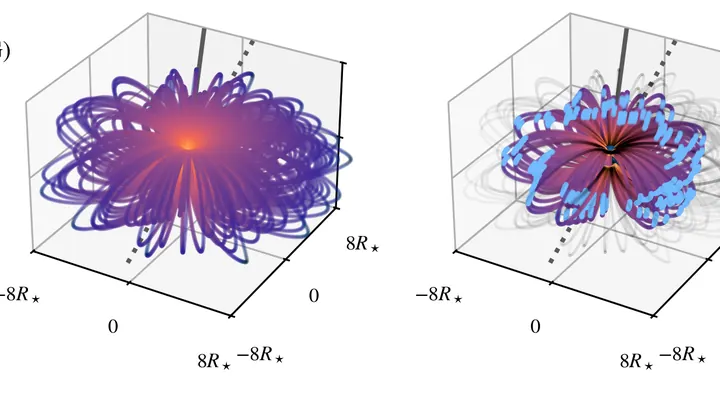
The Sun's Magnetic Loops: Chaos You Can Measure
A sunspot, a dark island on the fiery surface, lives its own turbulent life. Beneath it, in invisible depths, giant magnetic loops drift like twisted cables. When such a loop emerges, it can discharge as a flare, and hurl clouds of charged particles into space. Scientists have long tried to understand what determines the strength and suddenness of these events.
Stellar2026-07-192 minarXiv:2607.17359
The Cosmic Bell: How Pulsations from the Sun to Stars Fade Away
The Sun is constantly struck by blows — magnetic reconnection in the plasma releases energy, making the corona flare up. After each such blow, magnetohydrodynamic waves linger in the plasma loops, like the fading ring of a bell.
Reflation: When a Planet Inhales After Exhaling
The mystery of the radius valley — a sharp drop in the number of exoplanets with radii ~1.8 Earth — haunts astronomers. JWST, transit surveys like Kepler and TESS draw a clear gap: rocky super-Earths and gaseous sub-Neptunes are separated by almost a chasm.
Stellar2026-07-113 minarXiv:2607.10452
Local Big Bang: Explosive Outflows at the Birth of Massive Stars
In the quiet of cold molecular clouds, where interstellar gas under gravity condenses into dense clumps, the birth of massive stars is one of the great puzzles of astrophysics.
Whisper of Magnetic Monopoles: Plasma Resonance in a Quantum Spin Liquid
In a world locked in a crystal lattice and cooled nearly to absolute zero, matter knows how to hide its deepest secrets. A quantum spin liquid is a state where electron spins never freeze, even at zero temperature, remaining in an eternally flickering superposition.
The Arrow Piercing the Disk: Recipe for an X-ray Flare
Deep space, galactic center. A supermassive black hole is surrounded by a scorching disk of gas and dust. And then, through this fiery veil, a star shoots by every few hours — like an arrow loosed from the bow of gravity. Each passage triggers a dazzling X-ray flare that for a moment outshines the entire galactic nucleus.
Plasma Physics2026-06-262 minarXiv:2606.27833express
How Magnetic Fields Are Born in a Void
Space is threaded with magnetic fields. They exist around galaxies, stars, and even in nearly empty voids — the vast empty spaces between galaxy clusters. It's usually thought that fields are amplified from weak 'seed' fields by turbulence, much like a dynamo. But the origin of the seed fields themselves has remained a puzzle.
Exoplanets2026-06-231 minarXiv:2606.25070express
How a Comet Sneezes Dust
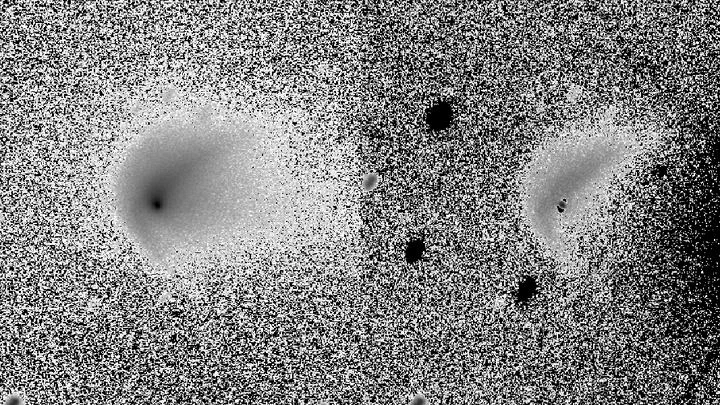
In the summer of 2021, comet 7P/Pons-Winnecke put on quite a show. A network of telescopes, the Las Cumbres Observatory, tracked it for nearly three months and counted eight sudden outbursts.
Popular Physics2026-06-141 minarXiv:2606.17105express
Gravitational Visitors: How Passing Planets Rewrote Earth's History
On the periphery of the Solar System lurk thousands of objects comparable in size to an exoplanet — a body of planetary mass not bound to our star. Their orbits are chaotic, and from time to time the trajectory of such a wanderer crosses Earth's path.
High Energy2026-06-111 minarXiv:2606.13953express
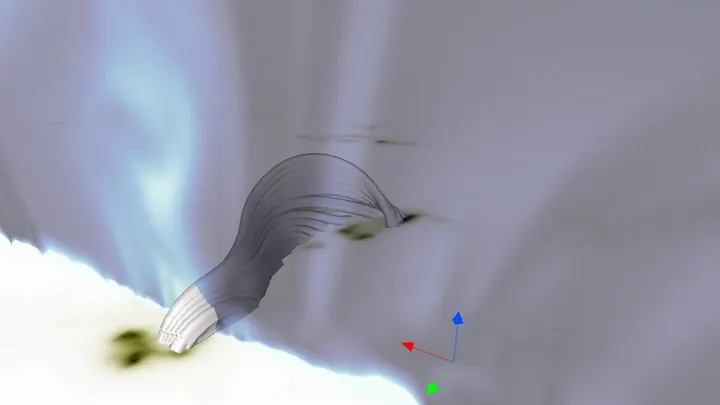
Twisted Solar Loop Reveals the Secret of Magnetic Explosions
A tightly twisted phone cord snaps and scatters sparks. Magnetic fields on the Sun behave the same way: they twist, break, and reconnect, powering flares. For the first time, astronomers have witnessed this process directly. One loop was twisted by 540 degrees — one full turn and then half again. That’s three times more than previously thought possible.
High Energy2026-06-082 minarXiv:2606.08931express
Cosmic Jet Slams into a Cloud
A fire hose blasts into a snowdrift. The water doesn't just shove the snow aside — at the point of impact, spray, steam, and a roar are born. That's roughly how jets behave: narrow streams of matter shooting out from around a black hole at enormous speeds.
Plasma Physics2026-05-202 minarXiv:2605.21672express
Turbulence from Impact: How Explosions Stir Up Flows
A clap of the hands compresses the air, and it flies outward — the simplest shock. In space, exploding stars play the role of hands: their shock waves sharply compress gas and trigger chaotic mixing — turbulence.
Exoplanets2026-04-232 minarXiv:2604.21322express
Cosmic Remelting of the First Rocks
An old chest of family heirlooms opens, and inside lie jewels that were thought to be as old as great-grandmother. But suddenly it turns out: the gold was remelted, the stones were recut, and this happened much later than thought. A similar story happened to the oldest particles in meteorites — calcium-aluminum inclusions, or CAIs.
Plasma Physics2026-04-172 minarXiv:2604.16156express
How a Star's Magnetic Field Puts the Brakes on Outflows
A stream of scorching gas races away from a star, and suddenly stalls, as if it hit an invisible wall. That's exactly what researchers saw when they tried to reproduce a stellar eruption on a laboratory scale. They used a laser to create a plasma jet and shot it through a magnetic field — first weak, then strong, like that of many stars.
Galaxies2026-04-151 minarXiv:2604.13671express
Baby Star Fires in Bursts
In a dense cloud of gas and dust where giant stars are born, the ALMA telescope has spotted something familiar. Four thin gas jets shoot out from the same region, each leaving behind a chain of bright knots, like a dashed line.
Stellar2026-03-231 minarXiv:2603.21885express
Solar Storms Trapped in a Cage
The Sun sometimes produces giant clouds of plasma that try to escape into space. But often they fail: an invisible magnetic cage keeps them near the surface. Such failed eruptions are called "trapped." Scientists built a computer model to understand exactly how this cage works.
Stellar2026-03-121 minarXiv:2603.11742express
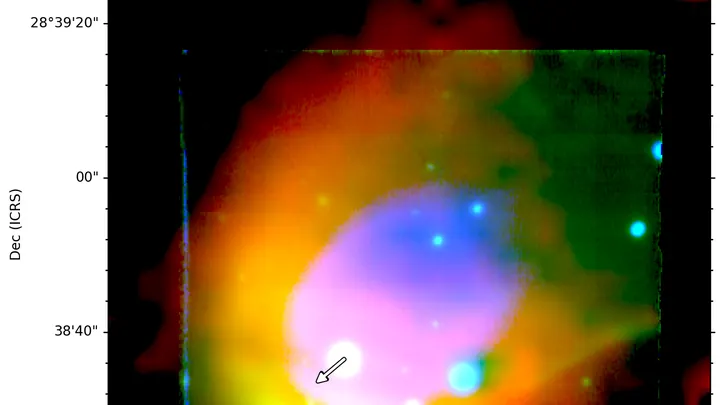
Double Arc Around Vampire Stars
Around certain close binary stars, where a white dwarf siphons matter from its companion, astronomers have seen a glowing arc. They took it for a shock wave — the place where a fast stellar wind slams into interstellar gas. But new observations show: there's more than one arc.
Plasma Physics2026-03-031 minarXiv:2603.03123express
Plasma on a Leash: How Turbulence Holds the Heat
Hot plasma in a tokamak is like a temperamental beast: you need to hold it in, but not let it overheat. In the ASDEX Upgrade reactor, researchers found a regime where plasma eddies solve this problem on their own. Stochastic modeling showed that oscillations at the plasma edge fling out blobs, like bubbles from a boiling pot.
Stellar2026-02-232 minarXiv:2602.20311express
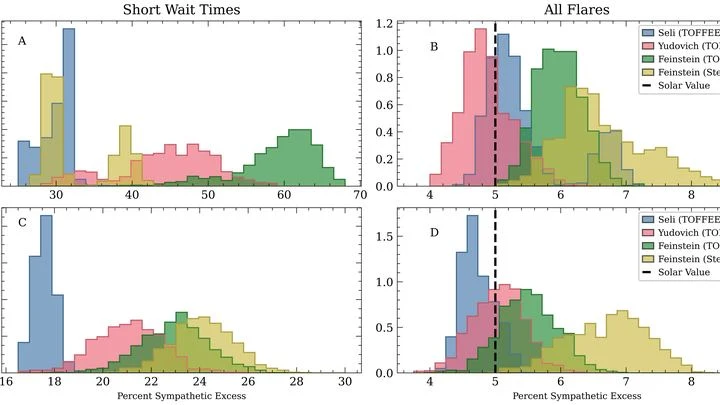
Stellar Flares Ignite Each Other
The Sun occasionally produces flares — powerful bursts of energy that last from minutes to hours. Most are random, like raindrops hitting a roof. But sometimes one flare seems to ignite another: the second begins almost immediately after the first, even though they occur in different locations. Astronomers call these sympathetic flares.
Stellar2026-02-142 minarXiv:2602.13644express
Four Sentinels of the Solar Wind
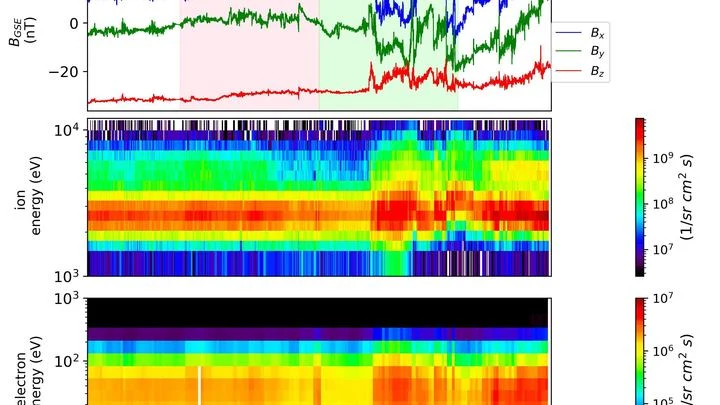
October 10, 2024. The Sun hurled a cloud of magnetized plasma toward Earth, and four spacecraft, stationed at a single point between the Sun and Earth, simultaneously recorded how that cloud churned. The distance between the outermost probes was just 80 Earth radii, about half a million kilometers.
Stellar2026-02-122 minarXiv:2602.12060express
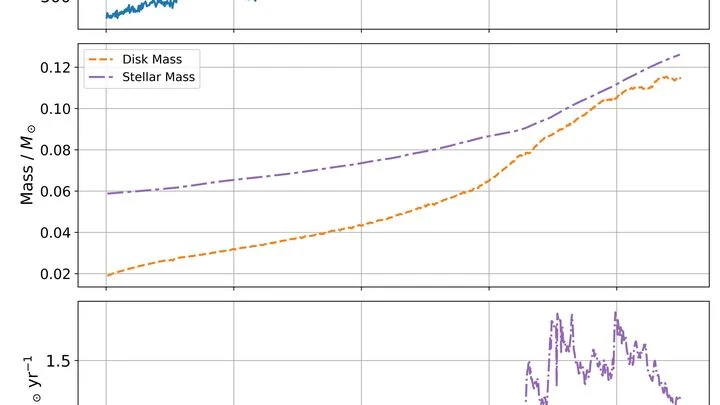
A Star Baby Sneezes: The Outburst of Protostar B335
The young star B335, which hasn't grown up yet, suddenly sneezed, and that sneeze is still going on. Astronomers spotted the outburst in the scattered light from its outflow cavity, and it offered a rare chance to see how such an energy release affects a jet — a stream of gas shooting out…
Stellar2026-02-122 minarXiv:2602.12475express
Solar Particles Don't Arrive on Schedule
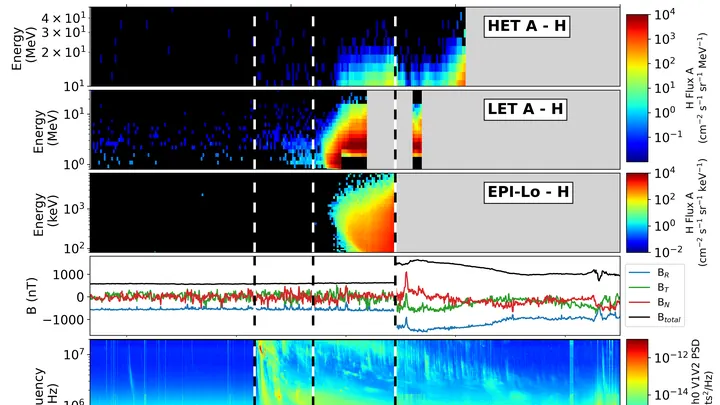
The Sun sometimes hurls vast clouds of charged particles into space. Usually, the fastest ones, with the highest energy, arrive at the probe first, like sprinters on a long-distance track.
Stellar2026-02-111 minarXiv:2602.10477express
Solar Eruption: How a Magnetic Loop Breaks into Space
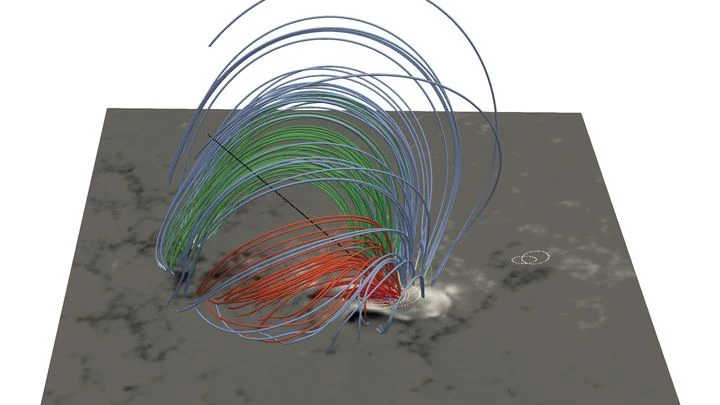
The Sun regularly produces explosions that hurl huge clouds of charged particles into space. Such a cloud travels toward Earth and can knock out satellites, disrupt radio communications, and even leave cities without electricity.
Stellar2026-02-101 minarXiv:2602.09390express
Solar Eruptions: Neutral Helium Reveals the Magnetic Field
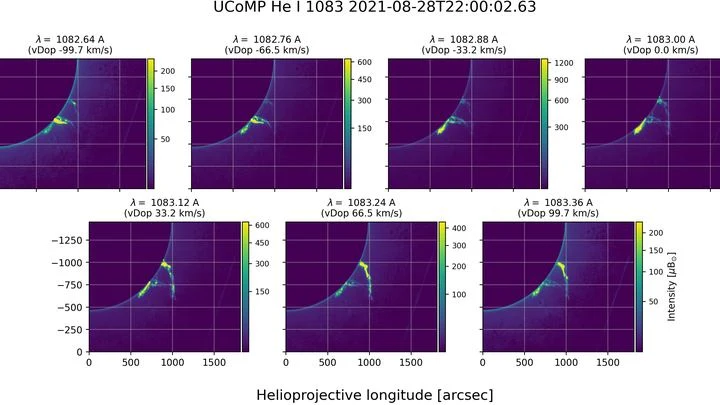
The Sun occasionally hurls enormous clouds of plasma into space — coronal mass ejections. Often tangled within these clouds are prominences: cooler, denser clumps of material. These contain plenty of neutral atoms that shine brightly in specific spectral lines.
Stellar2026-02-102 minarXiv:2602.10284express
Solar Flare with Two Accelerators
The solar flare of June 3, 2012 behaved like an orchestra where, after the main performance, a second soloist unexpectedly steps in. First, instruments recorded a sharp burst of gamma-ray emission with energies above 100 megaelectronvolts — as if billions of tiny bullets struck the detectors at once. Then, after a brief pause, the emission intensified again and persisted for more than eight minutes.
Stellar2026-02-051 minarXiv:2602.05282express
MeerKAT's Radio Ear Hears the Whisper of Solar Flares
A solar flare is like thunder on a clear day: a short but powerful burst of energy. The MeerKAT radio telescope in South Africa caught one such M1.3-class flare and examined it with unprecedented clarity. Ordinary instruments see either bright details or faint ones, but not both at once.
Optics2026-02-032 minarXiv:2602.02968express
How to Tame a Rogue Wave with a Laser
In the ocean, sometimes a huge solitary wave appears out of nowhere and then vanishes. Such rogue waves are rare but dangerous. Similar rare and intense spikes occur in other systems, from financial markets to lasers. The problem is that they are hard to predict, let alone trigger on demand.
Stellar2026-02-031 minarXiv:2602.03552express
Solar Flare: What the Radio Telescope Saw
A solar flare is like an explosion in a star's atmosphere: in minutes, it releases energy comparable to billions of nuclear bombs. On May 4, 2022, the RT-7.5 radio telescope in Moscow was watching an M5.7-class flare. The instrument was catching millimeter radio waves: those shorter than a centimeter and invisible to the eye.
High Energy2026-02-031 minarXiv:2602.03932express
Black Hole with Double Flashes
In the center of galaxy J2344 five years ago, a black hole tore apart a star, and now scorching gas bubbles there — a cosmic “stew pot”. Every 12 hours, giant X-ray bubbles rise in it, and on their ascent, super-hot splashes lasting 5–30 minutes appear.
Stellar2026-02-021 minarXiv:2602.01742express
The Solar Knot That Unties Itself
The Sun frequently launches narrow plasma jets, coronal jets, that resemble fountains of superheated gas erupting from the star's atmosphere. One such eruption, which occurred on November 10, 2022, caught scientists' attention: it was accompanied by a C1.1-class flare and had an unusually wide cone.
Stellar2026-02-012 minarXiv:2602.01117express
A Christmas Tree on the Sun: How a Flare Paints a Pattern in Radio Waves
On December 31, 2023, the Sun unleashed a flare of the highest class — one that releases the energy of billions of atomic bombs in just a few minutes. Along with it, a huge prominence, a cloud of superheated gas, tore away from the surface and shot outward at nearly 3000 kilometers per second.
Stellar2026-02-012 minarXiv:2602.01323express
The Solar Flare Mystery: Light That Shouldn't Have Been There
A solar flare is like an explosion in the atmosphere: bright, fast, with different 'voices.' X-rays come from electrons that have been accelerated and then abruptly slowed down, losing energy. But in 2017, detectors on the Fermi satellite caught a different signal — gamma rays that didn't fit this picture.
Stellar2026-01-301 minarXiv:2601.23046express
Solar Flare: Two Peaks, One Magnetic Ribbon
On October 1, 2024, a class X7.1 flare erupted on the Sun — one of the most powerful. Two spacecraft, HXI and STIX, watched it from different angles, like two eyes, and together with a computer model helped reconstruct the three-dimensional picture.
Stellar2026-01-181 minarXiv:2601.12476express
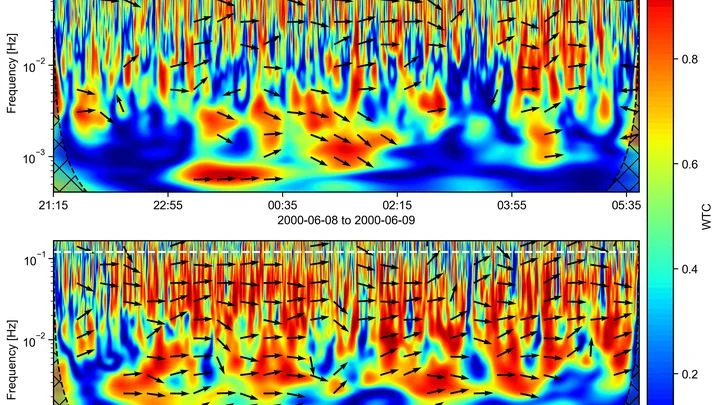
Waves Spinning in Opposite Directions Found Inside a Solar Eruption
The Sun constantly emits a stream of charged particles, mostly hydrogen — the solar wind. Sometimes the Sun ejects dense blobs of magnetized gas, inside which calm usually reigns. But in 2000, scientists noticed two regions inside one such cloud where the gas was churning.
Stellar2026-01-152 minarXiv:2601.10818express
Vortex rings that survived a solar eclipse
A total solar eclipse offers rare minutes when the Moon blocks the Sun's bright disk, revealing its outer atmosphere — the corona. In white light, the corona extends tens of solar radii, and images show fine structures: vortex rings, waves like ripples on water, and huge plasma ejections.
Stellar2026-01-071 minarXiv:2601.03568express
Stellar Prominences Ignite Radio Flares
The red dwarf V374 Pegasi is a star one-third the size of the Sun, but with the temperament of a volcano. Every few hours, giant clumps of plasma tear away from its surface, like steam bubbles from a boiling cauldron. These ejections, called prominences, fly off into space and generate bursts of radio waves.
High Energy2026-01-061 minarXiv:2601.02801express
Solar Storm Illuminated Magnetic Fields in Space
Cosmic rays are like a downpour pelting from all sides. But when the wind blows, the droplets change direction. In the same way, a solar storm, a cloud of magnetized gas from the Sun, bends the paths of these particles that normally rain down on Earth evenly. Cosmic rays are invisible messengers from distant galaxies.