Reconnection Layer Thickness: Four Probes versus One
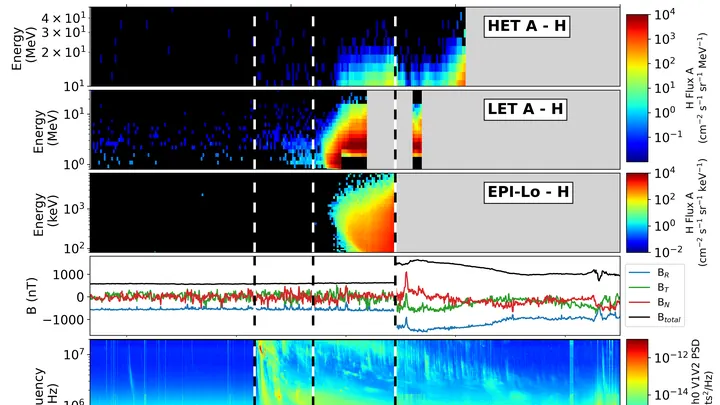
Four witnesses to a single crossing. On November 10, 2017, the four MMS spacecraft flew through an invisible boundary in the solar wind where magnetic field lines reconfigure and release energy.
A NASA spacecraft that travels close to the Sun to study the solar wind and corona.The Parker Solar Probe is a NASA spacecraft designed to fly closer to the Sun than any previous mission, plunging into the solar corona—the Sun's outer atmosphere—to study the solar wind and the processes that heat the corona to millions of degrees. Launched in 2018, it has repeatedly broken its own records for closest approach to a star, reaching within about 6 million kilometers of the solar surface. Its data are reshaping our understanding of how the Sun generates the solar wind, how energetic particles are accelerated, and how space weather propagates through the heliosphere.
The mission was proposed in the 2000s and named after Eugene Parker, who in 1958 first predicted the solar wind. It launched on August 12, 2018, and made its first perihelion in November 2018. Parker himself lived to see the mission's early results, dying in 2022.
The probe uses a series of Venus flybys to gradually shrink its orbit, allowing gravity assists to shed angular momentum. Protected by a 4.5-inch-thick carbon-composite heat shield, it survives temperatures exceeding 1,300°C. Its instruments sample the local plasma, magnetic field, and energetic particles in situ, while the heat shield keeps the payload at room temperature. The orbit is highly elliptical, so the probe spends most of its time far from the Sun, making brief, fast passes through the corona.
Data from the probe improve forecasts of space weather, which can disrupt satellites, power grids, and GPS, and it informs models of stellar evolution and the habitability of exoplanets.
At closest approach, the probe travels at about 190 kilometers per second—fast enough to fly from New York to Tokyo in under a minute.