The solar wind is not a smooth, steady breeze but a turbulent plasma full of waves. These waves — ranging from large-scale Alfvén waves to high-frequency electrostatic oscillations — carry energy and momentum through interplanetary space. They are crucial for understanding how the solar corona is heated to millions of degrees, how the solar wind accelerates, and why it produces radio bursts as it interacts with itself and with planetary magnetospheres.
History
The existence of waves in the solar wind was inferred from early spacecraft observations in the 1960s, with Alfvén waves identified as a key component by the 1970s. The detailed study of their role in coronal heating gained momentum in the 1990s with observations from SOHO and later Parker Solar Probe.
How it works
Waves in the solar wind arise from instabilities in the plasma, such as temperature anisotropies or beams of fast particles. As they propagate, they can transfer energy to particles via Landau damping or cyclotron resonance, heating the plasma or accelerating particles to high energies. When these energetic particles interact with the wave fields, they can emit coherent radio radiation, producing the observed radio bursts. The waves also mix and cascade energy from large scales to small scales, driving turbulence that shapes the wind's structure.
In practice
Understanding solar wind waves is essential for space weather forecasting, as they influence the propagation of solar energetic particles that can damage satellites and power grids.
Fun fact
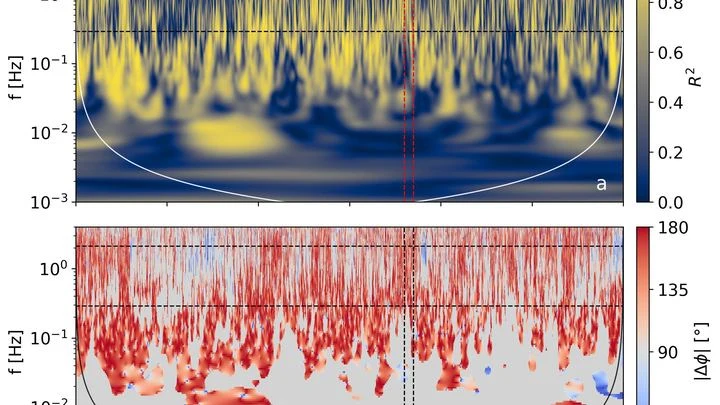
Some solar wind waves have a 'handedness' — they rotate in a specific direction as they travel, and this rotation can be opposite to what simple models predict, as observed inside solar eruptions.
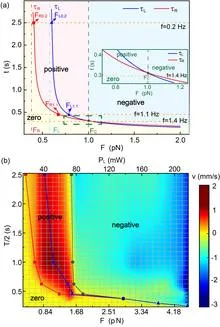
A swing that rocks on a sawtooth hill behaves strangely: without kicks, it gets stuck in the first dip, but with rhythmic pushes it can move uphill, downhill, or stay frozen in place. That is exactly what physicists saw when they placed a single dust grain in a trap with a sawtooth bottom and started pushing it alternately with laser beams.
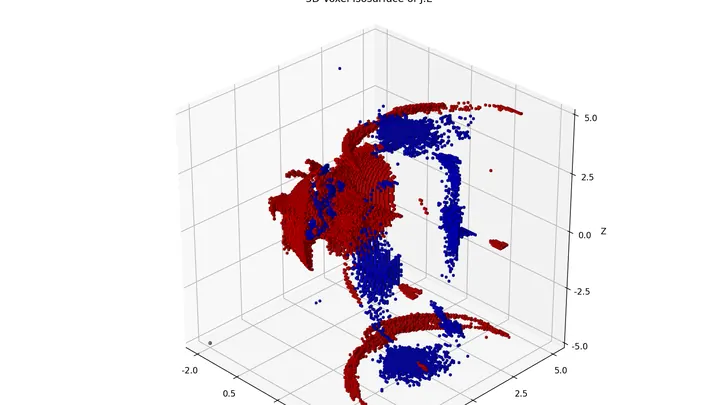
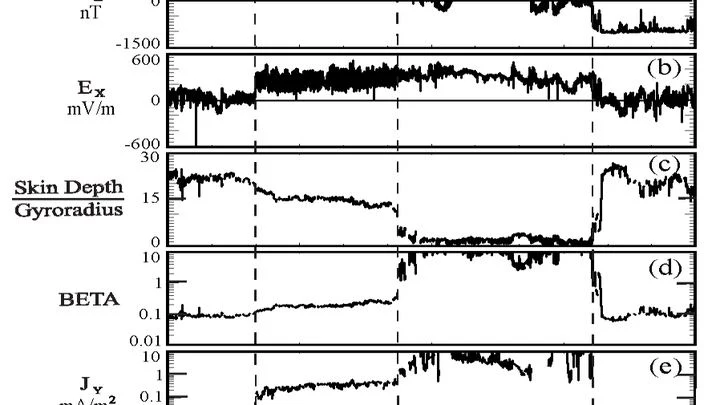
Two caravans travel toward each other along a narrow road. One is wide and slow, carrying a load of density. The other, a string of light carts carrying current, slips between the first. Thus, in a magnetron discharge, two structures rotating in opposite directions coexist: the density spoke and the current filaments.
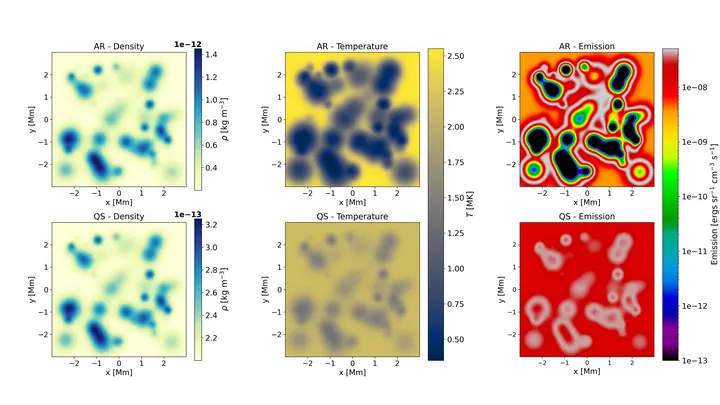
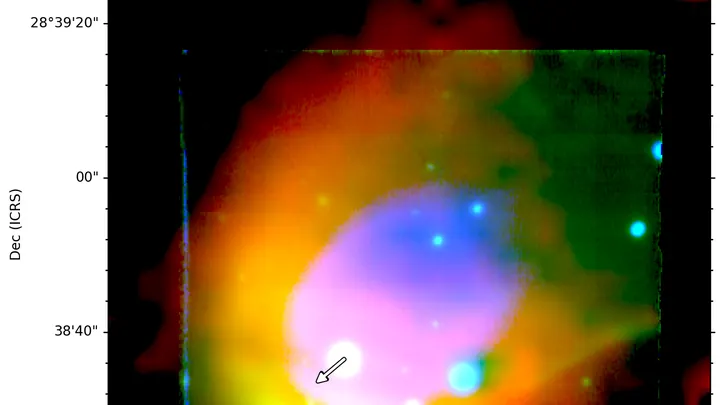
The solar corona is the Sun's outer atmosphere, heated to millions of degrees. How it gets so hot is still unclear. One candidate is torsional waves: they twist magnetic field lines like a rubber band. Such waves were recently spotted with the new Daniel K. Inouye Solar Telescope.
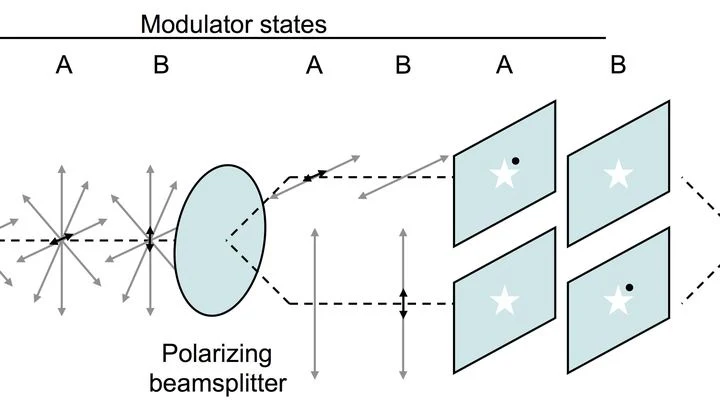
Night on La Palma. The 4.2-meter William Herschel Telescope is aimed at Venus. At the focus is the experimental polarimeter ExPo, designed to catch the ghostly light of exoplanets.
A pot of porridge boiling over a high flame: bubbles carry grains from the bottom to the surface. A similar mechanism works on a neutron star. As it accumulates hydrogen and helium from a companion star, it occasionally triggers a powerful nuclear explosion — an X-ray burst.
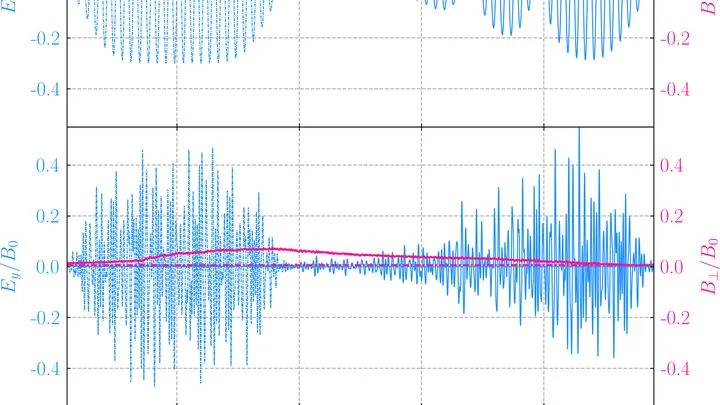
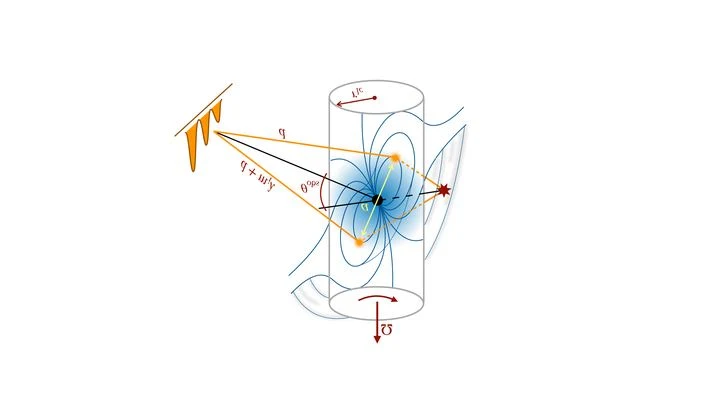
A lighthouse sends its beam through a storm of its own mirrors: that's roughly how fast radio bursts behave when trying to leave a magnetar's vicinity. A magnetar is a neutron star with a magnetic field a quadrillion times stronger than Earth's.
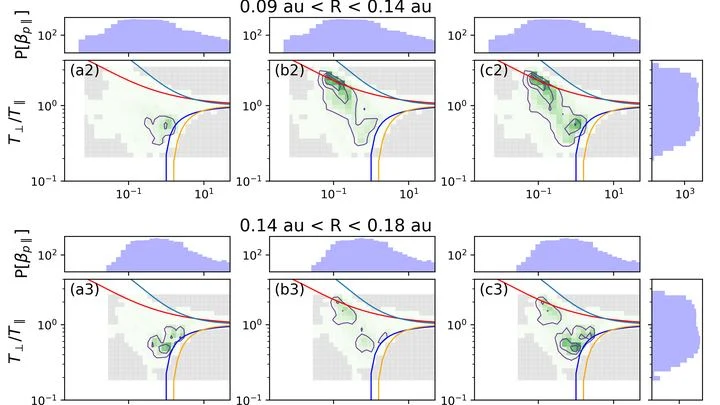
The paradox of the young solar wind has long puzzled heliophysicists. Measurements showed that near the Sun, proton beams aren’t smeared out but sharply compressed, as if someone had neatly hammered them into the shape of a hammerhead.
A clap of the hands compresses the air, and it flies outward — the simplest shock. In space, exploding stars play the role of hands: their shock waves sharply compress gas and trigger chaotic mixing — turbulence.
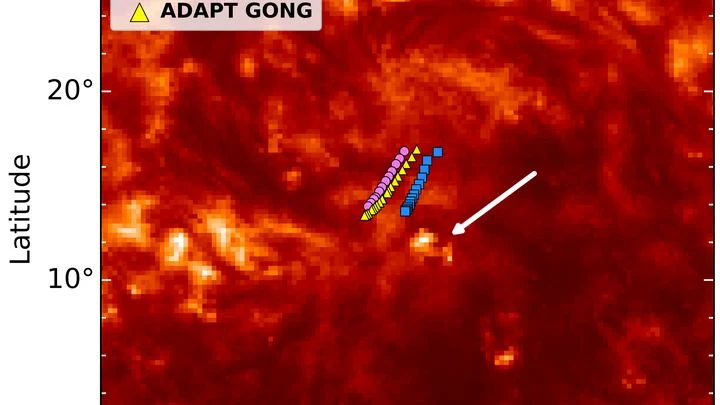
In December 2011, Comet Lovejoy boldly raced through the searing corona of the Sun. Right after — a flare. Scientists checked whether the comet could have caused it. The atmosphere of the Sun is threaded with taut magnetic loops, like a drawn bowstring.
A thin layer of oil on the surface of water breaks into separate droplets at the slightest disturbance. Something similar happens in the pulsar wind — a stream of particles ejected by a rapidly rotating neutron star. This stream also contains plasma layers, which can break apart into clumps — magnetic islands.
The crown of a huge tree sways in the wind, but the roots and trunk are hidden underground. On the Sun, magnetic fields play the role of such invisible roots. They emerge from the depths, thread through the entire atmosphere, and govern the motion of the hot gas — plasma.
Two neutron stars spiral closer together, about to merge in an instant. Their dance lasts fractions of a second, but just before the finale, one star plows into the other's magnetic envelope, like a swimmer cutting through water, kicking up waves. At that moment, a complex system of currents is born, carrying energy away.
The solar wind isn't a smooth flow: it's gusty. Inside it, protons and helium nuclei don't all travel at the same speed; they spread out like droplets in a hose stream. Usually, this spread is described by a simple bell-shaped curve.
Interstellar space is not empty: it is filled with tenuous gas, which is warm in some places and cold in others. The boundaries between such regions resemble the walls between soap bubbles.
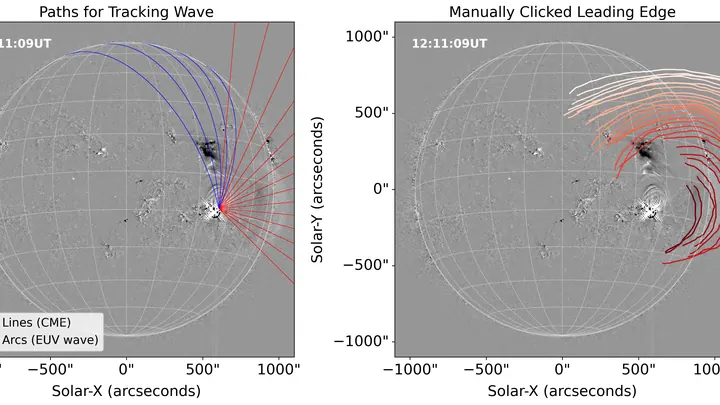
A shock wave in the Sun's corona is like the sonic boom from an airplane, except instead of air there is scorching plasma, and instead of sound there is a jump in density and magnetic field. On March 10, 2024, such a wave swept across the western part of the solar disk.
Radio waves passing through the solar corona, the outer atmosphere of the Sun, are distorted just like the air shimmers over scorching asphalt. This haze is caused by seething streams of charged particles — the solar wind.
Above the Sun's surface hang long ribbons of glowing gas — streamers. They look like giant harps stretched across the corona. When a wave runs along such a ribbon, it trembles and bends like a string after being plucked.
For a long time, it was thought that only a very fast ejection of material, one traveling at more than 500 kilometers per second, could launch such a wave.
The Sun's corona looks like a shaggy dandelion: bright petal-like loops hold hot gas near the surface, while long, tenuous jets escape into space between them. These jets, the heliospheric current sheet, stretch across the entire solar system.
Around certain close binary stars, where a white dwarf siphons matter from its companion, astronomers have seen a glowing arc. They took it for a shock wave — the place where a fast stellar wind slams into interstellar gas. But new observations show: there's more than one arc.
The X-ray pulsar Centaurus X-3 is a neutron star that spins rapidly and emits pulses of X-ray light like a lighthouse. Scientists pointed three space telescopes at it and studied the polarization of its emission — how the electric field of the light wave oscillates.
A radio telescope picks up a signal from the Crab Nebula, and instead of a smooth line, the screen shows bright and dark bands, like on a zebra's hide. This is the emission from the pulsar, a rapidly spinning neutron star left over from a supernova explosion.
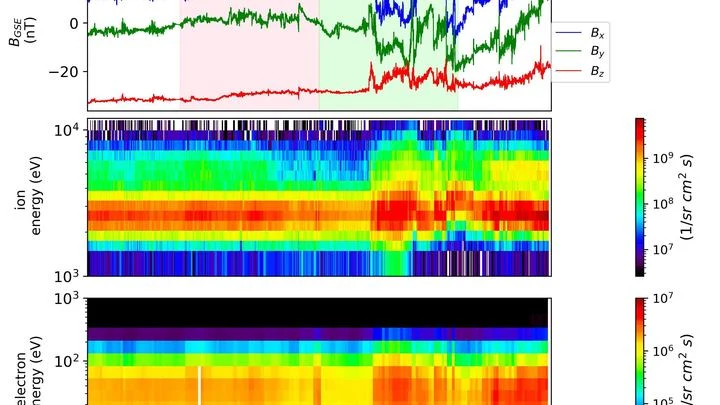
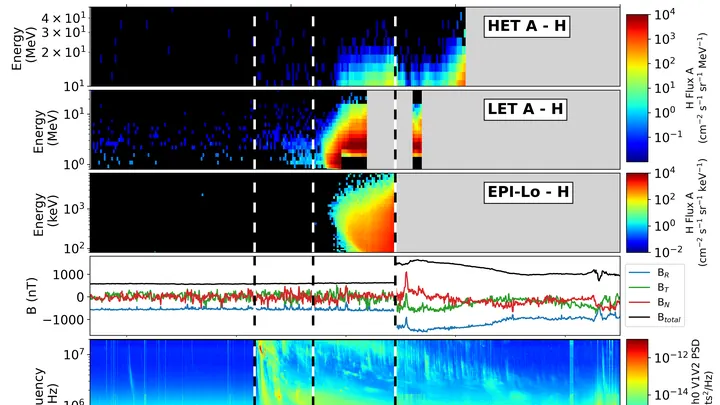
October 10, 2024. The Sun hurled a cloud of magnetized plasma toward Earth, and four spacecraft, stationed at a single point between the Sun and Earth, simultaneously recorded how that cloud churned. The distance between the outermost probes was just 80 Earth radii, about half a million kilometers.
The Sun sometimes hurls vast clouds of charged particles into space. Usually, the fastest ones, with the highest energy, arrive at the probe first, like sprinters on a long-distance track.
The Parker Solar Probe and Solar Orbiter spacecraft fly close to the Sun and measure the solar wind — the stream of charged particles that constantly blows from our star.
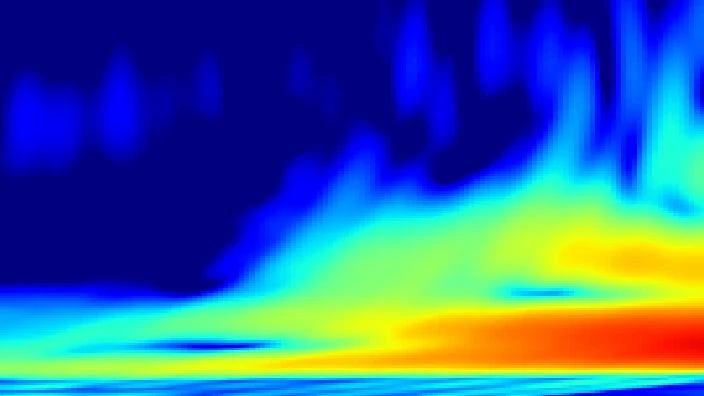
In the stream of charged particles that constantly blows from the Sun, radio bursts sometimes occur — short, powerful signals at frequencies you can pick up on an ordinary radio. Until now, it was unclear how exactly these signals are born in that stream.
A total solar eclipse offers rare minutes when the Moon blocks the Sun's bright disk, revealing its outer atmosphere — the corona. In white light, the corona extends tens of solar radii, and images show fine structures: vortex rings, waves like ripples on water, and huge plasma ejections.
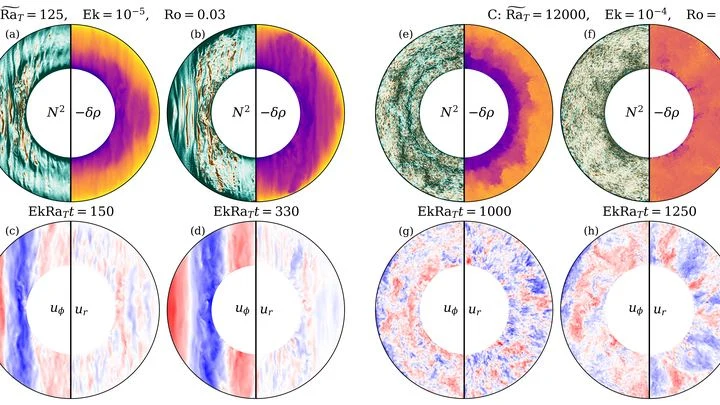
Inside giant planets like Jupiter and Saturn, heat doesn't always rise freely. Heavy elements, which are more abundant in some layers than others, prevent hot fluid from floating up. This creates semiconvection — a type of mixing where heat and composition spread at different rates.
The scorching gas streaming from the Sun is not a continuous flow but rather a soup of charged particles. In this soup, waves constantly boil up: electric fields flare and fade like ripples on water from a tossed stone. One such wave is the ion-ion acoustic wave.
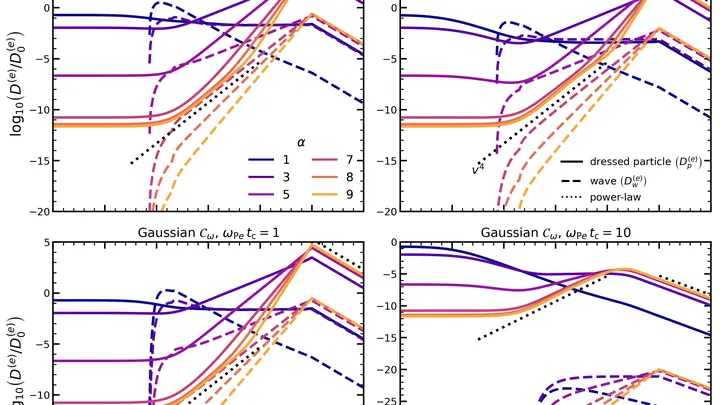
In a hot gas of charged particles — plasma — chaotic electric fields work like a sieve. A slow particle gets surrounded by a cloud of opposite charges, which cancels the external field. A fast one sheds this armor and gets accelerated.
The solar wind isn't a calm stream but a bubbling soup of charged particles. Diving close to the Sun, the Parker probe picked up two types of stirring waves. Left-handed ones, like a whisk in a chef's hand, whip up the material when the temperature differs along and across the flow.
A magnetar's crust cracks in milliseconds. A deep shift generates seismic waves that run across the surface and shake the magnetic field. This starquake is like an earthquake, but on a neutron star with a field a quadrillion times stronger than Earth's.
Over the tropical Pacific, air pressure breathes with periods from two to fourteen years. The barometer on Tahiti rises while it falls in Darwin, Australia, and the entire planet's climate shudders: El Niño arrives. Meteorologists call this the Southern Oscillation and have tracked it for 138 years, but until now they couldn't answer a simple question: where do such periods come from?