Light and Distance: Testing Cosmic Geometry express
Light from a distant star travels to us for billions of years, and during that time the universe has time to expand. How can we check that we correctly understand this journey? Astronomers use two 'rulers': supernova explosions, which shine with a known brightness, and fast radio bursts — short, powerful pulses of radio waves from other galaxies. If both rulers show the same distance, then cosmic geometry works like clockwork.
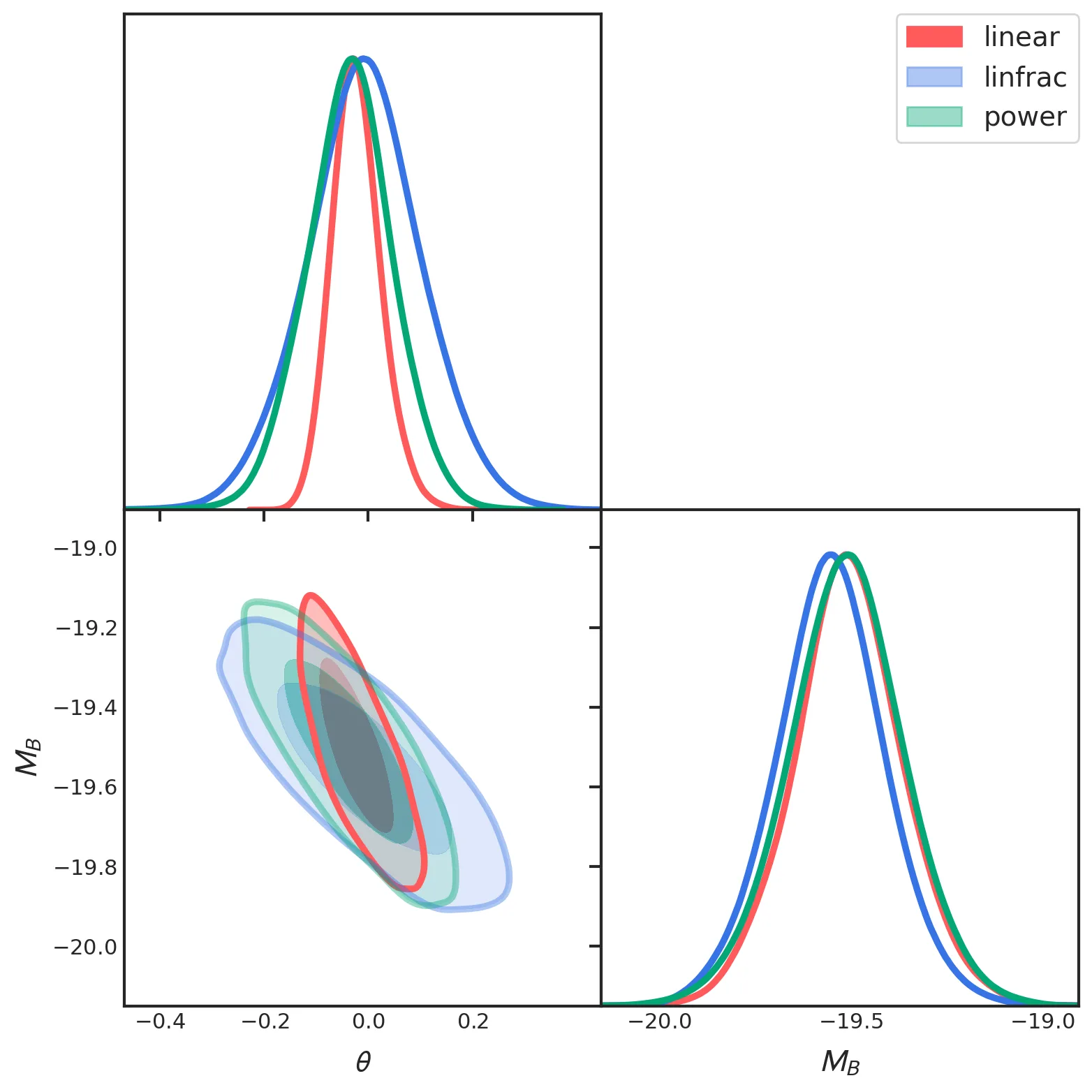
In this study, scientists took supernova data from the Pantheon+ survey and compared them with distances calculated from fast radio bursts using neural networks. The neural network helped reconstruct how radio waves are 'delayed' along their path due to intervening matter, and convert that into distances. The main result: no deviations from the expected relationship between brightness and size were found. The cosmos is honest.
Additionally, they managed to estimate how much matter lies directly near the sources of radio bursts — in their host galaxies. This number is important for future cosmological studies. For now, the precision is modest, but the method promises to become a powerful tool as more data accumulate.
Original abstract
as written by the authors arXiv:2602.16869
We test the Etherington cosmic distance-duality relation (CDDR), by comparing Type Ia supernova (SNIa) luminosity-distance information from the Pantheon+ compilation with an angular-diameter-distance reconstructed from localized Fast Radio Bursts (FRBs). The core of our methodology is a data-driven reconstruction from FRBs using artificial neural networks (ANNs): we infer a smooth mean extragalactic dispersion-measure relation and use its redshift derivative to recover $$H(z)$$ and hence $$D_\mathrm{A}^{\rm FRB}(z)$$ without assuming a parametric form for the expansion history. Possible deviations from CDDR are parameterized through three one-parameter models of $$\eta(z)\equiv D_\mathrm{L}/[(1+z)^2D_\mathrm{A}]$$. We implement two complementary likelihoods: (i) a direct approach using individual SNIa with the full Pantheon+ covariance, and (ii) a machine-learning approach in which we reconstruct the SN Hubble diagram on the FRB redshift grid, propagating SN and FRB uncertainties into non-diagonal covariance matrices via Monte Carlo and bootstrap realizations. Within the FRB reconstruction, we anchor the mean extragalactic dispersion measure at $$z=0$$, which yields a data-driven constraint on the average host/near-source contribution $$\mathrm{DM}_{\rm host}=128.8\pm 34.1\,\mathrm{pc\,cm^{-3}}$$ ($$3\sigma$$ of statistical confidence). We find that both likelihood implementations give consistent posteriors and no statistically significant evidence for departures from CDDR at the current precision.
A fast radio burst can outshine an entire galaxy, even though it lasts less than the blink of an eye.
In Carl Sagan's novel 'Contact', the alien signal also arrives as a series of short radio pulses — somewhat similar to real fast radio bursts.