The Pantheon+ catalog is a comprehensive collection of type Ia supernovae — the explosive deaths of white dwarf stars — that astronomers use as 'standard candles' to measure cosmic distances. Because these explosions have a known intrinsic brightness, comparing their apparent brightness from Earth reveals how far away they are, and by extension, how fast the universe was expanding at the time the light was emitted. The catalog compiles thousands of such supernovae across a wide range of distances, making it a cornerstone dataset for modern cosmology.
History
The Pantheon+ catalog is an extension of the earlier Pantheon dataset, released in 2018 by a team led by Dan Scolnic and Adam Riess. The updated version, published in 2022, includes additional supernovae and improved calibration methods, refining measurements of cosmic expansion.
How it works
Type Ia supernovae occur when a white dwarf in a binary system accretes matter from its companion until it reaches a critical mass and detonates. The key is that this critical mass is nearly identical for all such events, so their peak luminosities are remarkably uniform. By measuring the light curves and spectra of these supernovae, astronomers can correct for small variations and derive precise distances. The Pantheon+ catalog combines data from multiple surveys, standardizing the measurements to create a single, large sample that maps the expansion history of the universe over billions of years.
In practice
It is used to constrain cosmological parameters, particularly the Hubble constant (the current rate of expansion) and the equation of state of dark energy, helping to resolve the 'Hubble tension' — the discrepancy between local and early-universe measurements of expansion.
Fun fact
The catalog includes supernovae so distant that their light has been traveling for over 10 billion years, allowing astronomers to see the universe when it was less than a quarter of its current age.
In a quiet back alley of a galaxy, where stars are rare and old, a light suddenly flares up, brighter than an entire galaxy. This is a Type Ia supernova: a thermonuclear explosion of a white dwarf that astronomers use as a standard candle to measure cosmic distances.
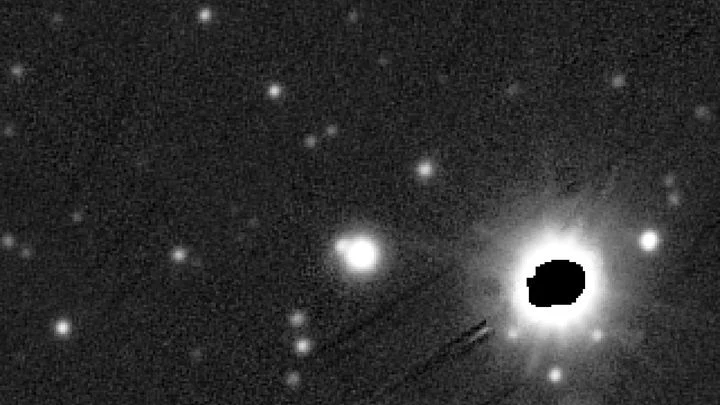
In the dense galaxy cluster Abell 2744, where gravity bends light like a lens, the James Webb Space Telescope spotted a new point of light. It appeared in images from 2023 and then began to change brightness. It was a supernova, the explosion of a dying star, but not just any kind: a Type IIP.
17 supernovae from the ZTF DR2 sample lit up ahead of schedule. In the first hours and days after the explosion, they emitted more light than standard models predict. Astronomers compare this to a Bickford fuse: before the blinding flash tears across the sky, a precursor spark runs through the outer layers.
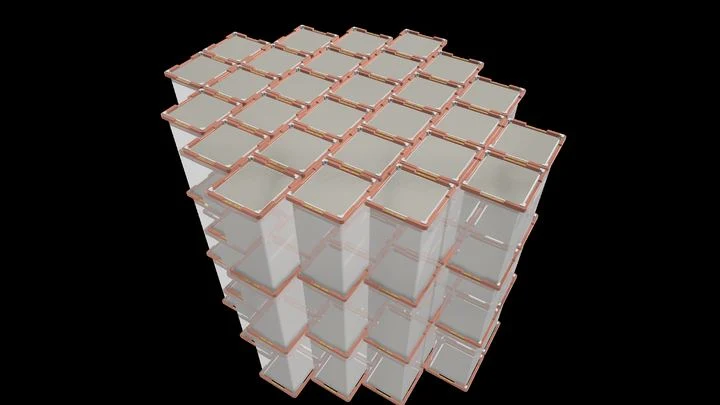
Deep underground, in the silence of a cryostat (a cooled container), lie crystals of lead that once belonged to an ancient Roman ship. This material barely emits background radiation — over two thousand years, unstable isotopes have decayed, leaving it perfectly clean for hunting the rarest events.
On August 6, 1181, Chinese astronomers spotted a new star in the constellation Cassiopeia. It shone for 185 days, slowly fading, and then vanished, leaving only a record in the chronicles. Today, at its location, there is a hot white dwarf — a compressed stellar core with no nuclear reactions, heated to tens of thousands of degrees.
The hunter of ancient light, the James Webb Telescope, aimed its mirrors at a tiny patch of sky and caught a strange beacon. The object, with the working name beacon_1420-$$5253_{4770}$$, flashed and faded. At first, it was logged as a candidate for the most distant galaxy, as if we were seeing it just 300 million years after the big bang.
A neutron star is the collapsed core of a massive star, squeezed to the size of a city. A teaspoon of its material weighs as much as a mountain. But inside this superdense sphere, a surprise may lurk: under unimaginable pressure, neutrons break apart into quarks, giving the star a new, more compact core.
Gravity isn't just the force that keeps us on the floor. On cosmic scales, it conducts galaxies, bends light rays, and decides the fate of everything. A century ago, Einstein described it as the curvature of space and time.
The cosmological orchestra doesn't tune to a single tuning fork. There are two groups of instruments: one listens to the hum of the young universe — the cosmic microwave background, while the other reads notes from mature galaxies and supernovae.
The universe is full of the invisible. We know about dark matter from galaxy rotation and gravitational lensing, but its nature has eluded us for a century.
Galaxies without dark matter are like beads from which the invisible thread has been ripped. Stretching around the elliptical NGC 1052 is a chain of eight ghostly dim dwarfs: they contain almost none of the mysterious mass that makes spiral arms rotate. Vera Rubin first showed that without the invisible framework, stars would fly apart.
A campfire that always blazes up to the same temperature — whether you toss a match into the center of a log or light several kindling sticks at the edges. That's roughly how Type Ia supernovas behave: cosmic explosions that astronomers use as rulers to measure distances across the universe.
Imagine inflating a balloon. It expands quickly at first, then slows down, and then suddenly speeds up again, as if someone gave the pump another squeeze. That's what seems to be happening to our universe.
Two lamps in a shop window: one glows with a cool, bluish light, the other a bit warmer and yellower. That's roughly how the two types of supernovae, Ib and Ic, look when astronomers view them through a telescope.
Conventional dark matter detectors are like a soccer goalkeeper waiting for a powerful shot while the ball barely rolls. The invisible particles filling our galaxy often move too slowly to be noticed by sensitive sensors.
The Sun constantly flares up like a campfire when you toss in more kindling. Big flares are obvious at once, but weak ones easily get lost in the overall glow. The neural network was taught to pick out even barely noticeable bursts from the stream of data that satellites send every second.
From 2018 to August 2025, the algorithm found 111,580 flares.
A massive star's explosion is bright but brief. The flash itself lasts weeks, but the dust it heats around it glows in infrared for years. It's like a camera flash illuminating a room, then hot dust particles lingering in the air — only on a cosmic scale.
Cosmologists have measured how fast distant galaxies are receding in different parts of the sky. To do this, they used two kinds of "cosmic rulers": galaxy clusters and a certain type of supernova explosion. Both methods showed the same thing: in one direction, the Universe is expanding slightly faster than in the opposite direction.
When a massive star explodes, its remnants fly apart like fragments of fireworks. But how do we know how far away such an explosion occurred? Astronomers have found a way: they look at the gas clouds that these remnants collide with.
The idea is simple. Supernova remnants are often surrounded by clouds of cold molecular gas.
A glass marble in a glass of water is nearly invisible, but if you look through it at a checkered tablecloth, the lines behind it appear distorted. Transparent cells behave the same way: light passes through them but is slightly slowed and changes direction.
A distant galaxy birthing hundreds of stars should glow in oxygen. That's what astronomers thought: hot young stars heat the gas, which then emits a characteristic infrared glow at a wavelength of 63 microns. It's like steam rising from a boiling pot — a sure sign of vigorous activity.
Light from a distant star travels to us for billions of years, and during that time the universe has time to expand. How can we check that we correctly understand this journey? Astronomers use two 'rulers': supernova explosions, which shine with a known brightness, and fast radio bursts — short, powerful pulses of radio waves from other galaxies.
An aging star sheds its outer layers, leaving behind a dense, hot core the size of Earth — a white dwarf. If remnants of planets, asteroids, or comets orbit nearby, they heat up and begin to glow in the infrared. That extra light is like a warm spot on a cold floor.
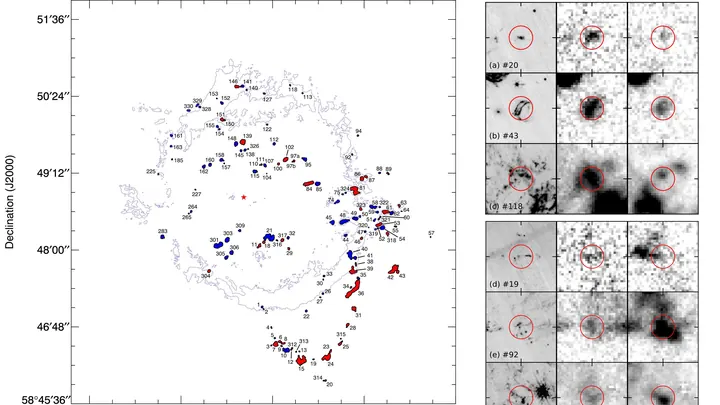
In 2013 and 2020, the same telescope in Hawaii looked at the remnant of an exploded star — Cassiopeia A. The images were taken in the light of glowing iron, as if photographing invisible streams of metal flying through space.
Over seven years, astronomers found 263 dense clumps — debris ejected by the explosion.
Dark matter is like an invisible glue that holds galaxies together. It emits no light, but if its particles collide, gamma rays can flash. Scientists hunted for such flashes in dwarf galaxies — small stellar clusters with lots of dark matter and almost no ordinary matter.
When a distant star explodes, its light travels toward us for billions of years. Astronomers measure how dim it appears and use that to calculate the distance. Usually, this involves complex models with dark energy and other mysteries.
Some superluminous supernovae show a bright oxygen imprint in their light and expand rapidly, while others do not. It seemed like different phenomena. But supernova PTF12dam broke the rules: as its brightness grew, its oxygen signature changed, shifting from one type to another.
Type Ia supernovae are the 'standard candles' of cosmology: their peak luminosity is nearly identical, allowing distances to be determined from apparent brightness — the fainter the object, the farther away it is.
A firefly blinks for one ten-billionth of a second somewhere above the Siberian taiga. Seeing such a thing is impossible, but the TAIGA-HiSCORE array, spread across a valley in the Tunkinsky district of Buryatia, tried to catch exactly such flashes — not from insects, but from the depths of space.
Deep in the Siberian taiga, there are a hundred light traps: each about the size of a small table, but together they cover a square kilometer. At night, these traps gaze at the sky, catching faint flashes of light born when cosmic particles slam into the atmosphere. The setup is called TAIGA-HiSCORE, and it usually works as a giant "eye" for such particles.