Charge Ripples That Outlived Order express
In some crystals, electrons line up into a wave, like ripples on the surface of water, but made of charge. Usually, such a wave exists only in extreme cold. But in this experiment, scientists saw that traces of the wave persist even at room temperature.
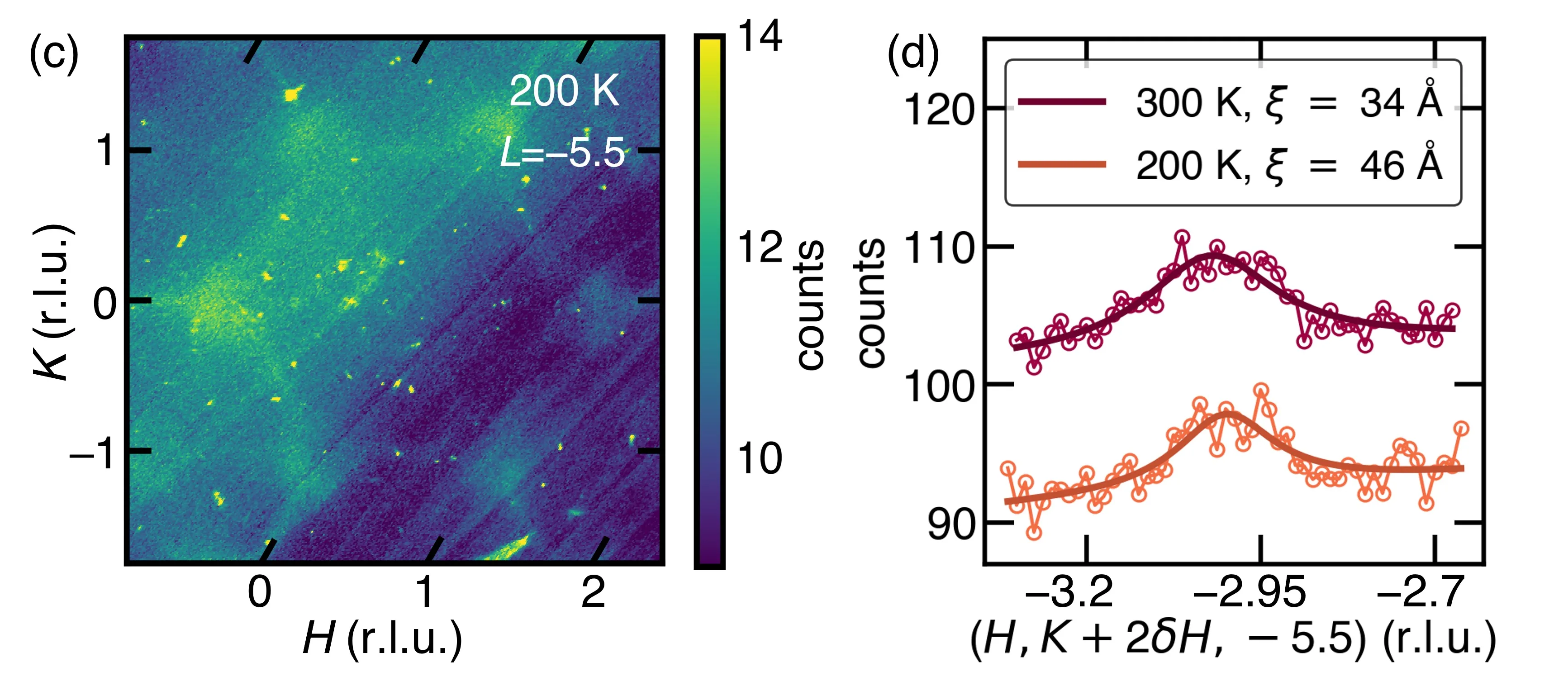
The researchers took a CsV$_3$Sb$_5$ crystal, added tin to it, and monitored the reflection of ultrashort laser pulses. From the vibrations of the lattice atoms, they deduced that the charge 'ripple' hadn't disappeared entirely: it had simply become disordered and frozen. The tin impurity acts like grains of sand that prevent the wave from moving freely, so it freezes in place.
So, in these crystals, the 'memory' of the charge wave lives much longer than previously thought. And this is not an exception but a general property of an entire family of materials.
Original abstract
as written by the authors arXiv:2602.17915
In this work, we perform ultrafast time-resolved reflectivity measurements to track the evolution of charge density wave (CDW) correlations in Sn-doped Kagome superconductor CsV$$_3$$Sb$$_{5-x}$$Sn$$_x$$. By extracting the coherent phonon spectrum, we evidence robust signatures of CDW correlations at temperature and doping ranges far beyond the phase boundary of long-range CDW order. Remarkably, we unveil short-range CDW correlations survive up to room temperature in $$x = 0.32$$ Sn-doped CsV$$_3$$Sb$$_5$$, supported by synchrotron X-ray diffraction measurements. We point out the introduction of quenched disorder by Sn doping can pin the CDW and form static short-range CDW, which can explain the observed persistent CDW signatures. Our results thus corroborate the ubiquity and robustness of CDW correlations in Sn-doped CsV$$_3$$Sb$$_5$$ and provide new insights on the role of disorders on the CDW correlations in AV$$_3$$Sb$$_5$$ family.
The laser pulse in this experiment lasts only a few femtoseconds — less than one millionth of one billionth of a second. In that time, light travels a distance smaller than the thickness of a human hair.