Hydrogen Flame: Measuring Its Hidden Power express
Someone starts crumpling a flat sheet of paper. At first, a few creases appear, then they spread across the entire surface, and the sheet is no longer flat but rough. A hydrogen flame behaves similarly: in a calm gas flow, it is smooth and tilted at a single angle, but changing the mixture composition causes the surface to break into cells and wrinkles. This phenomenon is called thermodiffusive instability: light hydrogen quickly escapes the combustion zone, and heat propagates differently than fuel molecules, so the planar front spontaneously begins to curve.
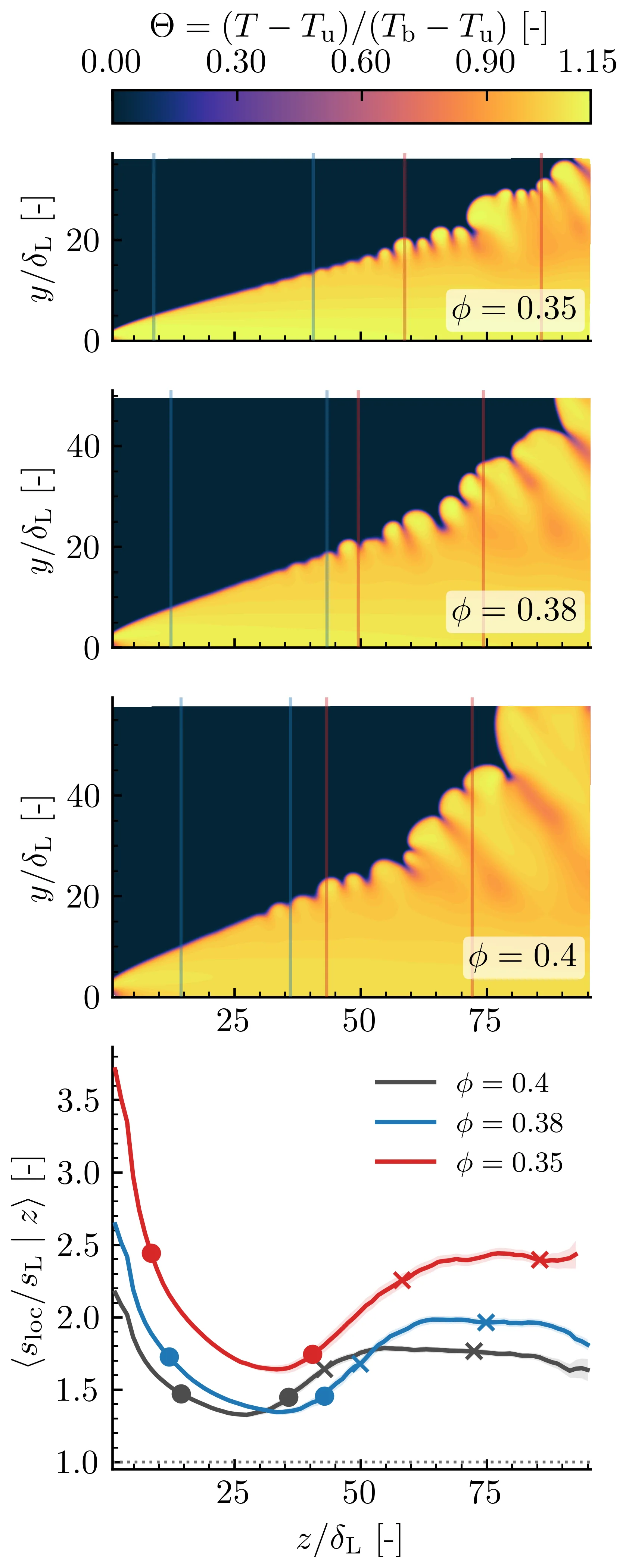
The scientists anchored the flame on a thin rod to keep it from blowing away, and directed a flow of premixed hydrogen and air onto it. While the mixture is lean (little hydrogen), the flame remains smooth, like taut fabric. But adding a bit more hydrogen causes it to abruptly transition downstream to a crumpled state, just like paper crumpled from one edge. From the flame's tilt, one can calculate how much faster it began to burn: the angle relative to the flow increases, visible in photographs.
To determine how many times the burning speed increased, measuring the tilt is not enough — one must also account for how much the flame's surface area grew due to wrinkles. Three different methods were used to estimate the area, all giving similar results. It turned out that for a very lean mixture (fuel-to-air ratio 0.35), the speed increases by a factor of 1.1–1.3, while for a slightly richer one (0.40), it actually drops to 0.8–0.9 of the original. This matches theoretical predictions and computer simulations.
Such precise measurement is important for future engines: hydrogen burns without soot or carbon dioxide, but its flame is prone to instability. If we learn to control this wrinkling, we can make burners more efficient and safer. For now, the flame on the rod is like a laboratory sheet of paper, showing every crease.
Original abstract
as written by the authors arXiv:2603.18852
This study introduces a novel experimental configuration using OH-PLIF imaging to directly determine the stretch factor ($$I_0$$) in laminar premixed hydrogen flames transitioning from a quasi-stable to a thermodiffusively unstable regime. A rod-anchored V-flame is stabilised in a laminar premixed reactant flow. Near the anchoring rod, the mildly strained flame remains quasi-stable, exhibiting a smooth surface and a well-defined inclination angle ($$\theta_{\mathrm{s}}$$) to the main flow. This stable branch is associated with a burning rate $$S_{\mathrm{s}}$$. Farther downstream, the flame abruptly transitions to a regime dominated by thermodiffusive (TD) instabilities, characterised by cellular structures and a wrinkled surface. The distance between this transition and the anchor decreases with increasing equivalence ratio. This TD-unstable branch exhibits a larger mean flame-surface angle ($$\theta_{\mathrm{u}}$$), enabling direct determination of the flame-speed increase, $$S_{\mathrm{u}}/S_{\mathrm{s}}$$. It is assumed that this ratio represents the normalised flame consumption speed, $$S_{\mathrm{c}}/S_{\mathrm{L}}$$. Determination of $$I_0$$ additionally requires the increase in flame-surface area caused by the thermodiffusive instabilities. Three complementary methods are therefore used to evaluate the surface area of the TD-unstable branch ($$A$$) relative to a smooth reference area ($$A_0$$), yielding consistent trends in $$A/A_0$$ over the investigated equivalence-ratio range. The resulting $$I_0$$ values, with the main uncertainty arising from $$A$$, decrease monotonically with increasing equivalence ratio, from about 1.1--1.3 at $$\phi=0.35$$ to 0.8--0.9 at $$\phi=0.40$$, consistent with theoretical predictions. Additional numerical simulations in a reduced two-dimensional representation reproduce the same transition behaviour and yield qualitatively consistent results.
Hydrogen is the lightest gas, and its flame is nearly invisible during the day: it is blue and transparent. That's why hydrogen plants use special sensors to detect leaks in time.
In Andy Weir's novel 'The Martian', the protagonist obtains water from hydrogen fuel by burning it with oxygen, but there the flame behaves calmly, while in reality it can suddenly break into cells.