A flux constant is a proportionality factor that relates the flux of a physical quantity (such as energy, particles, or field lines) to the source strength or the gradient that drives the flux. It is a characteristic parameter of a system, often depending on the geometry and material properties, and it appears in equations like Fick's law for diffusion, Fourier's law for heat conduction, and Ohm's law for electric current. The flux constant essentially quantifies how efficiently a medium transmits the quantity in question.
History
The concept of a flux constant emerged in the 19th century with the formalization of Fourier's law of heat conduction (1822) and Fick's law of diffusion (1855), and it was later generalized to other transport phenomena.
How it works
In a typical transport equation, the flux J is given by J = -k ∇φ, where φ is the potential (e.g., concentration, temperature, or voltage) and k is the flux constant (also called the transport coefficient). The negative sign indicates that flux flows from high to low potential. The value of k is determined by the microscopic properties of the medium, such as the mean free path of particles or the thermal conductivity, and it can be measured experimentally or derived from statistical mechanics.
In practice
Flux constants are essential in engineering for designing heat exchangers, in environmental science for modeling pollutant dispersion, and in electronics for calculating current flow in semiconductors.
Fun fact
In some systems, the flux constant is not a constant at all but depends on the local conditions, leading to nonlinear transport equations that describe phenomena like turbulence and shock waves.
Membraneless organelles, tiny factories inside the cell, defy conventional rules. Take the nucleolus: here ribosomal RNA is synthesized — long chains woven from carbon sugars, rich in oxygen phosphate groups, and stitched with hydrogen bonds, suspended in the watery environment of the nucleus.
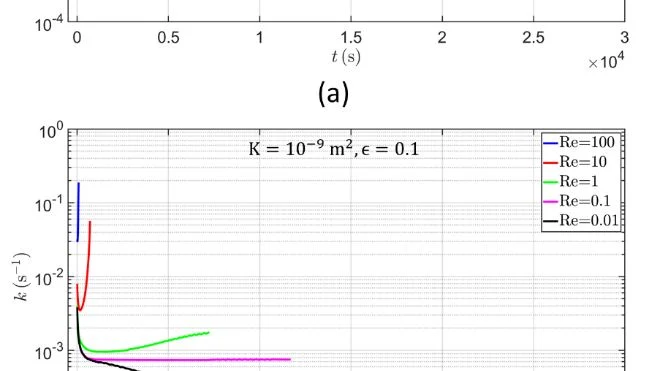
A porous implant filled with a drug works like a sponge that slowly releases the substance into the surrounding fluid. But if the fluid flows quickly, it washes out the drug differently than in a calm environment. The authors computed on a computer how different flow rates and properties of the porous structure affect drug release.
Toss a handful of sand on the floor: there are few large grains, many medium ones, and even more tiny ones. This skew, where small events are common and large ones are rare, is described by a power law. It shows up in city sizes, earthquake magnitudes, and citation counts of scientific papers.
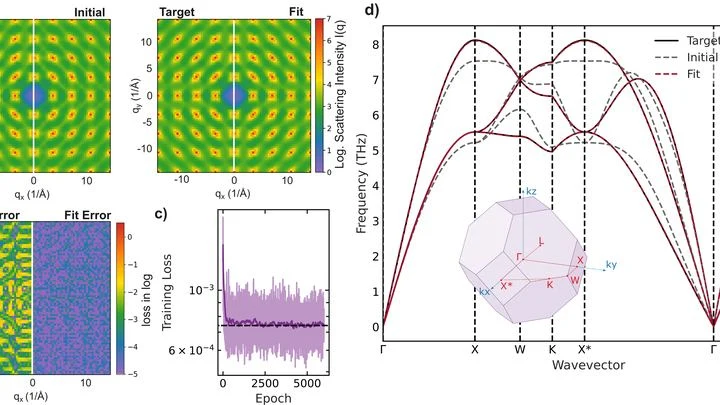
Heat a crystal, and its atoms start to jiggle like plucked strings. An X-ray beam passing through the crystal scatters off these vibrations, painting on the detector not only sharp spots but also faint, smeared patterns. These patterns are like fingerprints: from them, you can reconstruct how strongly atoms pull and push on each other.
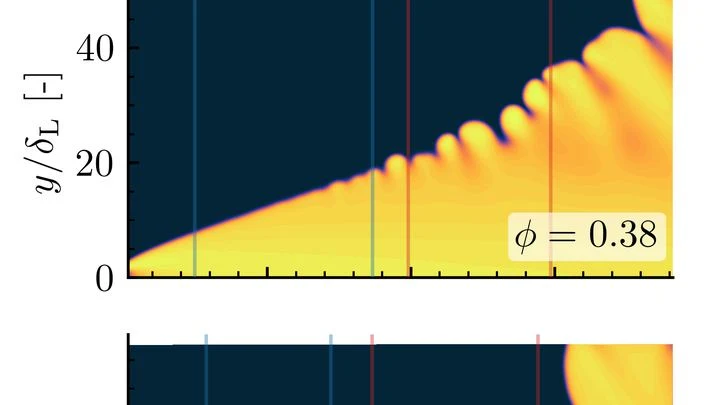
Someone starts crumpling a flat sheet of paper. At first, a few creases appear, then they spread across the entire surface, and the sheet is no longer flat but rough. A hydrogen flame behaves similarly: in a calm gas flow, it is smooth and tilted at a single angle, but changing the mixture composition causes the surface to break into cells and wrinkles.
A cell is a city with gates. Each gate is a protein channel in the membrane: through it, ions, sugars, and signaling molecules pass in and out. Some gates are almost always open, while others open and close randomly, like subway doors that let a passenger through one moment and slam shut in their face the next.
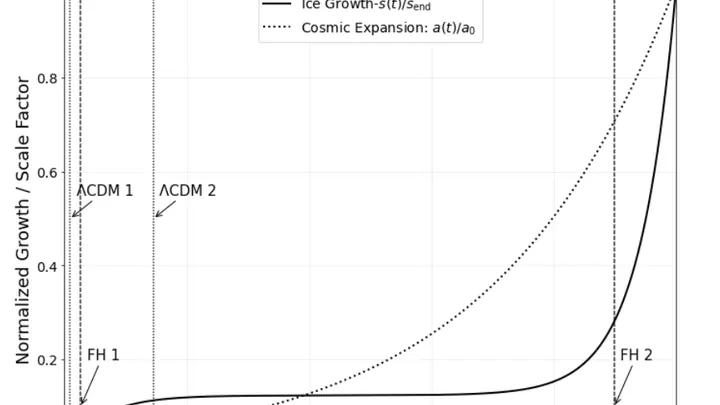
In winter, a lake freezes over, and this simple process turns out to be a living model of an expanding universe. Ice thickness grows according to the same mathematical law as the distances between distant galaxies.
The secret lies in the movement of water beneath the ice crust.
A pot of water heated from below is a simple example of turbulence. Hot fluid rises, cold fluid sinks, and the flow spontaneously breaks into rotating cells that look like horizontal rolls. In a new study, physicists took a wide rectangular container (ten times longer than its height) and tracked how many such rolls appear.
The diffusion equation, a mathematical tool describing how particles spread out in space, has long painted a paradoxical picture: a disturbance, like ripples on Water, instantly engulfs the entire universe. This challenged the theory of relativity, which holds that nothing can move faster than light.
When water churns behind a boat, the energy of motion is converted into heat through a cascade of vortices. Measuring how quickly this happens directly is difficult: you'd need to track all the vortices at once. So scientists use a simplification: they look at only one velocity component at a single point.
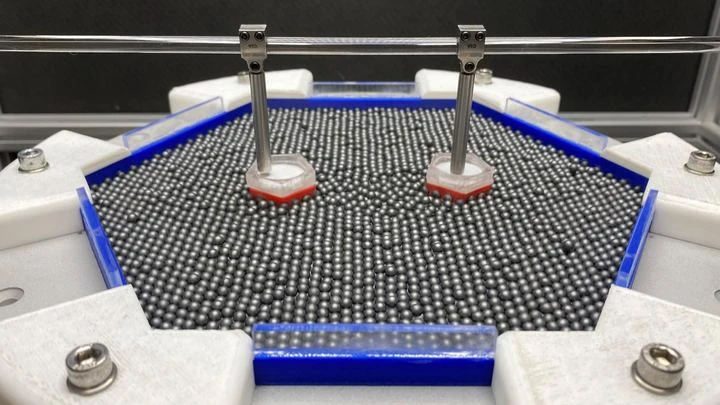
Shake a jar of sand and marbles, and you'll see large objects float or sink depending on their size. But if you shake it cleverly, you can make the marbles gather into pairs and chains, as if glued together. It's this kind of 'invisible glue' that physicists from India and Germany have now caught and measured for the first time.
Every machine, whether a car engine or a tiny nanocooler, runs with a jitter. Fuel burns unevenly, electrons slip through contacts off schedule, and the power needle on your instruments vibrates slightly. These vibrations are called fluctuations. They are not just noise: they tell you how stable a device is and how much energy it wastes.
Neutrinos are the most elusive of all known particles. Every second, trillions of neutrinos from the Sun fly through your body, but you never notice: they barely interact with matter. To catch even one, physicists build giant detectors — pools of water or liquid argon deep underground.
Drop honey onto a sponge. It lazily creeps, avoiding the voids. But if the honey becomes thinner under pressure, the flow gets trickier. Liquid with variable thickness in an uneven labyrinth of pores — a problem that had defied calculation. The authors of the new work averaged the chaos of microchannels into simple equations.