Thermal boundaryresistance, also known as Kapitza resistance, is the resistance to heat flow that occurs at the interface between two different materials. Even when two surfaces are in perfect contact, the difference in their atomic vibrations (phonons) and electronic properties makes it difficult for heat to pass directly across the boundary. This effect becomes especially significant at microscopic scales, where interfaces dominate the overall thermal behavior of a system.
Heat is carried through solids primarily by phonons (quantized lattice vibrations) and electrons. At an interface, a phonon arriving from one material must either transmit into the other material or reflect back. Because the two materials have different vibrational spectra and acoustic impedances, many phonons are reflected, creating a temperature drop at the boundary. The resistance is quantified as the ratio of this temperature discontinuity to the heat flux across the interface.
In practice
Thermal boundaryresistance is a critical factor in cooling microelectronics, such as computer chips, where heat must pass through many material interfaces; it also affects the design of thermal interface materials, thermoelectric devices, and cryogenic systems.
Fun fact
In some cases, thermal boundaryresistance can be reduced by adding a thin intermediate layer with intermediate properties, acting like a 'bridge' for phonons.
In a superconductor, where electrons move in pairs without resistance, special waves can run along the edges, like ripples along the edge of a carpet. The number of such waves is an important characteristic of the material, but measuring it directly is difficult.
A superconducting quantum interferometer is a device that senses magnetic fields billions of times weaker than the needle of an ordinary compass. Inside it, there is a narrow bridge where superconductivity briefly breaks.
Drop a pebble into a pond, and ripples spread across the water. In much the same way, any body, even the tiniest, perturbs the gravitational field around it. In empty, cold space, these perturbations, like ripples on a calm surface, make two nearby objects always repel each other.
In a crystal, heat travels on waves. Atoms vibrate, and these vibrations, called phonons, carry energy from the hot edge to the cold one. For a long time, it was believed that if phonons hit resonance (their frequencies exactly match) and can exchange energy, heat would flow like an avalanche. It turns out that's not the case.
The classical Mpemba paradox — hot water freezes faster than cold — has teased scientists for centuries. Only recently has nonequilibrium statistical mechanics explained it: it’s all about boundary conditions; the system seems to seek an excuse to “hit the wall” and speed up cooling.
In the first moments of its life, the Universe resembled a boiling cauldron. As it cooled, phase transitions occurred — much like steam turning into water, but instead of molecules, the very state of space changed. In this cauldron, bubbles of the new phase were born, akin to bubbles in a pot coming to a boil.
Two-dimensional worlds never cease to amaze: here even crystal melting is not a symmetry breaking but a vortex drama discovered by Kosterlitz and Thouless. At the heart of this theater are topological сингулярности, whose energy and энтропия bargain for order. This language is common to сверхтекучести и сверхпроводимости.
If you stick two identical thermometers into a pot of hot water, they'll both read the same, and we relax, thinking the temperature is measured correctly. But in a rarefied gas heated to millions of degrees, this trick stops working.
A bridge of aluminum just a few atoms thick is the heart of many quantum devices. Current flows through such a bridge without resistance, and it can be controlled with a magnetic field. These bridges are called Josephson junctions, after the British physicist who described their behavior.
Superconductivity is when electric current flows without losses, like water through a perfectly smooth pipe. It usually occurs at very low temperatures, but there are materials where it appears at higher ones.
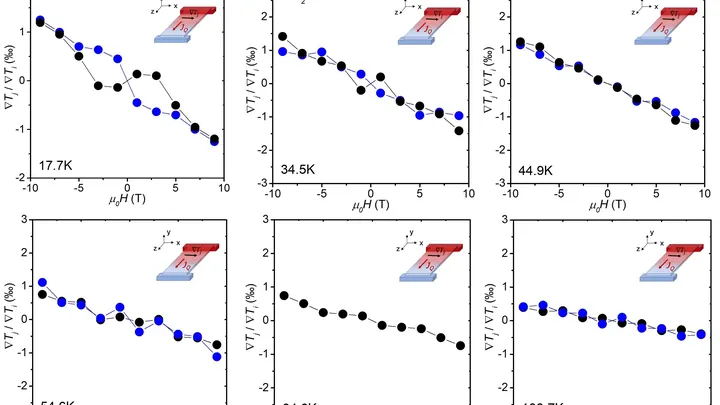
In an insulating crystal, heat usually flows from the hot end to the cold end. But when you switch on a magnetic field, part of the heat flow veers sideways, like water running down a slope that drifts to the side when the wind pushes it. This behavior is called the thermal Hall effect.
The Mpemba effect is surprising: hot water sometimes freezes faster than cold. Scientists built a simple model: a bead in a thick, honey-like medium, on a landscape with two dips and a wall at the edge. The bead moves viscously, unable to hop over the central bump.
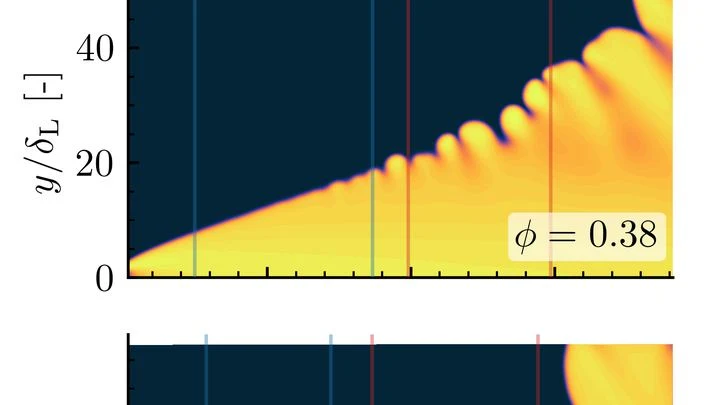
Someone starts crumpling a flat sheet of paper. At first, a few creases appear, then they spread across the entire surface, and the sheet is no longer flat but rough. A hydrogen flame behaves similarly: in a calm gas flow, it is smooth and tilted at a single angle, but changing the mixture composition causes the surface to break into cells and wrinkles.
A hot chain of atoms lined up in a row behaves like a tiny black hole. Such a chain is a series of particles, each resembling a tiny magnet. At normal temperatures, the little magnets flip randomly, but when cooled, they align in a uniform order. Physicists have discovered that when heated, this simple system reproduces the strange properties of black holes.
A magnet that stacks up like a pile of pancakes: that's how the material CrSBr is structured. At low temperatures, each layer is magnetized, but neighboring layers point in opposite directions, and their magnetic fields cancel each other out. This order is called antiferromagnetic, and it's fragile: just a slight warming demagnetizes the layers.
Electronics get hot. The more powerful the processor, the more heat you need to get rid of, or it will fail. One bottleneck is the boundary between two materials: heat hits it like a seam between tiles and slows down.
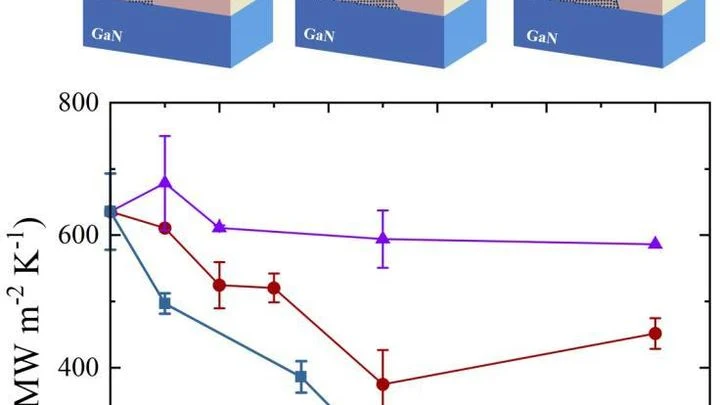
Inside a high-power transistor, heat escapes through junctions between different crystals, like water through narrow locks. For aluminum and gallium nitrides, key materials in power electronics, that lock is often a thin layer of their alloy. It is added deliberately or forms on its own during crystal growth.