The gas constant (R) is the proportionality constant that links the energy scale of a gas to its temperature in the ideal gas law, PV = nRT. Its value is approximately 8.314 joules per mole per kelvin, meaning that one mole of an ideal gas at 300 K has about 2,500 joules of thermal energy. It appears in thermodynamics, physicalchemistry, and statistical mechanics, connecting macroscopic quantities like pressure and volume to microscopic molecular motion. The gas constant is also the product of the Boltzmann constant (k_B) and Avogadro's number (N_A): R = k_B × N_A.
History
The ideal gas law was developed over the 17th–19th centuries by Boyle, Charles, Gay-Lussac, and Avogadro, but the constant R was first explicitly introduced by the French physicist Henri Victor Regnault in the 1840s, who measured it accurately for different gases. The name 'gas constant' became standard in the late 19th century.
How it works
In the ideal gas law, R converts the product of the amount of substance (in moles) and temperature (in kelvin) into an energy, which then appears as pressure times volume (work). For a monatomic ideal gas, the average kinetic energy per molecule is (3/2)k_B T, and summing over a mole gives (3/2)RT. The constant R appears in the entropy change of an ideal gas, in the speed of sound, and in the Nernst equation for electrochemical cells. Its value depends on the units of pressure and volume used, but in SI it is fixed.
In practice
It is used in engineering for calculating the behavior of gases in engines, air conditioning, and chemical reactors, and in meteorology for atmospheric models.
Fun fact
The gas constant is the same for all ideal gases, but real gases deviate from it at high pressures — a fact that helped scientists develop more accurate equations of state like the van der Waals equation.
Deep inside Jinping Mountain, beneath two kilometers of rock, a proton beam slams into a cloud of gas. Previously, a thin foil stood between the accelerator and the target, like glass in a window. It slowed particles, smeared their energy, and obscured the rare nuclear reactions that power stars.
A proton beam aimed at a tumor cuts through soft tissue like a knife through butter, but its range depends on the subtle properties of water, the stuff we're mostly made of. Water is the body's main component, and how quickly protons slow down in it determines exactly where they deposit their energy.
The Kerr-NUT black hole is not just a cosmic vacuum cleaner. It's a solution to Einstein's equations where the hole has mass, rotation, and a strange NUT parameter. This parameter behaves like a magnetic charge for gravity: seemingly invisible, yet it alters the properties of surrounding space.
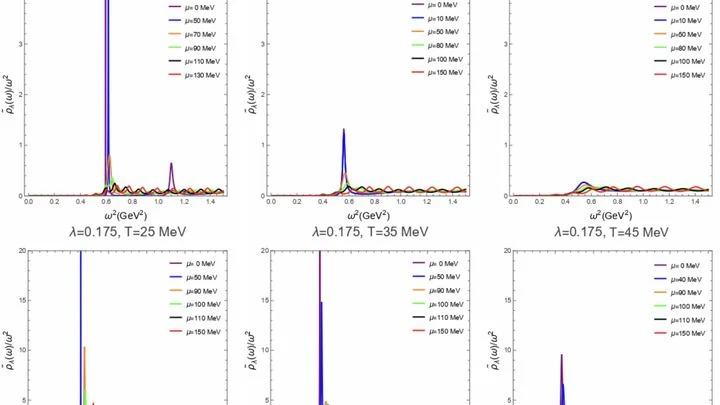
An ice cube in hot tea melts strictly at zero degrees. But what if the ice is made of subatomic particles and the tea is scorching nuclear matter? The authors studied the rho meson, a particle made of a quark and an antiquark that lives for just 4×10⁻²⁴ seconds, and searched for its 'melting temperature'.
If you pour sand into a glass, it settles in a flat layer. But instead of sand, take the tiniest particles of gas: in a gravitational field they don't just fall: each particle races along its own trajectory, collides with neighbors, and all this commotion creates pressure.
An aluminum pot on the stove melts at 660 degrees Celsius — everyone knows that. But what happens if you heat aluminum a hundred times hotter? The liquid starts to boil, and here's the puzzle: at what exact temperature does that happen?
Cosmic rays are particles that arrive from deep space. When such a particle hits the atmosphere, it triggers a whole shower of new particles, like a billiard ball breaking a rack, sending balls scattering in all directions. To predict what such a shower will look like, we need to know how the primary particle interacts with the nuclei of air atoms.
A doughnut-shaped magnetic trap holds plasma made of boron and hydrogen. Inside, the temperature rises above one hundred million degrees — hotter than the center of the Sun. At such heat, nuclei collide and fuse, releasing energy.
When a heavy nucleus slams into interstellar gas at enormous speed, it shatters into pieces. Those pieces (lithium, beryllium, boron) then fly onward, and their abundance in the cosmic-ray flux depends on how the breakup unfolded. Conventionally, one expected the proportions to shift smoothly with energy, like the taste of soup when you keep adding water.
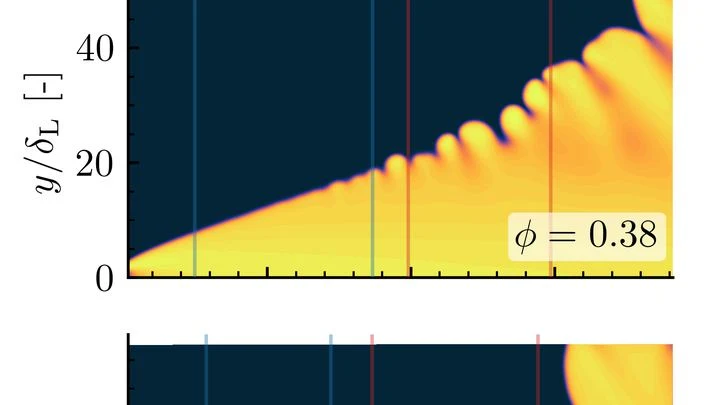
Someone starts crumpling a flat sheet of paper. At first, a few creases appear, then they spread across the entire surface, and the sheet is no longer flat but rough. A hydrogen flame behaves similarly: in a calm gas flow, it is smooth and tilted at a single angle, but changing the mixture composition causes the surface to break into cells and wrinkles.
A pot of water heated from below is a simple example of turbulence. Hot fluid rises, cold fluid sinks, and the flow spontaneously breaks into rotating cells that look like horizontal rolls. In a new study, physicists took a wide rectangular container (ten times longer than its height) and tracked how many such rolls appear.
Two laser beams cross at a tiny angle, and an invisible lattice appears in a cloud of rubidium atoms: some atoms are excited, others are not. Then this lattice begins to melt, like a pattern in the sand under the wind. Atoms collide with surrounding gas molecules and drift apart.
The speed of this blurring depends directly on the surrounding gas.
The neutron is a particle with no charge but with internal structure. Like a ball that looks smooth on the outside but has a complex filling inside. Scientists have long wanted to understand how electric and magnetic forces are distributed inside the neutron. To do this, you need to "feel" it — collide it with its antiparticle and see what happens.
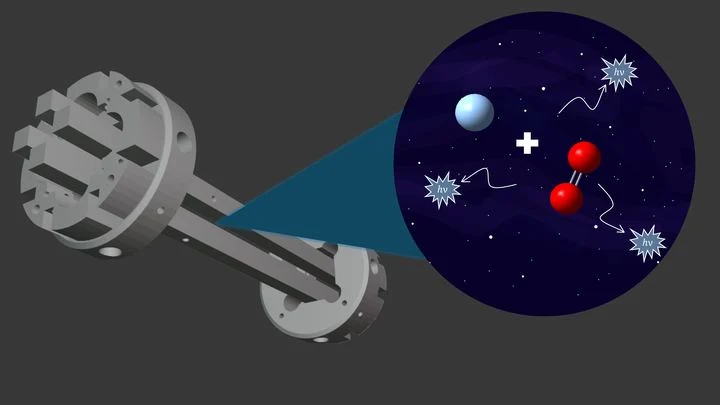
In the cold, sparse clouds of space, particles rarely meet, but sometimes an ion and a neutral molecule pass close enough to stick together. As they do, they emit light, like a muted flash carrying away excess energy. This process is called radiative association, and it is responsible for the formation of many molecules in interstellar space.
Galaxies in the Universe are not scattered randomly: neighboring ones move in the same direction, like a school of fish, while distant ones each go their own way. Where the boundary between 'together' and 'apart' lies has been unclear until now.
Just as in a crowded room each new person sharply increases the pressure on the walls, in a neutron star increasing density leads to a rise in internal resistance. But even this resistance has an absolute ceiling.