How Wave Shape Saves the Universe from Collapse express
In the first moments, the Universe was squeezed to tiny sizes. What keeps it from collapsing entirely into a point? One answer comes from quantum mechanics: the wave function describes all possible states, and particles move along hidden trajectories that depend on the shape of this wave.
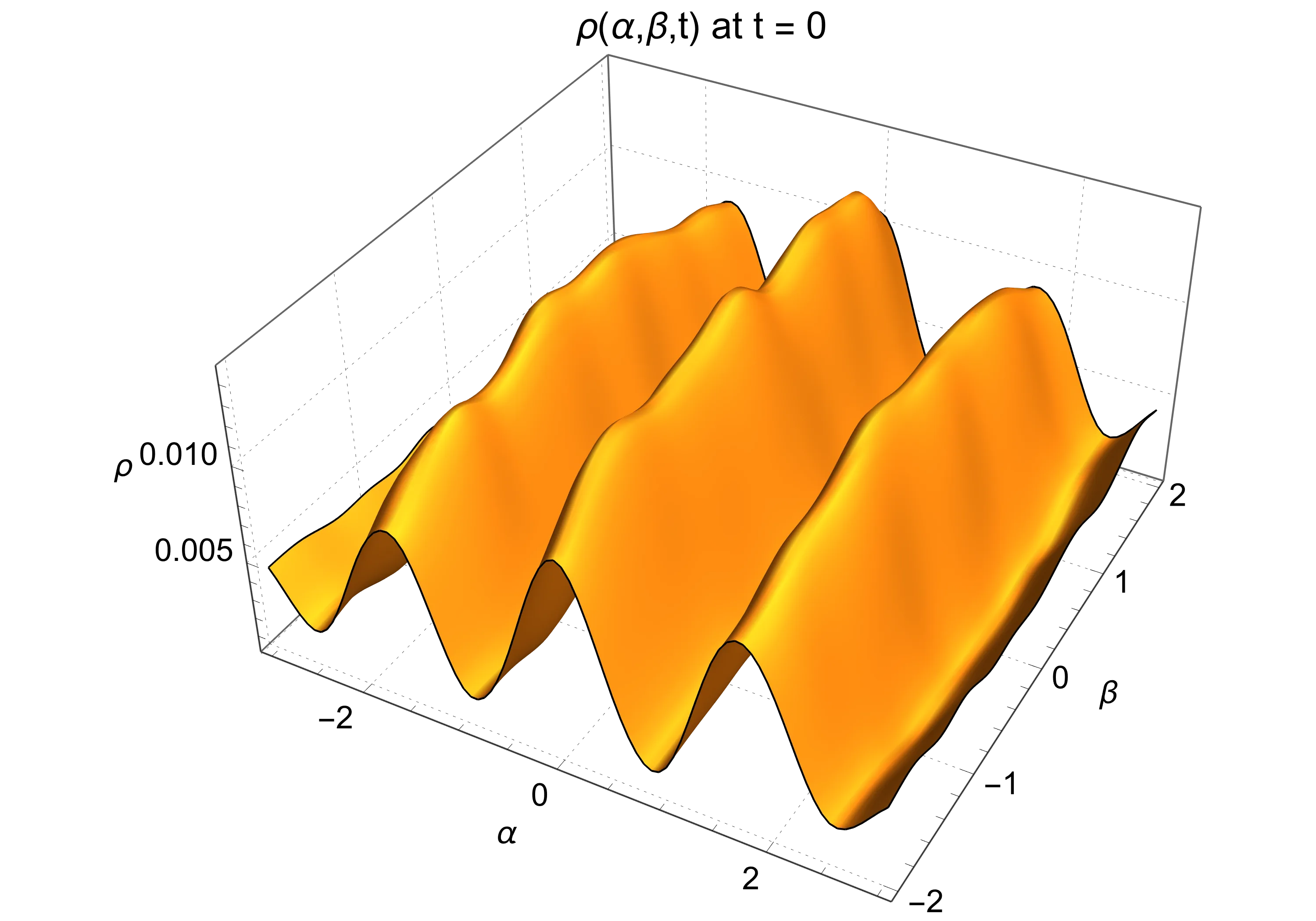
The authors took two simple shapes of wave packets — Gaussian (bell-shaped) and Lorentzian (with a long power-law tail). For each, they computed trajectories in mini-superspace — a simplified model of the Universe with flat symmetry. The Gaussian wave almost always leads to classical collapse into a singularity: only a small fraction of trajectories make small cycles. The Lorentzian wave, on the contrary, creates a strong quantum potential barrier and a rich velocity field, so a significant portion of trajectories experience a bounce and avoid singularity over a wide range of volumes.
Then they checked how quickly the probability distribution reaches equilibrium, as predicted by Born's rule. For the Gaussian wave, the trajectory flow is laminar: they accumulate near boundaries and do not mix, so the H-function (a measure of deviation from equilibrium) decreases non-monotonically and gets stuck at a nonzero level. The Lorentzian wave gives complex trajectories, monotonic decrease of the H-function, and better, though still incomplete, approximation to equilibrium.
It turns out that the very structure of the wave packet governs both the fate of the singularity and the speed of forgetting initial conditions. A Universe with a "heavy tail" in the wave function not only bounces more often but also reaches a typical quantum state faster. This is a step toward understanding why our world looks classical, even though quantum uncertainty lies at its core.
Original abstract
as written by the authors arXiv:2603.27229
We investigate cosmological singularity resolution and relaxation dynamics within the Bohmian mechanics via the plane-symmetric Bianchi type-I minisuperspace model in the Wheeler-DeWitt framework of quantum cosmology by constructing wave functions as Gaussian and Lorentzian wavepackets. Our analyses of the corresponding Bohmian trajectories reveal that Gaussian superposition predominantly yields classical singular solutions, with only a low fraction of small-amplitude cyclic trajectories. On the other hand, the Lorentzian wavepacket, characterized by the power-law momentum tail, generates stronger quantum potential barrier and a substantially rich velocity field, producing a significant fraction of non-singular bounce trajectories over extended volume ranges. We further examine quantum relaxation by evolving non-equilibrium distributions under the corresponding guidance dynamics. The Gaussian superposition exhibits laminar flow leading to boundary accumulation and incomplete relaxation, with non-monotonic decay of the $$H$$-function followed by saturation. In contrast, the Lorentzian wavepacket induces more complex trajectories, yielding monotonic decay of the $$H$$-function and better, though still incomplete, approach to Born-rule equilibrium. These results demonstrate that the inherent structure of the wave packet governs both singularity resolution and quantum relaxation through the nature of the Bohmian velocity field.
The Lorentzian wave packet has a power-law tail that decays much more slowly than the Gaussian one. It is this tail that is responsible for rare but strong deviations of trajectories — like in finance, where rare events with "heavy tails" change the entire market dynamics.