concept

quantum bounce

A quantum gravity mechanism where black holes avoid singularities through quantum repulsion effects.
39 related articles · 1 formulas

Description

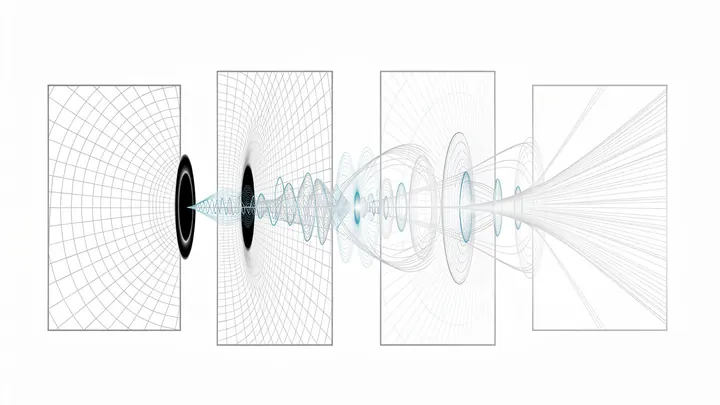
Quantum bounce is a proposed mechanism in quantum gravity that replaces the classical singularity at the center of a black hole (or at the Big Bang) with a finite, extremely dense but non-singular state. Instead of matter collapsing to an infinitely small point where known physics breaks down, quantum repulsion effects—arising from the discrete nature of spacetime—counteract gravity at extreme densities, causing the collapse to halt and then reverse into an expansion. This idea is central to loop quantum cosmology and related approaches, where the universe itself may have undergone a bounce rather than starting from a singularity.

History

The concept emerged from loop quantum gravity in the late 1990s and early 2000s, with key contributions by Martin Bojowald and later Abhay Ashtekar and colleagues, who applied it to cosmological models.

How it works

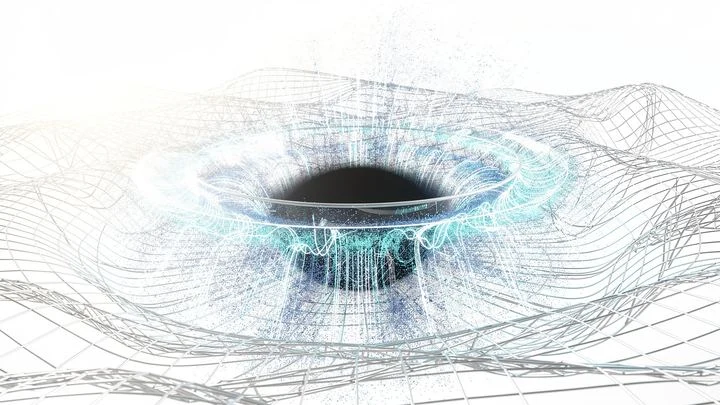
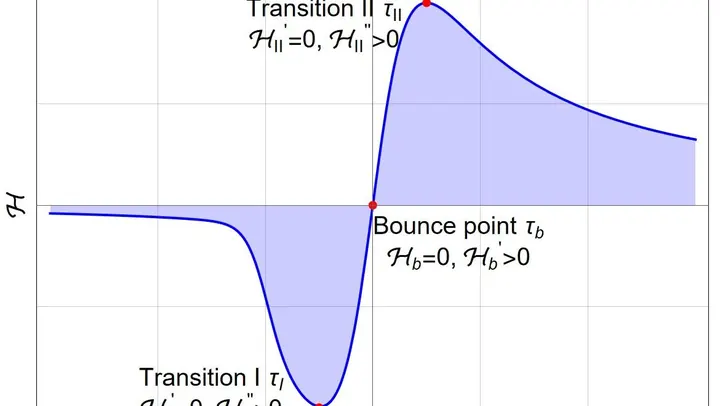
In classical general relativity, gravity becomes infinitely strong at a singularity. Quantum gravity theories, however, suggest that spacetime itself has a granular structure at the Planck scale (about 10^-35 meters). When matter is compressed to this scale, the quantum uncertainty in geometry generates a repulsive force, akin to the pressure that prevents an atom from collapsing. This force opposes gravitational attraction, stopping the collapse and triggering a rebound. The bounce is not a physical collision but a quantum transition from a contracting phase to an expanding one.

In practice

Quantum bounce models are used to study the early universe's homogeneity and the possible observational signatures of quantum gravity in the cosmic microwave background and gravitational wave data.

Fun fact

In some models, the quantum bounce could leave a detectable imprint on the polarization of the cosmic microwave background radiation, potentially observable with next-generation telescopes.

Concept graph →

Formulas

$$\Gamma \propto e^{-S}$$
Quantum tunneling rates are exponentially suppressed by the bounce action.
What is in the formula
\GammavariableTunneling rate (probability per unit time) — rate per second
SvariableEuclidean action of the bounce solution — action joule second
\proptooperatorIndicates proportionality — proportional to
e^{-S}operatorExponential function with exponent -S — exponential
\gamma/v=m^4e^{-s} · 2606.06587v1

Related articles · 39

General Relativity2026-08-061 minarXiv:2608.05818express
Black Hole Without a Singularity Emerges from a Dust Cloud
A homogeneous, spherical cloud of cosmic dust begins to contract under its own gravity. At some point, by classical laws, it should collapse into a point of infinite density — a singularity.
HEP Theory2026-08-052 minarXiv:2608.04745express
A Cold Black Hole and Quantum Chaos
In the far reaches of space, there exists a hypothetical object: an ultracold black hole. It is charged and resides in an expanding universe (de Sitter space). Its temperature hovers just above absolute zero — about one trillionth of a degree above it.
General Relativity2026-08-052 minarXiv:2608.05292express
Black Holes Without Singularities: What's Heard from Inside
A classical black hole is a bottomless well: everything that falls past the horizon disappears into a point of infinite density. But in loop quantum gravity (one approach to quantum gravity), that point is replaced by a quantum 'bounce'—a sphere of finite size where spacetime doesn't tear but rearranges itself.
General Relativity2026-07-262 minarXiv:2607.23776express
A Black Hole with a Curved Momentum Space
In a two-dimensional universe, a black hole looks like a funnel in spacetime. But the authors of the new work went further: they proposed that the space where particle momenta 'live' is also curved, like a saddle.
General Relativity2026-07-101 minarXiv:2607.09840express
General Relativity2026-07-082 minarXiv:2607.07790express
Black Holes Without Singularities: A New Approach
In classical theory, a black hole is where matter collapses to a point of infinite density. Such a 'singularity' looks like an error in the equations: nature hardly tolerates infinities. Many physicists seek ways to 'smooth out' this flaw, and one idea is to modify the theory of gravity itself at small distances.
General Relativity2026-07-031 minarXiv:2607.03272express
How Friction Gives Birth to Dark Energy
In the first moments of the universe's life, there was not even a hint of dark energy — the very force that today pushes galaxies apart ever faster. But if you look deeper, down to the Planck scale (billions upon billions of times smaller than an atomic nucleus), spacetime ceases to be smooth.
General Relativity2026-06-291 minarXiv:2606.30818express
Black Holes Survived the Universe's Contraction
The universe hasn't always been expanding. In some models, it first contracted, nearly empty and flat, and then, upon reaching a limit, bounced back and started growing, like the world we know. This scenario is called bouncing cosmology.
General Relativity2026-06-281 minarXiv:2606.29307express
Quantum Ripples Around a Black Hole
A textbook black hole resembles a perfectly smooth sphere: everything outside it calmly flies off to infinity. However, quantum gravity paints a different picture. Recently, within loop quantum gravity, a solution was found — a 'Kruskal' black hole where spacetime beyond the horizon behaves differently.
General Relativity2026-06-152 minarXiv:2606.17135express
A Quantum Cloak for the Naked Singularity
A star contracts under its own gravity, and at some point its fate hangs on a razor-thin balance. Classical physics paints a grim picture: if the mass and the force of compression are tuned with terrifying precision, what emerges is not a black hole but a 'naked' singularity.
General Relativity2026-06-151 minarXiv:2606.17178express
How a Pair of Black Holes Creates Particles from the Void
Two black holes circle in a slow dance, gradually drawing closer. Their motion perturbs spacetime itself, like two heavy balls rolling on a stretched sheet, making it tremble. These tremors are what we call gravitational waves.
HEP Theory2026-06-142 minarXiv:2606.16024express
Vacuum cracks not with a bubble but with a pair of rings
An empty glass on the table seems reliable. But if there's a microcrack in the bottom, one day it will break — not with a crash, but quietly, spreading in a web of lines. So too with the vacuum: it may not be the true vacuum but a false one — temporarily stable, yet ready to transition to a deeper, real state.
General Relativity2026-06-131 minarXiv:2606.15423express
There Is No Singularity in Black Holes
Space is like a sheet of paper: gravity bends it, making lines converge toward the center. But if you bend too hard, the paper tears, just as space, under monstrous curvature, doesn't collapse into a point but forms a torn edge. That edge is the quantum boundary.
General Relativity2026-06-121 minarXiv:2606.14126express
Quantum Trick Inside a Black Hole
At the center of attention is a black hole with two points of no return: the outer and inner horizons. Beyond the outer horizon, space and time swap roles, but the journey is not over. Further in, at the inner horizon, gravity has another surprise in store.
Galaxies2026-05-271 minarXiv:2605.29069express
Dark Matter: Quantum Vortices Around Black Holes
In the quantum world, dark matter particles can merge into a single superfluid droplet — a state where matter flows without friction, like an ideal fluid. When near a black hole, this droplet doesn’t just disappear into it but twists into stable vortices, like water swirling around a rock in a stream.
Cosmic Spinning Top: Gravity vs. Quantum Superpositions
Quantum objects live in a world of superpositions — being here and there at the same time, with one spin and another. But as soon as they gain enough mass, this magic fades. Roger Penrose suggested that gravity itself is to blame.
HEP Theory2026-05-111 minarXiv:2605.11046express
Laboratory Black Holes: Playing with Temperature
An ordinary kettle: you heat it up — temperature rises, molecular chaos grows, and steam shoots out. But in the lab, they've created a peculiar "kettle"—an analog black hole made from superconducting circuits cooled to the extreme.
Fuzzy-nova: A Quantum Wave Dissolving Black Holes
A dying star is not just fading away. In its final moments, the core, starved of fuel, collapses into itself at colossal speed. Classical gravity leaves no choice: if the mass is large enough, a black hole is born — a region from which not even light can escape.
HEP Theory2026-05-072 minarXiv:2605.06780express
When Quantum Connectivity Beats Area
Holography is the idea that everything happening inside a volume can be encoded on its boundary, like an image on a hologram. In physics, this helps connect gravity to the quantum world. But sometimes, the holographic rules fail to assemble familiar spacetime, and scientists are looking for where exactly the mechanism breaks down.
Ashes of Inevitability: The Quantum Singularity of Evaporating Black Holes
In 1965, Penrose unleashed a mathematical thunderbolt on physics: any sufficiently massive star, shrinking under its own weight, inevitably collapses into a singularity — a region where spacetime curvature becomes infinite and the laws of physics break down.
HEP Theory2026-05-041 minarXiv:2605.02523express
A Black Hole with Quantum Armor
You can picture a black hole as a whirlpool in a river: it has an edge, the event horizon, beyond which the current drags everything in irreversibly. At the center lurks the singularity, a point where the familiar laws break down.
General Relativity2026-05-032 minarXiv:2605.01808express
When a Black Hole Breaks the Void
A star that has exhausted its fuel falls into itself. Its outer layers fly apart, while the core compresses to unimaginable densities. It was once thought that this process ends in a point — a singularity where the laws of physics break down. New work shows that just before the very end, something strange happens inside the future black hole.
Lightning over the Horizon: The Collapse of Semiclassical Gravity in Black Hole Evaporation
The standard picture of black hole evaporation, painted by Hawking, long seemed reassuring: quantum fluctuations near the horizon produce thermal radiation, the hole slowly melts away, and the spacetime behind it remains smooth.
General Relativity2026-04-302 minarXiv:2604.27880express
Black Hole with a Fluffy Core
A pencil dropped on the floor hits with its entire surface at once. But if the floor were quantum, made of countless vibrating grains of sand, the pencil would never touch a single point.
Cosmology2026-04-292 minarXiv:2604.27103express
A Universe with No Beginning: A Bounce Instead of a Bang
Usually, the story of the universe goes like this: there was nothing, then a bang, and ever since everything has been flying apart. But what if there was no 'nothing'? A group of physicists has shown that the universe could have existed forever: it just sometimes contracts and then expands again, like a spring.
Quantum Physics2026-04-172 minarXiv:2604.16144express
Gravity Focuses the Wave
A thrown stone arcs along a clean trajectory, but an electron's position in an atom is smeared out like fog. The transition from one to the other is a puzzle. New work shows that the fuzziness disappears not because of an observer, but because of the particle's own gravity.
General Relativity2026-04-031 minarXiv:2604.02775express
Gravitational Boundary Effects Instead of Dark Matter
When stars at the edges of galaxies rotate faster than calculations based on visible mass predict, standard cosmology invokes the hypothesis of hidden dark matter — invisible substance that reveals itself only through gravity. A new study offers an alternative that requires no new particles.
General Relativity2026-03-311 minarXiv:2604.00077express
How to Make the Universe’s Beginning Without a Bang
The equations of Einstein and the model of Lemaître led to the conclusion that the Universe began from an infinitely dense point — the singularity of the Big Bang. At that point, familiar physics broke down, leaving the mystery of the first moment.
General Relativity2026-03-282 minarXiv:2603.27229express
How Wave Shape Saves the Universe from Collapse
In the first moments, the Universe was squeezed to tiny sizes. What keeps it from collapsing entirely into a point? One answer comes from quantum mechanics: the wave function describes all possible states, and particles move along hidden trajectories that depend on the shape of this wave.
Cosmology2026-03-142 minarXiv:2603.13924express
Gravitational Waves: Echo of a Cosmic Rebound
The standard cosmological model describes the birth of the universe as an explosion from a singularity — a point of infinite density and spacetime curvature.
General Relativity2026-03-071 minarXiv:2603.07125express
Black Holes with a Fifth-Dimensional Twist: Nonlinear Geometry and Residual Entropy
Picture a black hole as a funnel in a taut sheet — the classic analogy for spacetime curvature caused by a massive body. But if a fifth dimension exists, this simple picture gets complicated: the sheet gains hidden springs.
General Relativity2026-02-121 minarXiv:2602.12101express
The Quiet Phantom Before a Black Hole Rings
When two black holes merge, the newborn hole should ring like a bell, emitting gravitational waves — ripples in space. Yet before the ring, a silence can fall: the black hole gets caught in a phantom trap, as if an invisible hand grips the bell’s clapper.
physics.gen-ph2026-02-081 minarXiv:2602.17702express
Black Holes Are Born When the Universe Bounces
The universe can behave like a spring: compressing to microscopic sizes and then expanding again. In this cycle of contraction and bounce, black holes and dark matter are born.
General Relativity2026-02-021 minarXiv:2602.02646express
A Universe Without the Big Bang: A Smooth Beginning
Traditional cosmology begins with the Big Bang — the idea of Georges Lemaître. However, a new approach, inspired by the work of Stephen Hawking, bypasses the mystery of the initial moment.
General Relativity2026-01-281 minarXiv:2601.20955express
Spun to the Limit: Black Hole Bypasses Laws
The third law of black hole mechanics, proposed by Stephen Hawking, forbids a hole from spinning up to its limit in finite time — much like a whirlpool would need an eternity to reach absolute speed. Yet numerical simulations in five dimensions break this rule.
Cosmology2026-01-051 minarXiv:2601.01938express
Dark Energy as a Falling Pencil
Modern telescopes see distant galaxies flying apart faster and faster. The cause is called dark energy, but its nature has been a mystery. On top of that, calculations of the expansion rate in the early and late Universe don't match. The answer might lie in an event much like a falling pencil.
General Relativity2025-12-171 minarXiv:2512.15393express
Gravity vs. Superposition: Why the World Isn't Blurred
In the quantum world, an object can be in several places at once. Yet in everyday life we see things strictly in their places. The reason is gravity. A massive star under its own weight inevitably collapses into a black hole or a neutron star, but it can't be both at the same time.
General Relativity2025-10-151 minarXiv:2510.14021express
Quantum Bounce: How the Universe Became Uniform
The early universe was far from perfect: some regions stretched faster than others, creating folds and warps. But a quantum bounce — the transition from contraction to expansion, driven by the laws of the microworld — fixes everything.