Scientist

Barry Barish

род. 1936 · Experimental physics, gravitational-wave astronomy, particle physics
American experimental physicist, organizer and driving force behind the LIGO (Laser Interferometer Gravitational-Wave Observatory) project, under whose leadership the first direct gravitational waves were detected.

Biography

Born in 1936 in Omaha, Nebraska. He studied at the University of California, Berkeley, where he earned his PhD in experimental physics in 1962. He spent most of his career at the California Institute of Technology, working on elementary particle physics (neutrino experiments). In 1994, he became director of LIGO and transformed the project, leading it to successful detection in 2015. He won the Nobel Prize in Physics in 2017.

Key discoveries

💡 Barry Barish was originally a neutrino physicist and even led an experiment at the Large Hadron Collider searching for magnetic monopoles before taking over LIGO at the age of 58. He likes to say that it's never too late to change fields if you believe in science.
"He saw the construction of the telescope as opening a new window onto the Universe, through which the sounds of the cosmic fabric can be heard."
Concepts
black hole mergergravitational wavesinterferometryLIGO
Laws
quadrupole radiation formula
Scientists
Henri PoincaréFritz ZwickyRainer WeissCharles TownesStephen HawkingJoseph WeberKip ThorneAlbert A. Michelson

Related articles

Climate as a Conversation: How to Hear Who Is in Charge
A translator who hears only the meaning, not the noise in the hall, can convey a conversation accurately. Climatologists have long sought such a translator for the ocean–atmosphere pair: their interaction resembles a dialogue where voices drown in the roar of extraneous sounds.
Enso: The Blockchain That Learns to Store Logic as Data
Today's blockchain is like a music box: the melody (the rules of the game) is embedded in the mechanism, and to change it you have to take the whole thing apart. Every time developers want to change an application's logic, they have to perform a fork, splitting the network into two branches that then compete with each other.
A neural network trained on 127,137 years of model climate predicts winter
A translator who learned a language from thousands of books can interpret a conversation without being distracted by noise in the hall. Similarly, a neural network trained on 127,137 years of model climate produces a winter forecast in a fraction of a second, faster and more accurately than bulky dynamical systems.
Instrumentation2021-09-202 minarXiv:2109.09637express
Hunting Celestial Flashes
Deep in the Siberian taiga, there are a hundred light traps: each about the size of a small table, but together they cover a square kilometer. At night, these traps gaze at the sky, catching faint flashes of light born when cosmic particles slam into the atmosphere. The setup is called TAIGA-HiSCORE, and it usually works as a giant "eye" for such particles.
A Translator That Never Loses the Meaning
A long conversation between two people can be condensed into a few key phrases that preserve the essence. That is exactly how a macrovariable works: temperature stands in for billions of moving molecules, and sea level for thousands of waves.
The Ocean Conducts the Rivers: How a Neural Network Heard the Whole Orchestra, Not Just the First Violin
The orchestra plays a symphony, and you listen only to the first violin. That is roughly how river discharge forecasts have worked for decades: the entire El Niño signal is reduced to a single number calculated from a small rectangle in the Pacific Ocean. Yet the ocean is a vast ensemble, where heat flows from one region to another, and its full score contains far more information than a single note.
A Sieve for Nature: How IMPIT Indices Sift Important Episodes from Noisy Signals
A fisherman in Queensland notices that in some years snapper are harder to catch, even though the nets and boat are the same. The reason hides not in the catch itself but in the water temperature several months earlier, when the fry were just hatching. A warm current arrived not for the whole year but only for a few weeks, and that short episode decided the fate of an entire fish generation.
A Translator That Follows the Meaning: How a Neural Network Reads the Ocean Two Years Ahead
A translator who gets distracted by every rustle in the room turns a one-hour meeting into two. That is how old statistical El Niño models worked: they picked out individual numbers from ocean maps but missed how a warm patch off Peru connects to a cool tongue near Australia. The new neural network behaves differently: it follows not every word but the meaning of the paragraph.
math.NA2024-02-232 minarXiv:2402.15184
Colored Noise: How to Hear Memory in Random Jolts
A translator in a conference room hears not only the words but also the echo of previous phrases still bouncing around the ceiling. If they get distracted by every reverberation, an hour of conversation turns into two. Similarly, a complex system, whether an ocean or a power grid, receives random jolts that do not vanish instantly but drag behind them a tail of memory.
Two Seismographs on One Shore: How Ice Cores Hear Different Oceans
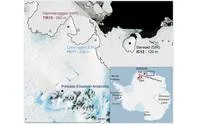
On the coast of Dronning Maud Land, two ice cores stand like two seismographs on one shore. One, FK17, was drilled on the crest of the Lokenryggen ice rise; the other, TIR18, on the crest of Hammaryggen. A hundred kilometers apart, they catch different tremors of the climate. One hears the Pacific, the other the Atlantic and Indian Oceans.
SFANet: a translator that hears both words and intonation
A translator at negotiations picks up not only the words but also the tone in which they are spoken. If they focus only on vocabulary, they might miss sarcasm or fatigue in the voice. If only on intonation, they could mistranslate the details of the contract.
A Wide-Angle Lens for the Subatomic World
At Jefferson Lab, electrons are accelerated to 12 GeV and smash into protons to pry out their secrets. But existing detectors are like cameras with a narrow field of view: you either see a lot but dimly, or brightly but only a tiny patch. Electron scattering is the main tool, but statistics are insufficient for subtle effects.
Neural Network Hears the Ocean's Whisper Three Months Before a Storm
Imagine an interpreter in a huge hall who hears not only the person next to them but also a whisper in the far corner, and from those fragments reconstructs the entire conversation. That's how the CAS-Canglong neural network works: it picks up connections between pressure, wind, and heat across the whole planet and uses them to predict what the ocean will look like three months from now.
Quantum Ripples That Accelerated the Universe
In the first moments after the Big Bang, space expanded at an incredible rate. A tiny quantum ripple, embedded in the uncertainty principle itself, pushed matter apart more strongly than any known force. This ripple is the generalized uncertainty principle, or GUP.
A Digital Twin of the Atmosphere: How a Neural Network Speeds Up Climate Modeling by 350 Times
A translator at a high-stakes negotiation doesn't just render words quickly; they make sure the meaning doesn't get lost. CAMulator does the same: it takes the complex climate model CAM6 and translates it into the language of a neural network that runs hundreds of times faster, without losing the physical essence.
The Rydberg Waltz: How a Dance of Losses Amplifies Quantum Sensitivity
Picking up an ultraweak microwave signal is like trying to hear a whisper in a storm. Rydberg atoms, inflated to the size of bacteria, promise to become perfect antennas. But there's a fatal catch: during optical readout, up to 98% of messenger photons vanish without a trace in the detector.
IAFormer: Sparse Attention for Collision Analysis
At the Large Hadron Collider, millions of jets are born every second: streams of particles flying out from a single quark or gluon. Telling a jet from a top quark apart from a jet from an ordinary quark is a task on which the hunt for new physics depends.
A Maze for the Signal: How to Keep a Particle in a Single Pixel
In a silicon detector, a particle leaves a trace—a tiny electrical signal that must be captured and precisely localized. But as pixels shrink and their number grows, the signal starts to spread: like water spilled on a table, it seeps into neighboring cells.
How to Predict Chaos When Everything Is Noisy
Imagine a translator in a noisy hall, trying to catch a speech through the buzz of voices. The usual approach is to memorize a set of phrases and slot them into templates. But when the noise cranks up, the template falls apart.
Galaxies2025-07-312 minarXiv:2507.23332
Radio Map of Three Galaxies: Compact Sources Versus Diffuse Background
At a distance of 8.58 megaparsecs, the spiral galaxy M51 spins its arms, while the VLA radio telescope in its most extended configuration observes it with a resolution of 0.16×0.14 arcseconds. That is like spotting a coin on the surface of the Moon from Earth.
The Moon as a Gravitational Bell: How to Hear the Ripples of Spacetime
The Moon is not just a satellite; it is a potential gravitational bell. When massive bodies collide, spacetime shudders, and that shudder, gravitational waves, makes everything in their path vibrate.
The Dance of Black Holes and the Birth of Gravitational Molecules
Two black holes circle in a tight dance, and around them something remarkable is born: a gravitational molecule. A cloud of ultralight bosons, particles with masses below an electronvolt, envelops the pair like the electron cloud in an H2+ ion.
Listening to the Long Ring: How Gravitational Waves Reveal the Neutron Star Equation of State
The collision of two neutron stars is a strike heard across the universe. Gravitational wave detectors pick up the ripples in spacetime, but the most interesting sound begins after the impact: the merger remnant, a rapidly spinning hypermassive neutron star, continues to vibrate, emitting waves for a few more…
Quantum Physics2025-10-091 minarXiv:2510.07844express
Listening to the Shudder of Space: The Nano-Mirror Experiment
Two great theories describe reality: one — how massive bodies cause curvature of space, the other — the Standard Model — governs elementary particles. Reconciling them remains elusive, like trying to describe an ocean storm in the language of a diamond lattice.
General Relativity2025-10-191 minarXiv:2510.16903express
Gravitational Waves Gain Overtones
A guitar string after being plucked produces not only the fundamental note, but also quiet overtones. A similar phenomenon appeared in the gravitational waves from the merger of two black holes (event GW250114).
Exoplanets2025-11-061 minarXiv:2511.04067express
The Moon — a Giant Gravitational Bell
The Moon is not just a rocky sphere, but a giant bell. Passing through it, gravitational waves cause it to vibrate almost imperceptibly. This tremor was predicted by Einstein, and Weber was the first to try to hear it with Earth-based detectors.
General Relativity2025-11-172 minarXiv:2511.13848express
Gravitational Atoms: How Black Holes Give Dark Matter a Voice
Black holes are rarely alone in the cosmos. They are often shrouded in invisible clouds of hypothetical dark matter particles — so light that they feel only gravity, barely interacting with each other or ordinary matter.
HEP Theory2025-12-152 minarXiv:2512.13947express
Quantum Bubbles as a New Source of Gravitational Waves
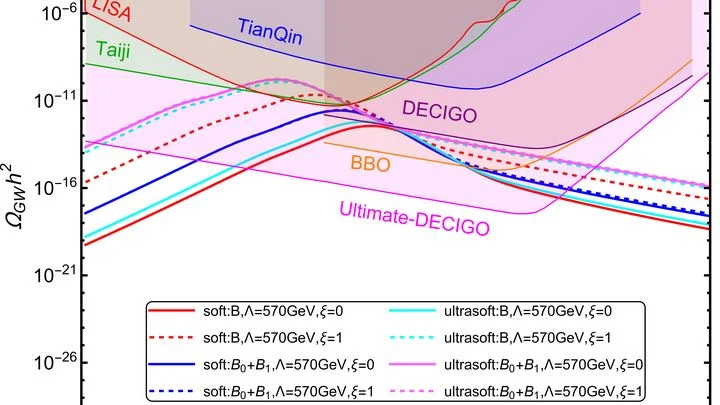
The early universe was an extremely hot and dense medium. In this medium, like bubbles of steam in boiling water, bubbles of a new state of space spontaneously emerged — regions where physical properties changed abruptly.
Machine Learning2026-01-012 minarXiv:2601.00175express
Computer Predicts Cirrhosis Two Years Ahead
The liver is a quiet workhorse. It processes everything we eat and drink, and rarely complains out loud. By the time the first obvious symptoms of cirrhosis appear, the disease has already destroyed a significant portion of the organ. Doctors have long sought a way to see into the liver's future, and a new study offers an unexpected tool — ordinary hospital records.
q-bio.CB2026-01-012 minarXiv:2601.00374express
How Cells Choose Their Own Leaders
In the first weeks of an embryo's life, a dense crowd of cells crawls across its body. These cells will later form the facial bones, parts of the heart, and nerves. The crowd doesn't move randomly: a few leader cells take the front, and the rest follow them, like cyclists in a peloton. For a long time, it was believed that leaders are a special breed of cells, born with a drive to lead.
Optics2026-01-021 minarXiv:2601.00630express
A Hologram from a Speckle of Light
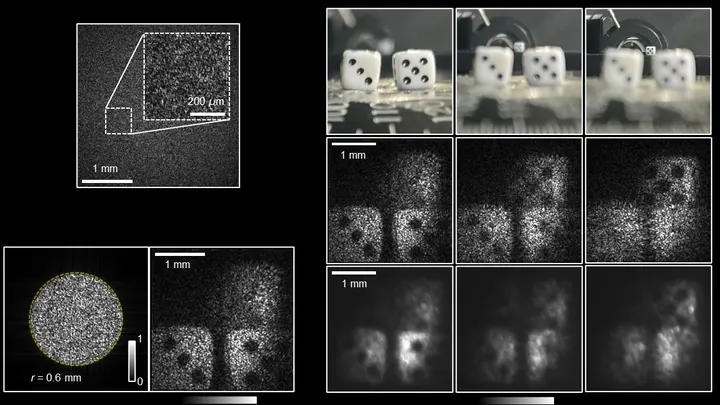
Shine a flashlight through rough glass, and the wall lights up with a speckled pattern of bright and dark dots. Once dismissed as useless noise, this pattern now serves as the key to reconstructing 3D images. In the new system, light from an object passes through a specially designed plate with known irregularities.
High Energy2026-01-041 minarXiv:2601.01402express
How to Hear Stellar Collisions More Clearly
Neutron stars — the super-dense remnants of supernovae — create gravitational waves when they collide. These ripples in space can be thought of as a silent melody: the more precisely we catch its notes, the better we understand the interiors of these objects.
Quantum Physics2026-01-041 minarXiv:2601.01437express
Neural Networks Learn in Five Steps
An ordinary neural network for quantum chemistry is like a student who learns from mistakes but keeps tripping over the same spot. It crawls toward the right answer, is sensitive to settings, and often loses stability. For the fluorine molecule, the new method sped up calculations by 17,900 times compared to the popular Adam method.
Fluid Dynamics2026-01-042 minarXiv:2601.01476express
Invisible Waves in the Ocean's Depths
The ocean is like a layered cake: warm, light water on top, cold, heavy water below. Between the layers, at the interface, invisible waves roam. They don't lift crests like a storm; instead, they slowly rock the entire water column, as if someone were shaking a giant aquarium from within.
General Relativity2026-01-071 minarXiv:2601.03571express
Gravitational waves test the symmetry of the Universe
Two giant black holes spiral together and collide — a ripple of spacetime spreads across the Universe. Detectors of gravitational waves catch this ripple. But the signal may hide more than just mass and distance: if the laws of physics differ ever so slightly in different directions, the wave will be distorted.
Instrumentation2026-01-071 minarXiv:2601.04276express
Tilted Hits from Invisible Pairs
Two black holes circle each other, and their dance isn't always a smooth waltz. If the holes spin on their own axes, their orbit can start to tumble, like a top that's been pushed and wobbles on its side while still spinning.
High Energy2026-01-072 minarXiv:2601.04355express
Dancing Stars
Two stars whirl in a tight dance. One is a neutron star — an ultra-dense sphere the size of a city but with a mass of one and a half Suns. The other is an ordinary star that swells and spills its matter onto its neighbor. Sometimes this transfer happens too fast, and the stars become enveloped in a shared gas shell, like two spoons in one pot of boiling soup.
General Relativity2026-01-091 minarXiv:2601.05734express
A black hole rings nonlinearly: new gravitational overtones heard
When two black holes merge, the newborn hole rings like a bell, emitting gravitational waves. In the past, only the fundamental tone of this ringing was captured. But analysis of the GW250114 merger showed that the signal hides extra faint vibrations — nonlinear overtones.
HEP Phenomenology2026-01-091 minarXiv:2601.05793express
Gravitational Waves from the Boiling Universe: A New Precise Method
In the infant universe, right after the Big Bang, space was expanding rapidly, and the vacuum resembled a superheated liquid. When 'boiling' began, bubbles of true vacuum emerged. Expanding at the speed of light, they triggered gravitational waves — tremors of space itself that have reached us.
General Relativity2026-01-121 minarXiv:2601.07179express
How Gravitational Waves Twist Light
A sugar solution can twist light — many have seen this in polarization experiments. Surprisingly, a similar trick appears in the fabric of the cosmos itself.