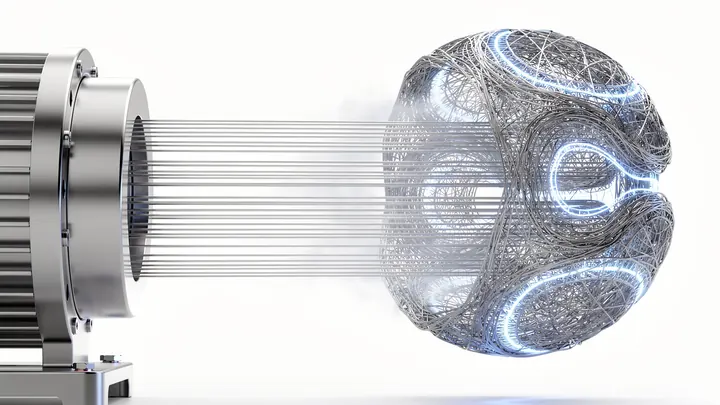
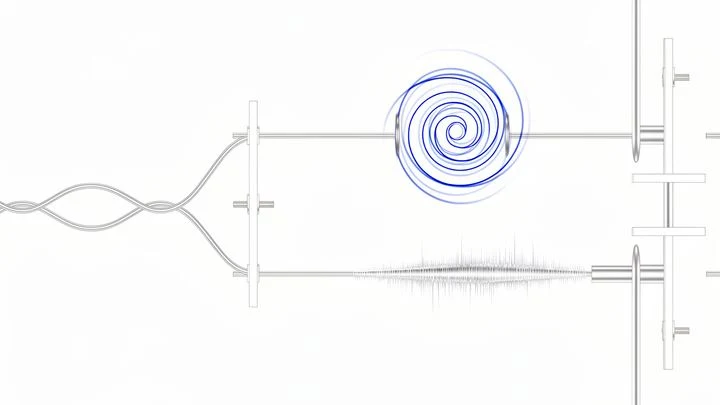
In 1926, Max Born published a paper proposing a probabilistic interpretation of the wave function introduced by Schrödinger. Before that, the Schrödinger equation predicted waves, but it was unclear what they described. Born guessed: the intensity of the wave is the probability density. For this idea he received the Nobel Prize only almost three decades later, it seemed so radical. In physics, it became established: the quantum world is fundamentally random, but this randomness is strictly mathematically predictable.
History
Max Born proposed the probabilistic interpretation of the wave function amplitude in a 1926 paper, analyzing particle scattering. Initially the idea met resistance, including from Schrödinger and Einstein. Born shared the 1954 Nobel Prize in Physics 'for fundamental research in quantum mechanics, especially for the statistical interpretation of the wave function'. The development of the principle continued in the works of von Neumann, who introduced the concept of the density matrix, and in the modern formulation of quantum information theory.
How it works
The Born rule is applied in all areas of quantum physics — from calculating atomic spectra to designing quantum computers. It sets the connection between mathematics and experiment. Applicability limits: the same as for quantum mechanics — distances much larger than the Planck length, energies much lower than the Planck energy. No violations of the principle have been found, but the question of its origin from the many-worlds interpretation or quantum Darwinism remains open.
In practice
Without it, one cannot understand why electrons in atoms form clouds of certain shapes — all chemical bonds and material properties depend on this.
Fun fact
Born himself initially doubted the probabilistic interpretation and even sent the paper to press with reservations. Only later, seeing its success, did he accept his own guess.
In 1998, mathematician David Boyd noticed something strange. He was studying the Mahler measure of polynomials, a quantity that gauges the "complexity" of their roots, and found that for a family of curves, it always equals a special rational number times the derivative of an L-function.
A massive aluminum cylinder weighing a ton hangs in a vacuum. A gravitational wave, a ripple in spacetime, passes through it, and the bar begins to tremble almost imperceptibly. That trembling can be heard as sound: gravitational waves turn into a phonon — a quantum of sound vibrations.
If you accelerate an observer to near-light speed, the emptiness around them stops being cold. A thermal glow emerges — an effect predicted in 1976 and named after William Unruh. For earthly accelerations, this glow is vanishingly faint, like a whisper at a rock concert.
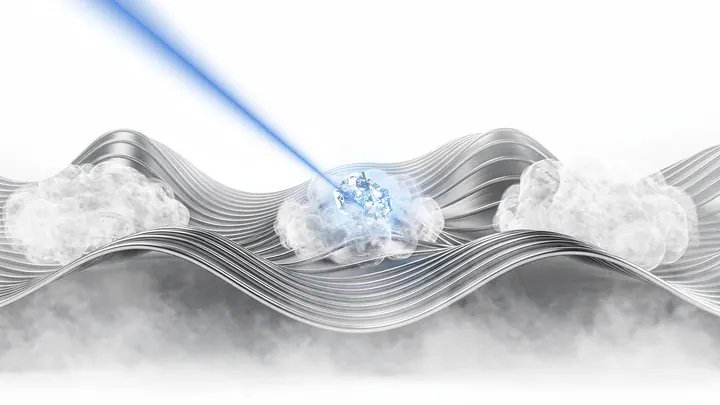
Imagine an old theater in the damp fog. On the stage, a scattering of actors, but only one is caught by the spotlight beam, made to freeze in the bright patch. The rest billow in the dim light, ready to dissolve at any moment.
Crystals fascinate us with their perfect spatial order: atoms frozen at lattice points, like beads on an invisible string. But what if the same symmetry unfolds in time? Time crystals are systems that, without any external cue, start repeating their states cyclically — clocks wound by nature itself. Inside this tireless rhythm, disorder seems to have no place.
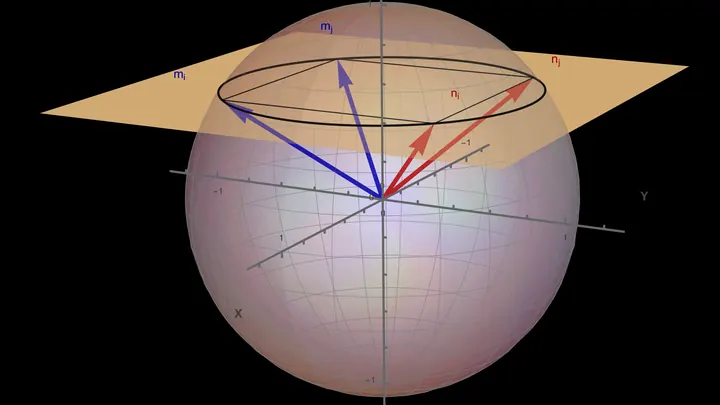
A quantum wave is like a long-exposure photograph: everything’s blurred, but the blur itself reveals motion. Usually these frozen waves are treated as convenient abstractions. Yet if at each point in the image you estimate, by brightness, the moment on the particle’s internal clock it landed there, flat space suddenly acquires curves.
Quantum entanglement often behaves like a synchronized dance visible from only one angle. Change the way you observe it, and the particles appear disconnected. This limits secure communications. Now physicists have created a pair of photons whose 'dance' is flawless from all perspectives.
A regular object moves along a predictable path, like a ball. In the quantum world, a particle is smeared into a probability cloud. To find order in this fog, scientists have recast Schrödinger's equation in the language of flowing water.
In quantum mechanics, everything is fuzzy: a particle is not at a single point but smeared across space, and an event does not happen at a single moment. Yet our everyday world is full of definiteness — the coin landed heads, the light bulb turned on, a note appeared in the notebook.
Twins enter a room from different doors. Each gets a box with a button, and each time they press it, either a red or a green light flashes. If the twins are perfectly identical, you'd expect their lights to follow the same internal rules. But what if the rules differ even though the twins are exact copies?
That's precisely the scenario the authors explored.
You're pouring water into a glass, but you want exactly one million drops — not approximately, but exactly. An ordinary faucet pours a stream where the number of drops always varies. In the quantum world, photons have the same problem: a laser emits light where the number of particles fluctuates like a crowd in a square.
The quantum world is known for uncertainties: for example, you can't measure a particle's position and its speed at the same time. But new research shows that in a 'fuzzy' spacetime, even probability itself — the measure of chance — loses sharpness. A foggy compass doesn't give an exact direction: its needle wavers.
The quantum world is usually drawn with points, but real instruments only see blurry spots. Heisenberg and von Neumann long suspected: precision is unattainable.
In a football stadium, the crowd's emotions arise from the chatter of individual fans. If mood could be both joyful and sorrowful at once, you'd have a quantum superposition. But the murmur of thousands of voices instantly forces that blend into a single definite state.
Throw a stone into a pond, and ripples spread across the water. Throw two stones nearby, and the ripples intersect, creating a pattern of reinforced and canceled waves. That's interference.
A distant orchestra plays a symphony, but the recording is full of noise. The melody is written for two instruments, yet a third voice seems to break through the static — quiet and unfamiliar. This is how astrophysicists listen to gravitational waves, trying to catch the slightest deviations from Einstein's predictions.
According to Einstein, spacetime is a flexible fabric, curved by matter. But in the quantum world, everything is different: particles are smeared over a probability cloud, governed by a rigid rule discovered by Max Born.
A thrown stone arcs along a clean trajectory, but an electron's position in an atom is smeared out like fog. The transition from one to the other is a puzzle. New work shows that the fuzziness disappears not because of an observer, but because of the particle's own gravity.
A typical recipe explains how to cook a dish: step by step, from the initial ingredients to the finished result. The new approach flips the logic: imagine that the future pie itself dictates how much flour to add now. In the quantum world, researchers suggest, a particle receives signals from the future measurement outcome.
A struck tuning fork fades: its vibrations leak into the air. But there are systems where the oscillation does not decay, even though there are plenty of free waves around, ready to carry energy away. Physicists call such 'captured' states bound states in the continuum (BIC).
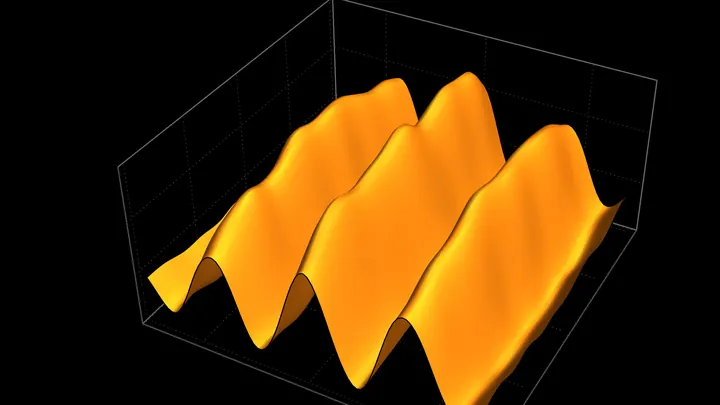
Before measurement, a quantum object lives in a world of possibilities, where wave amplitudes add up like sound waves in a studio before pressing the “record” button. Crests amplify each other, troughs cancel out.
In the first moments, the Universe was squeezed to tiny sizes. What keeps it from collapsing entirely into a point? One answer comes from quantum mechanics: the wave function describes all possible states, and particles move along hidden trajectories that depend on the shape of this wave.
A drop of water on the table looks calm, but inside it, quantum life is bustling. Protons in hydrogen atoms are like tiny spinning tops that constantly rotate. Each has its own direction of spin.
In quantum theory, a particle can run along two paths at once. When measured, we catch it on just one. According to Niels Bohr, all other possibilities vanish instantly — like a branch snapped off a trunk. Yet Hugh Everett insisted: the tree of reality grows all its branches at once, and we only see the one we’re on.
A quantum computer based on electron spins is like a row of tiny spinning tops. Each top spins either clockwise or counterclockwise: that's a qubit. To find out the result of a computation, you typically stop the top and see which way it fell. But if you have many tops, each one needs its own "eye"—an extra helper qubit.
A fridge magnet sticks because the tiny atomic arrows inside it are aligned in one direction. But quantum mechanics makes these arrows jitter, so the overall magnetization falls short of the ideal.
Light can be more than just a stream of particles; it can be a wave with a specific shape over time. Sometimes this shape changes so rapidly that capturing it is like photographing a bullet in flight. Scientists have devised a way to measure such fleeting quantum states of light.
For this, they use a device called a balanced homodyne detector.
A regular wall clock runs smoothly, but quantum clocks are a different story. They tick at random moments, and each tick can have a different duration. On average, if you watch such a clock for a long time, it will show the correct time. But at any given moment, its hand might jump forward by an unexpected amount.
The quantum world is full of surprises: even simply observing a particle changes its behavior. In a new study, physicists showed that continuously measuring energy can make quantum chaos more pronounced. They used a quantity that indicates how long a quantum state remains similar to itself under repeated measurements.
The number 551 looks harmless, but finding the two primes that multiply to give it is no easy task. A classical computer tries options one by one, like someone searching for a key on a keyring. A quantum processor works differently: it tries all possibilities at once, but you need a way to steer it toward the right answer.
The ocean is like a layered cake: warm, light water on top, cold, heavy water below. Between the layers, at the interface, invisible waves roam. They don't lift crests like a storm; instead, they slowly rock the entire water column, as if someone were shaking a giant aquarium from within.
Usually, to understand a quantum state of light, you need to perform dozens of complex measurements, like trying all the keys on a keychain. The new AI model works differently: it's a universal key that, after a slight adjustment, opens many 'locks'—simple and the most tricky states.
A quantum particle, an inhabitant of the elementary particle world, resembles a coin spinning in the air: neither heads nor tails, but a blend of possibilities. Yet when it lands on the table, the outcome becomes definite. What serves as the table in a measurement?
There's always a risk that someone will peek at your ballot during an election. Physicists have come up with a solution: anonymous voting safeguarded not by people, but by the laws of nature.
Their 'magic ballot box' operates with light particles — photons.
Quantum walking is not a series of random steps, but a musical score where the piano of space sounds under the conductor's baton of the internal state. The coin sets the tone. Until now, it was believed that detuned keys (phase disorder) mute any melody, leading to Anderson localization — a ringing silence.
Quantum mechanics gave us a captivating image: a system’s state is not a frozen point but a wave of possibilities, dancing in an abstract space. Thanks to the work of Шрёдингера and Дирака, we represent it as vectors in Hilbert space.
Niels Bohr insisted: you cannot simultaneously know which path a photon took and see interference. For a long time, this was considered a limitation of knowledge — we simply cannot obtain both types of information at once.
Light strikes a metal plate, and electrons fly out. This is the photoelectric effect, and it works only if the light has enough energy to cross the threshold that holds electrons inside.