concept

quantum state

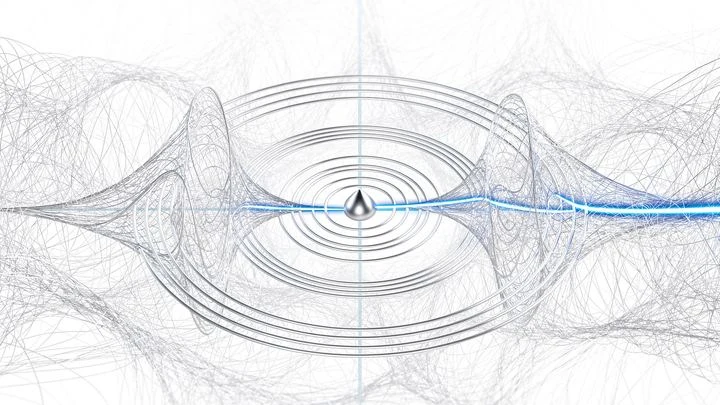
A quantum state is the complete description of a quantum system defined by its wavefunction or state vector.
19 related articles · 6 formulas

Description

A quantum state is a mathematical object (state vector) in Hilbert space (an abstract infinite-dimensional space) that contains all information about a system. It evolves deterministically according to the Schrödinger equation, but the measurement result is fundamentally random: for each observable quantity, there is a set of possible values, and measurement yields one of them with a certain probability. Moreover, the state after measurement collapses to an eigenstate of the measured observable operator. The property of superposition allows for 'ghost' states where a particle passes through two slits simultaneously.

History

Key steps in understanding quantum states were taken in the 1920s. Erwin Schrödinger introduced the wave function and his equation in 1926, hoping to bring visualization back to quantum theory. That same year, Max Born proposed the probabilistic interpretation of |ψ|². Werner Heisenberg developed matrix mechanics, and Paul Dirac unified the approaches into a general theory of transformations and introduced bra-ket notation. John von Neumann formalized the concept of Hilbert space for states. Later, in 1935, Schrödinger described the 'cat' paradox and coined the term 'entanglement.' The study of quantum states continues in quantum information and quantum computing.

How it works

The state |ψ⟩ contains probability amplitudes, the squared moduli of which determine the probabilities of measurement outcomes. The Schrödinger equation iħ d|ψ⟩/dt = Ĥ|ψ⟩ ensures unitary evolution: superpositions are preserved. Measurement causes an irreversible collapse to one of the possible states with probability |⟨φ_i|ψ⟩|². For mixed states, the density matrix is used, evolving according to the Liouville–von Neumann equation. Entangled states, such as the Bell singlet (|01⟩ - |10⟩)/√2, exhibit nonlocal correlations. The superposition principle enables quantum parallelism—the basis of quantum computing. Decoherence (interaction with the environment) rapidly destroys pure states on macroscopic scales.

In practice

Quantum states underlie lasers, transistors, MRI scanners, and quantum computers—any device that uses quantum effects operates with particle states.

Fun fact

A quantum state can be entangled: two particles separated by kilometers are described by a single state, and measuring one instantly determines the result of measuring the other—Einstein called this 'spooky action at a distance.'

Concept graph →

Formulas

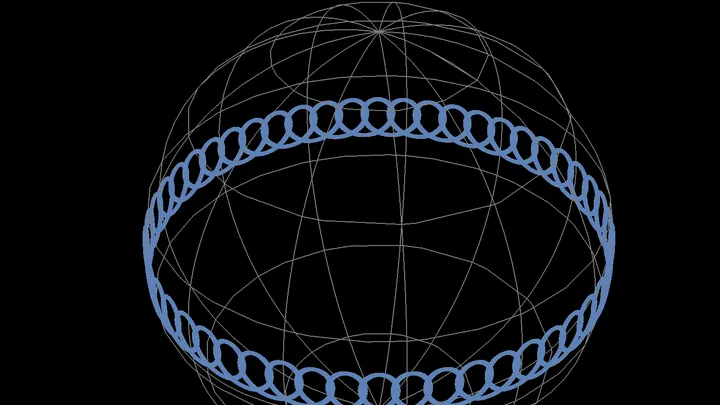
$$|\theta, \phi\rangle = \begin{pmatrix} \cos\frac{\theta}{2} e^{-i\frac{\phi}{2}} \\ \sin\frac{\theta}{2} e^{i\frac{\phi}{2}} \end{pmatrix}$$
A qubit's pure state parameterized by polar and azimuthal angles on the Bloch sphere.
What is in the formula
θvariablePolar angle on Bloch sphere — angle radian
φvariableAzimuthal angle on Bloch sphere — angle radian
|θ,φ⟩variableQubit state vector — quantum state
|θ,φ\rangle=\begin{pmatrix}\cos\frac{θ}{2}e^{-i\frac{φ}{2}}\\sin\frac{θ}{2}e^{i\frac{φ}{2}}\end{pmatrix} · 2505.00777v1
$$\operatorname{Tr}[A\rho]$$
The expectation value of operator A in quantum state ρ.
What is in the formula
AvariableOperator whose expectation is taken — operator
ρvariableDensity matrix (quantum state) — density matrix
TroperatorComputes the sum of diagonal elements of a matrix — trace operator
\operatorname{tr}[\varphi(h(θ))ρ] · 2607.05000
$$\rho = \sum_i p_i |i\rangle\langle i|$$
A quantum state's density matrix becomes diagonal after measurement.
What is in the formula
ρvariableDensity matrix — density matrix
p_ivariableProbability of state |i⟩ — probability
|i⟩variableEigenstate of the density matrix — quantum state
⟨i|operatorDual vector (bra) of |i⟩ — bra operator
$$C(\psi) = 2|\alpha\delta - \beta\gamma|$$
Concurrence measures entanglement from 0 to 1.
What is in the formula
ψvariabletwo-qubit pure state — quantum state
αvariableamplitude of |00> component — probability amplitude
βvariableamplitude of |01> component — probability amplitude
γvariableamplitude of |10> component — probability amplitude
δvariableamplitude of |11> component — probability amplitude
$$| heta,\phi\rangle = \cos(\theta/2)\,|0\rangle + e^{i\phi}\sin(\theta/2)\,|1\rangle$$
Quantum state on Bloch sphere with polar and azimuthal angles.
What is in the formula
\thetavariablePolar angle on the Bloch sphere — polar angle radian
\phivariableAzimuthal angle on the Bloch sphere — azimuthal angle radian
|\theta,\phi\ranglevariableQuantum state on the Bloch sphere — quantum state
|0\ranglevariableComputational basis state 0 — basis state
|1\ranglevariableComputational basis state 1 — basis state
$$|W_n\rangle = \frac{1}{\sqrt{n}} (|10\ldots0\rangle + |010\ldots0\rangle + \ldots + |0\ldots01\rangle)$$
Entangled quantum state with single excitation distributed.
What is in the formula
nvariableNumber of qubits — qubit number
|W_n⟩variableW state of n qubits — quantum state

Related articles · 98

Measuring Chaos Without Burning Extra Copies
A quantum state is like mountain weather: it changes with every glance. To estimate its uncertainty, physicists make copies and take measurements. Each copy is a thermometer that breaks after use.
Statistical Mech2026-08-142 minarXiv:2608.13855express
The Quantum Computer as a Dating Pool
A quantum computer isn't just a bunch of qubits: it's a whole city, where each resident is one of the machine's possible states. Residents get to know each other through weak interactions between qubits: if one state can transition to another, a thread of acquaintance is drawn between them.
Quantum Physics2026-08-102 minarXiv:2608.09727express
Magic States: How Distillation Makes Quantum Computers Reliable
A washing machine sometimes tears clothes. To get a whole shirt, you wash several and then piece one together from the survivors. A quantum computer treats 'magic states'—special ingredients without which complex computations are impossible — in much the same way. These states are extremely fragile. The slightest noise, and the magic evaporates.
Quantum Coherence Microscope: Seeing the Phase of Atoms in a Lattice
In a hall with a thousand spectators, applause blends into a general noise, but if someone falls out of rhythm — a ripple runs through the crowd. The quantum world works similarly: atoms in a trap can behave as a single whole, or they can fall apart into independent individuals.
Quantum Physics2026-08-092 minarXiv:2608.08821express
Quantum Puzzle: How Measurements Assemble Complex States
Imagine a huge puzzle where each piece is a quantum particle. To complete the picture, you don't just fit the pieces together: you need to entangle them in a special way. Usually, this is done by carefully applying operations one after another, like assembling the puzzle strictly by the instructions, row by row.
Quantum Physics2026-08-092 minarXiv:2608.08778express
How to Test Whether Gravity Is Quantum
Two tiny diamonds float in a vacuum, separated by a distance that light cannot cross during the experiment. Inside each, like a frozen spark, resides an entangled spin — a quantum state linking them into a single whole. Now the diamonds begin to move, but not just any motion: each one seems to split, existing in two places at once.
Quantum Physics2026-08-062 minarXiv:2608.05972express
Quantum Ripples in a Massive Sphere
Quantum mechanics allows a particle to be in two places at once: this is called superposition. But massive objects, like a dust grain or a ball, don't behave that way: their position is always definite. Why? One idea is that it's an illusion: the particle is constantly "jittering" from random environmental kicks, and the blurred picture averages out.
Quantum Physics2026-08-052 minarXiv:2608.04876express
A Quantum Compass for 3D Vision
A camera looks at two distant sparks. They're so close together that they merge into a single fuzzy blob. It seems impossible to tell them apart — the classic limit of optical microscopy has been reached. But quantum mechanics hints that the light field still holds a secret about where each spark sits.
Quantum Physics2026-08-041 minarXiv:2608.03056express
A Free Electron Wakes Sleeping Light
In a tight row of atoms, spaced closer than the wavelength of light, a remarkable state hides. The excitation is distributed among all particles so that their radiation cancels itself out. This quantum 'silence' is an ideal vault for a photon: it can be stored there hundreds of times longer than usual.
math.PR2026-08-042 minarXiv:2608.03771express
How Chaos in the Quantum World Gives Rise to Universal Order
The quantum world is a constant buzz of activity. Particles exchange energy, become entangled, and influence one another. You'd think that the more players in this game, the harder it is to predict the outcome. But sometimes, order emerges from chaos. Physicists took a close look at the SYK model — a mathematical playground for studying quantum chaos.
General Relativity2026-08-032 minarXiv:2608.01814express
How Energy Learns to Behave Itself
In the big world, there's a simple rule: energy density can't be negative, and its flow can't outrun light. In a café, that would look like this: a waiter can't deliver orders faster than he can run. Physicists call this restriction the energy dominance condition. But in the microworld, where quanta rule and spacetime can bend, energy starts acting up.
Quantum Physics2026-08-021 minarXiv:2608.01011express
Seven Qubits Tie the Perfect Knot
Seven dancers step onto the stage. They join hands so that any trio or quartet moves in perfect harmony with the rest — no group falls out of the overall rhythm. In the quantum world, this is called an absolutely maximally entangled state (AME for short). It's a perfect knot where every part knows everything about the whole.
Quantum Physics2026-08-022 minarXiv:2608.01111express
A Quantum Cat on Guard for Computing
A quantum computer based on neutral atoms is like a city where couriers, laser tweezers, physically carry packages between addresses. While one courier drags an atom across the entire chip, the others sit idle. This is slow and error-prone. The new architecture replaces couriers with a shared radio wave.
Strongly Correlated2026-08-022 minarXiv:2608.01363express
Flat Bands: Magnetism Without Motion
Imagine a postal service where couriers suddenly stop moving. It would seem that letters would stop arriving and communication between cities would break down. But what if the envelopes themselves suddenly gained the ability to change shape and transmit messages through a shared web without moving an inch?
Atomic Physics2026-07-251 minarXiv:2607.23090express
Dancing Atoms Under Optical Tweezers
Two dancers on stage must move in perfect sync, but if one hesitates, the whole routine is ruined. That's roughly how quantum computers with neutral atoms work: two atoms are entangled by putting them into a Rydberg state (as huge as a balloon compared to an ordinary atom), and then you wait for them to 'dance' their part.
General Relativity2026-07-211 minarXiv:2607.19141express
Quantum Clocks to Test the Equivalence Principle
Gravity in our world is curved spacetime. That's how Einstein's general theory of relativity describes it. But what happens to gravity at the level of atoms and particles, where quantum mechanics rules? This question has remained unanswered for nearly a century.
Quantum Physics2026-07-192 minarXiv:2607.17023express
Light Amplifier Sees What Is Hidden
A delicate watermark on wet paper, and a fogged-up glass before your eyes. That's roughly what reading quantum states of light looks like: fragile photon patterns get distorted by losses, and detectors catch only a small fraction of the signal.
Quantum Physics2026-07-182 minarXiv:2607.16592express
A Quantum Top in a Magnetic Trap
A tiny magnetized sphere floats in a vacuum, held by invisible fields. It starts to spin around the axis of the magnetic field, just like a top that's been given a gentle nudge. That's precession. But when the sphere becomes really small, quantum laws come into play.
Quantum Physics2026-07-101 minarXiv:2607.09875express
Quantum Dance of Entanglement and Magic
A quantum computer relies on two forces: entanglement (particles behaving as a single whole) and "magic"—a measure of how far a state is from familiar classical physics. But how these two resources relate as a many-particle system evolves in time has remained a puzzle. The authors approached the problem through time.
Quantum Physics2026-07-082 minarXiv:2607.07167express
Quantum Entanglement of Positions: A Spatial Dance of Giant Atoms
Quantum entanglement — a phenomenon where the states of two or more particles become interconnected regardless of the distance between them — usually links intrinsic properties such as spin or polarization. However, a new experiment has for the first time realized entanglement of the positions of two atoms in space.
Quantum Physics2026-07-031 minarXiv:2607.03622express
Quantum Dance of Dust Grains in a Magnetic Trap
A magnetic field holds a tiny particle in mid-air, like an invisible dance partner. A special tuning of the field creates a trap with two "positions." In the ordinary world, a dancer occupies only one, but in the quantum world — both at once. Physicists have learned to achieve this for dust grains weighing trillionths of a gram.
Quantum Boiling of the False Vacuum
The quantum vacuum is not a dead void but a boiling cauldron of probabilities. In some theories, our Universe is frozen in a metastable state: like superheated water, it's ready to explode into steam at the slightest nudge.
Quantum Physics2026-06-302 minarXiv:2606.31678express
Quantum Physics2026-06-291 minarXiv:2606.30468express
Entanglement That Can't Be Broken: Photons in Invulnerable Quantum Communication
Quantum entanglement often behaves like a synchronized dance visible from only one angle. Change the way you observe it, and the particles appear disconnected. This limits secure communications. Now physicists have created a pair of photons whose 'dance' is flawless from all perspectives.
Quantum Physics2026-06-261 minarXiv:2606.28640express
Vortices in the Quantum World
A regular object moves along a predictable path, like a ball. In the quantum world, a particle is smeared into a probability cloud. To find order in this fog, scientists have recast Schrödinger's equation in the language of flowing water.
Quantum Physics2026-06-252 minarXiv:2606.27358express
Growing a Precision Catalyst
Quantum computers make mistakes. Each step of a computation introduces a tiny inaccuracy, and if left uncorrected, the result degenerates into noise. One of the main challenges is rotating a phase by an arbitrary angle. The standard approach is to assemble the desired rotation from a set of simple operations, like a mosaic.
Mesoscale2026-06-212 minarXiv:2606.22479express
Quantum Geometry Traps Particles
Light or sound can be confined in a tiny region of a crystal, like a pearl in a shell. Usually, two methods are used. The first is like a heavy ball in a pit: a particle with large mass simply cannot roll out. The second is a perfect cage of mirrors, where waves cancel each other everywhere except in the trap itself.
Quantum Physics2026-06-212 minarXiv:2606.22707express
Quantum pendulum probes reality
In the lab, there's a trap, an invisible 'pit' made of electric fields, where a charged dust grain about a hundred nanometers across levitates. It oscillates back and forth like a pendulum in a clock.
Quantum Physics2026-06-202 minarXiv:2606.22127express
How the Quantum World Gives Rise to Precise Facts
In quantum mechanics, everything is fuzzy: a particle is not at a single point but smeared across space, and an event does not happen at a single moment. Yet our everyday world is full of definiteness — the coin landed heads, the light bulb turned on, a note appeared in the notebook.
Quantum Gases2026-06-192 minarXiv:2606.21567express
How a foreign particle in a quantum sea learns to walk
A pebble falls into a pond, and ripples spread across the water. In the quantum world, the pond is not made of water but of many identical particles, and the pebble is also a particle, just a foreign one. Such a foreign particle is called a Fermi polaron.
Mesoscale2026-06-192 minarXiv:2606.21580express
Quantum Capacitance Peers Inside a Topological Qubit
Two pendulums hang from the same crossbar. A push, and they start swinging, gradually falling into and out of sync. In a topological qubit, Majorana particles, special excitations that can store quantum information, play the role of these pendulums.
Quantum Physics2026-06-172 minarXiv:2606.19649express
Quantum Whisper: Squeezed Light Yields to New States
Gravitational-wave observatories are like a keen ear listening for distant rumbles of cosmic catastrophes. To catch the faint whisper of merging black holes, detectors of gravitational waves use specially prepared light — known as squeezed vacuum.
Quantum Physics2026-06-091 minarXiv:2606.10266express
The Quantum Ghost of the Pass
In the mountains, there is a saddle — a point where the trail from one valley crosses over into another. Standing exactly on it, you take a step and are already descending the new slope. In chemistry, such a place is called the transition state: a brief moment when atoms are frozen on the threshold of transformation.
Atomic Physics2026-06-072 minarXiv:2606.08528express
Quantum Knots from Particle Trajectories
A thrown stone follows a smooth arc: its path is easy to predict. But if the stone skips across water, the trajectory becomes jagged and far more interesting. Quantum particles behave much the same way when their state is not a calm wave with fixed energy but a turbulent mix of several waves at once.
Quantum Physics2026-06-062 minarXiv:2606.08189express
When Quantum Entanglement Takes the Wheel
Two dice lie in different rooms. If they are 'entangled,' a roll of one instantly determines the outcome of the other — even at a distance. In the quantum world, such a link is called steering: one party, by performing measurements on their side, seems to dictate the state of the partner.
Quantum Physics2026-06-021 minarXiv:2606.02986express
Quantum Physics2026-06-021 minarXiv:2606.03293express
Quantum Physics2026-06-021 minarXiv:2606.03676express
Magnet in Superposition: Quantum Compass
An ordinary magnet is like a compass: its needle points north. But a quantum compass can look in both directions at once. If a magnet floating in a vacuum is gently spun, its electron 'tops' synchronize so the whole piece of metal starts living by the rules of the microworld — freezes in a superposition, like a split pointer.
Quantum Physics2026-06-021 minarXiv:2606.03914express
Quantum Eraser Captures Two Pictures in One Snap
A single camera shot stores both a normal picture and a hidden map of how light rippled through the scene. Quantum entanglement makes this possible. Pairs of linked photons are generated: one visits the object, its twin takes a detour. Later, measuring the twin one way pulls out the brightness information.