A probability distribution is a mathematical function that assigns probabilities to each possible outcome of a random process. It describes how likely different results are, from the roll of a die to the position of an electron in an atom. In physics, probability distributions are essential for understanding systems with inherent randomness, such as quantum particles or thermal fluctuations.
History
The concept was developed in the 17th century by mathematicians like Blaise Pascal and Pierre de Fermat, and later formalized by figures like Jacob Bernoulli and Carl Friedrich Gauss, whose normal distribution became ubiquitous in physics.
How it works
The distribution is defined over a sample space of outcomes. For a discrete variable, it gives a probability for each outcome; for a continuous variable, it gives a probability density. The total probability always sums or integrates to 1. In quantum mechanics, the probability distribution of a particle's position is given by the square of the wavefunction's amplitude, linking the abstract mathematics to observable reality.
In practice
Probability distributions are used in statistical mechanics to predict the behavior of gases, in quantum physics to calculate measurement outcomes, and in data analysis to model noise and uncertainty.
Fun fact
The normal distribution, also called the bell curve, appears so often in nature—from heights of people to measurement errors—that it's known as the 'Gaussian' after Carl Friedrich Gauss, who used it to predict the orbit of the dwarf planet Ceres.
As you slowly turn the tuning knob of an old radio, the sound doesn't fade in gradually from the static: it bursts forth in a sudden jump, the moment the antenna hits resonance with the wave. Genes in a living cell behave much the same way.
Toss a handful of sand onto a table — the grains scatter equally in all directions. But if a magnet is hidden under the table and the sand is iron, the trajectories get trickier: an invisible structure overlays the chaos. That's roughly how molecular motion works inside a living cell.
A courtroom interpreter is distracted by every rustle: the creak of a chair, a cough in the back row, the rustle of papers. By the end of the day, they are translating not what the witness said, but what they heard through the noise. Rare translation errors are not the result of a single loud shout, but of the accumulation of many small disturbances.
Imagine a ball in an unfamiliar hall: two guests start from opposite corners. Their movements are not a smooth waltz but chaotic improvisation in search of rare treasures. Contrary to intuition, the outcome hinges not on tempo but on the geometry of the floor.
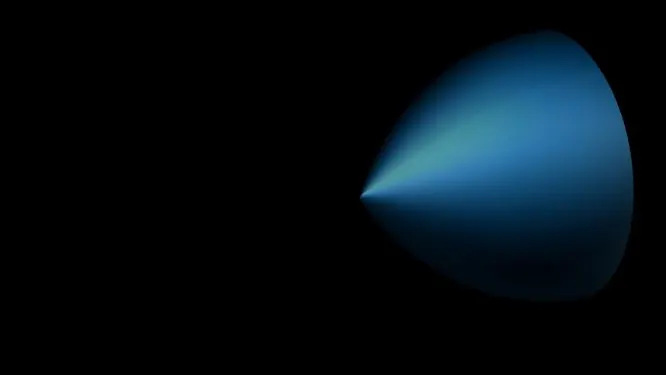
The light cone is a blueprint of causality, laser-cut onto the fabric of the universe. In classical physics, it is as sharp as a scalpel: events inside are linked by invisible threads of influence, while outside lies eternal isolation, sealed by the ultimate speed limit.
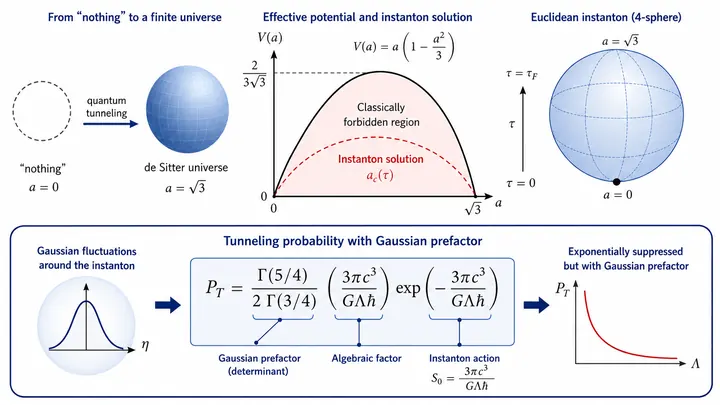
Quantum nothingness resembles water in a pot just before boiling. From time to time, a bubble spontaneously swells up — but not of steam, but of an entire universe. Such a bubble doesn't collapse; instead, it inflates into spacetime, triggering its own Big Bang. The only question is how often this happens.
Spread a handful of coins on the table. Each coin is a possible outcome: heads, tails, or something else. If we know how chaotic this set is (its entropy), which combinations of probabilities will we encounter more often? It turns out the answer depends on how much chaos we allow.
A handful of sand lands on the table. The grains settle in different ways, but if the handful is large, the total volume barely changes. That's roughly how classical gravity works: space appears smooth and definite. But look closely at the individual grains, and you'll find that at the quantum level, volume itself is no longer fixed.
Hot tea cools down, and its temperature is the same throughout the cup. But in many systems (for example, in the rarefied gas between stars or in plasma) temperature is not uniform: in one place particles are faster, in another slower. Physicists call such systems "superstatistical": it's as if the tea consisted of many small regions, each with its own temperature.
A thin film for a solar cell or display is like a dense crowd in a square: each person faces a different direction, and whether light passes through the crowd or gets stuck depends on which way everyone is looking. In organic electronics, molecules play the role of passersby. Until now, instruments could only measure the crowd's overall direction — the average head tilt and its spread.
A typical recipe explains how to cook a dish: step by step, from the initial ingredients to the finished result. The new approach flips the logic: imagine that the future pie itself dictates how much flour to add now. In the quantum world, researchers suggest, a particle receives signals from the future measurement outcome.
Toss a handful of peas into a pot of semolina porridge — the peas quickly sink, pushing the grains aside. But if you make the porridge very thick and sticky, the peas get stuck. That's roughly how light lithium atoms behaved in a cloud of heavy potassium atoms at temperatures just a few millionths of a degree above absolute zero.
On a table lies a handful of round magnets. As long as no one touches them, they lie in disarray. But send a short current pulse through them, and each disk flips: the north pole swaps with the south. Neighboring disks push each other with their fields, like people in a crowded queue, and the whole handful arranges into a pattern that depends on which way the magnetic wind blew and how warm it is around.
A quantum particle quantum particle can exhibit backward motion even if its overall direction is forward. Imagine a river: the main current rushes toward the mouth, but individual currents suddenly swirl and momentarily dart against the flow, creating local disorder.
A translator learns not from a dictionary but from speech. They listen to native speakers and pick up rules that are written in no textbook. Similarly, a new method for forecasting complex systems such as climate or turbulence does not require knowing their equations. Instead, it looks at data and learns to predict their behavior.