Scientist

Russell Hulse

род. 1950 · Astrophysics, pulsar physics, gravitational waves
American physicist who, together with Joseph Taylor, discovered the binary pulsar PSR B1913+16, which provided the first indirect confirmation of the existence of gravitational waves.

Biography

Born in 1950 in New York. He studied at Cooper Union, then at the University of Massachusetts Amherst, where he received his doctorate in 1975. As a graduate student, he worked with Taylor at the Arecibo radio telescope laboratory, where they made their famous discovery. He later worked at the Princeton Plasma Physics Laboratory. He won the Nobel Prize in Physics in 1993.

Key discoveries

💡 Hulse made his epochal discovery as a 23-year-old graduate student, and still jokes that his main contribution was not throwing away the 'strange' signal. After astrophysics, he moved into plasma research and became an expert on nuclear fusion.
"He described the discovery as like finding a needle in a haystack, scanning kilometers of paper tape with data and suddenly seeing a signal that could only be explained by a binary system."
Concepts
gravitational wavesLIGOneutron starpulsarradio astronomy
Laws
quadrupole radiation formula
Scientists
Henri PoincaréFritz ZwickySubrahmanyan ChandrasekharJocelyn Bell BurnellRainer WeissCharles TownesStephen HawkingJoseph Weber

Related articles

Quantum Ripples That Accelerated the Universe
In the first moments after the Big Bang, space expanded at an incredible rate. A tiny quantum ripple, embedded in the uncertainty principle itself, pushed matter apart more strongly than any known force. This ripple is the generalized uncertainty principle, or GUP.
The Rydberg Waltz: How a Dance of Losses Amplifies Quantum Sensitivity
Picking up an ultraweak microwave signal is like trying to hear a whisper in a storm. Rydberg atoms, inflated to the size of bacteria, promise to become perfect antennas. But there's a fatal catch: during optical readout, up to 98% of messenger photons vanish without a trace in the detector.
The Dance of Black Holes and the Birth of Gravitational Molecules
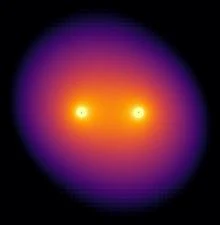
Two black holes circle in a tight dance, and around them something remarkable is born: a gravitational molecule. A cloud of ultralight bosons, particles with masses below an electronvolt, envelops the pair like the electron cloud in an H2+ ion.
Listening to the Long Ring: How Gravitational Waves Reveal the Neutron Star Equation of State
The collision of two neutron stars is a strike heard across the universe. Gravitational wave detectors pick up the ripples in spacetime, but the most interesting sound begins after the impact: the merger remnant, a rapidly spinning hypermassive neutron star, continues to vibrate, emitting waves for a few more…
General Relativity2025-10-191 minarXiv:2510.16903express
Gravitational Waves Gain Overtones
A guitar string after being plucked produces not only the fundamental note, but also quiet overtones. A similar phenomenon appeared in the gravitational waves from the merger of two black holes (event GW250114).
General Relativity2025-11-172 minarXiv:2511.13848express
Gravitational Atoms: How Black Holes Give Dark Matter a Voice
Black holes are rarely alone in the cosmos. They are often shrouded in invisible clouds of hypothetical dark matter particles — so light that they feel only gravity, barely interacting with each other or ordinary matter.
HEP Theory2025-12-152 minarXiv:2512.13947express
Quantum Bubbles as a New Source of Gravitational Waves
The early universe was an extremely hot and dense medium. In this medium, like bubbles of steam in boiling water, bubbles of a new state of space spontaneously emerged — regions where physical properties changed abruptly.
High Energy2026-01-041 minarXiv:2601.01402express
How to Hear Stellar Collisions More Clearly
Neutron stars — the super-dense remnants of supernovae — create gravitational waves when they collide. These ripples in space can be thought of as a silent melody: the more precisely we catch its notes, the better we understand the interiors of these objects.
Fluid Dynamics2026-01-042 minarXiv:2601.01476express
Invisible Waves in the Ocean's Depths
The ocean is like a layered cake: warm, light water on top, cold, heavy water below. Between the layers, at the interface, invisible waves roam. They don't lift crests like a storm; instead, they slowly rock the entire water column, as if someone were shaking a giant aquarium from within.
General Relativity2026-01-071 minarXiv:2601.03571express
Gravitational waves test the symmetry of the Universe
Two giant black holes spiral together and collide — a ripple of spacetime spreads across the Universe. Detectors of gravitational waves catch this ripple. But the signal may hide more than just mass and distance: if the laws of physics differ ever so slightly in different directions, the wave will be distorted.
Instrumentation2026-01-071 minarXiv:2601.04276express
Tilted Hits from Invisible Pairs
Two black holes circle each other, and their dance isn't always a smooth waltz. If the holes spin on their own axes, their orbit can start to tumble, like a top that's been pushed and wobbles on its side while still spinning.
High Energy2026-01-072 minarXiv:2601.04355express
Dancing Stars
Two stars whirl in a tight dance. One is a neutron star — an ultra-dense sphere the size of a city but with a mass of one and a half Suns. The other is an ordinary star that swells and spills its matter onto its neighbor. Sometimes this transfer happens too fast, and the stars become enveloped in a shared gas shell, like two spoons in one pot of boiling soup.
General Relativity2026-01-091 minarXiv:2601.05734express
A black hole rings nonlinearly: new gravitational overtones heard
When two black holes merge, the newborn hole rings like a bell, emitting gravitational waves. In the past, only the fundamental tone of this ringing was captured. But analysis of the GW250114 merger showed that the signal hides extra faint vibrations — nonlinear overtones.
HEP Phenomenology2026-01-091 minarXiv:2601.05793express
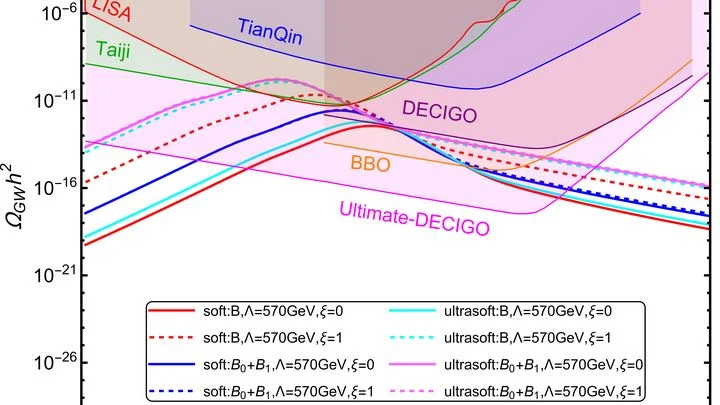
Gravitational Waves from the Boiling Universe: A New Precise Method
In the infant universe, right after the Big Bang, space was expanding rapidly, and the vacuum resembled a superheated liquid. When 'boiling' began, bubbles of true vacuum emerged. Expanding at the speed of light, they triggered gravitational waves — tremors of space itself that have reached us.
Plasma Physics2026-01-131 minarXiv:2601.08329express
The Solar Wind Whispers: How to Catch Its Wave
The scorching gas streaming from the Sun is not a continuous flow but rather a soup of charged particles. In this soup, waves constantly boil up: electric fields flare and fade like ripples on water from a tossed stone. One such wave is the ion-ion acoustic wave.
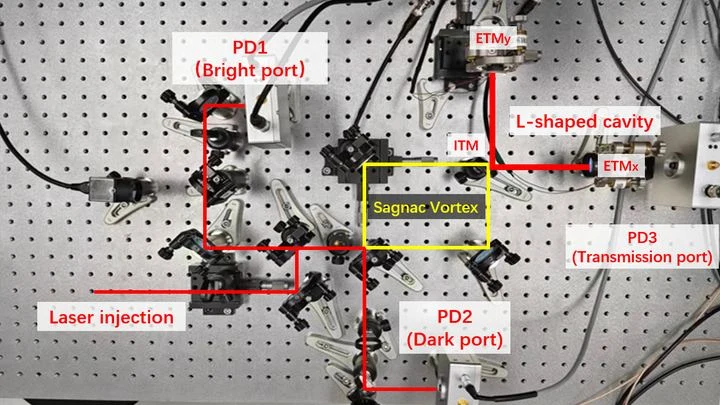
A Laser Maze for Hunting Space-Time Tremors
Gravitational waves are ripples in space itself, caused by events like colliding black holes. To hear these ripples, we build giant L-shaped facilities: a laser beam travels down two arms, bounces off mirrors, and returns. If space has been slightly squeezed or stretched, the light arrives with a difference, and we see a signal.
HEP Phenomenology2026-01-141 minarXiv:2601.09834express
A hiccup in the early Universe gave rise to a gravitational hum
Right after its birth, the Universe wasn't just expanding: it was inflating at an unimaginable pace. This stage, called inflation, was proposed by Alan Guth. New models compare the process to inflating a balloon with quick, jerky pumps.
Stellar2026-01-181 minarXiv:2601.12476express
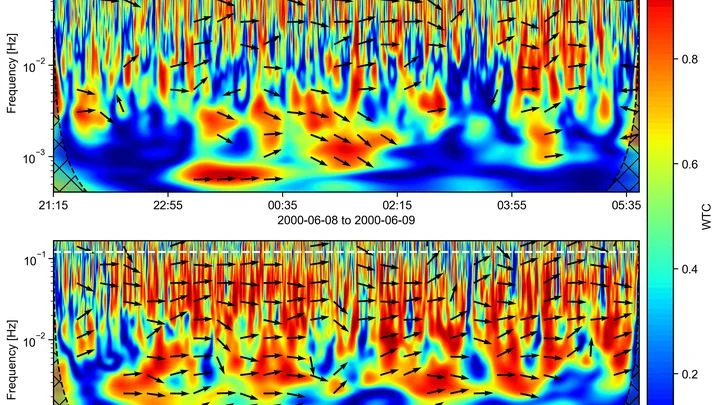
Waves Spinning in Opposite Directions Found Inside a Solar Eruption
The Sun constantly emits a stream of charged particles, mostly hydrogen — the solar wind. Sometimes the Sun ejects dense blobs of magnetized gas, inside which calm usually reigns. But in 2000, scientists noticed two regions inside one such cloud where the gas was churning.
General Relativity2026-01-231 minarXiv:2601.16567express
The Moon as a Gravitational Wave Detector
Gravitational waves are ripples in spacetime curvature that imperceptibly stretch and squeeze everything around. But the Moon, like a bell, catches these waves: as a gravitational wave passes through it, it makes our satellite vibrate.
Plasma Physics2026-01-262 minarXiv:2601.18495express
Solar Wind: Waves Give Birth to Radio Bursts
In the stream of charged particles that constantly blows from the Sun, radio bursts sometimes occur — short, powerful signals at frequencies you can pick up on an ordinary radio. Until now, it was unclear how exactly these signals are born in that stream.
Quantum Physics2026-01-291 minarXiv:2601.21555express
How a Classical Pendulum Creates Quantum Entanglement
For a long time, physicists were certain: quantum entanglement requires direct quantum contact. A new study refutes this. Two microscopic magnetic particles, connected only by a classical spring, successfully become entangled.
Listening to a Membrane's Tremor
A thin film, clamped between two metal posts, trembles at the slightest nudge. Its movements are picked up by a microwave resonator — a cavity where radio waves bounce around like sound in an empty room. When the membrane shifts, the cavity's response changes.
General Relativity2026-02-121 minarXiv:2602.12101express
The Quiet Phantom Before a Black Hole Rings
When two black holes merge, the newborn hole should ring like a bell, emitting gravitational waves — ripples in space. Yet before the ring, a silence can fall: the black hole gets caught in a phantom trap, as if an invisible hand grips the bell’s clapper.
Stellar2026-02-171 minarXiv:2602.15735express
Why Spinning Stars Stay Silent
A star like the Sun hums like a bell: sound waves inside make its surface tremble ever so slightly. From this trembling, astronomers, like doctors reading a pulse, infer the star's temperature, density, and age. But the Kepler telescope spotted an oddity: many stars that spin fast and are covered in spots show no trembling at all. It's as if they've lost their voice.
Math Physics2026-02-171 minarXiv:2602.15943express
Light, Sorted into Shelves
A charged particle spiraling in a magnetic field doesn't stay silent: it emits light. This light is called synchrotron radiation, and it shows up everywhere — from distant galaxies to laboratory accelerators.
Cosmology2026-02-181 minarXiv:2602.16575express
Magnetic Echo of the First Moments
In its first moments, the universe resembled dough that alternately rises rapidly and then pauses for a second. During these short bursts, called expansion of the universe with interruptions, even tiny magnetic fields could have grown like bubbles in well-beaten dough.
High Energy2026-02-181 minarXiv:2602.16955express
The Zebra in the Heart of the Crab
A radio telescope picks up a signal from the Crab Nebula, and instead of a smooth line, the screen shows bright and dark bands, like on a zebra's hide. This is the emission from the pulsar, a rapidly spinning neutron star left over from a supernova explosion.
General Relativity2026-02-251 minarXiv:2602.21607express
How to Hear the Direction of a Gravitational Wave
Gravitational waves are ripples in space, born, for example, when pairs of supermassive black holes spiral around each other. To catch them, scientists monitor pulsars — dead stars that emit radio pulses with clockwork precision.
Gravity That Pushes Away: Quantum Superposition Against Attraction
Gravity attracts. Anyone who has ever dropped a cup knows that. But in the quantum world, where a particle can be in several places at once, even this truth begins to crack. Physicists have proposed an experiment in which a source of gravity, smeared across two trajectories, forces a test mass to move away after a clever measurement.
General Relativity2026-02-261 minarXiv:2602.23425express
Gravitational Waves Create Invisible Patterns in Space
Toss a handful of pebbles into a pond, and the spreading ripples intersect, creating splashes and calms. That’s roughly how gravitational waves, predicted by Einstein, behave. Except it’s not water that’s oscillating, but spacetime itself.
HEP Phenomenology2026-03-031 minarXiv:2603.02996express
Monopoles on Strings: A New Source of Gravitational Waves
According to theories beyond the Standard Model, our best description of elementary particles and their interactions, pairs of magnetic monopoles were born in the first instants after the Big Bang. These hypothetical particles carry only one magnetic pole—'north' or 'south'—unlike familiar magnets where poles are inseparable.
Plasma Physics2026-03-031 minarXiv:2603.03593express
Waves in the solar wind carve out voids
Ahead of the bow shock that Earth creates in the solar wind, giant bubbles of rarefied gas sometimes appear. Inside them, particle density drops by factors, and electric fields start to tremble like a plucked string.
Quantum Physics2026-03-052 minarXiv:2603.05051express
Magnetic Waves Tuned Like Guitar Strings
In a small copper box, resembling a matchbox, magnetic waves reside. They arise in a tiny crystal of yttrium iron garnet when radio waves are passed through it. Two waves with different characters (one fast, the other slow) usually ignore each other. But when their frequencies match, a dance begins: the waves either merge into one strong wave or cancel each other into complete silence.
Cosmology2026-03-051 minarXiv:2603.05191express
Gravitational echo saves the Universe from excess black holes
The Big Bang was like a cosmic thunderclap that set the fabric of space vibrating. These vibrations — gravitational waves — still echo through the Universe like a fading rumble from that ancient event. The louder the initial 'bang,' the more primordial black holes should have formed.
HEP Theory2026-03-051 minarXiv:2603.05683express
Why the New Dark Energy Theory Collapsed
An attempt to suppress room background noise by adding anti-sound turns into speaker howl if the circuit has an error. A similar glitch occurred with a theory that set out to remove the main cosmic hum — the inexplicably weak dark energy.
High Energy2026-03-052 minarXiv:2603.05722express
The Geometric Fingerprint of Black Holes: Picking a Signal Out of the Gravitational Noise
Imagine the hum of a crowded square (that's what the gravitational wave background of the Universe sounds like, as detected by a network of pulsars) neutron stars that emit regular radio pulses with the precision of atomic clocks.
High Energy2026-03-062 minarXiv:2603.06294express
Trembling Jets of Black Holes
A garden hose blasts a powerful stream of water. If you pinch it or give it a jerk, the stream starts to writhe like a snake, and spray flies everywhere. Something similar happens with the giant plasma jets that black holes shoot out.
High Energy2026-03-101 minarXiv:2603.10226express
How Neutron Stars Forge Their Light
A neutron star is a city the size of a metropolis squeezed into a small asteroid. Around it, plasma, a gas of charged particles, seethes, and waves ripple through it like ripples on a pond. There are three kinds of waves: Alfvén (A), ordinary (O), and extraordinary (X).
Cosmology2026-03-142 minarXiv:2603.13924express
Gravitational Waves: Echo of a Cosmic Rebound
The standard cosmological model describes the birth of the universe as an explosion from a singularity — a point of infinite density and spacetime curvature.
Cosmology2026-03-211 minarXiv:2603.20742express
Gravitational Waves Reveal Secrets of the Big Bang
The universe wasn't born in silence. Primordial gravitational waves — ripples in spacetime — still carry the echo of that event. Scientists try to hear it in two ways. Low 'notes' are captured in the Big Bang's afterglow — light emitted 380,000 years later.