How to Predict the Outcome of Brain Surgery express
When medications fail to control epilepsy, doctors may suggest surgery: removing the brain region where seizures originate. But predicting whether it will help a particular person is tricky. Pre-surgery MRI scans show only the current state, not how the brain will change after the intervention.
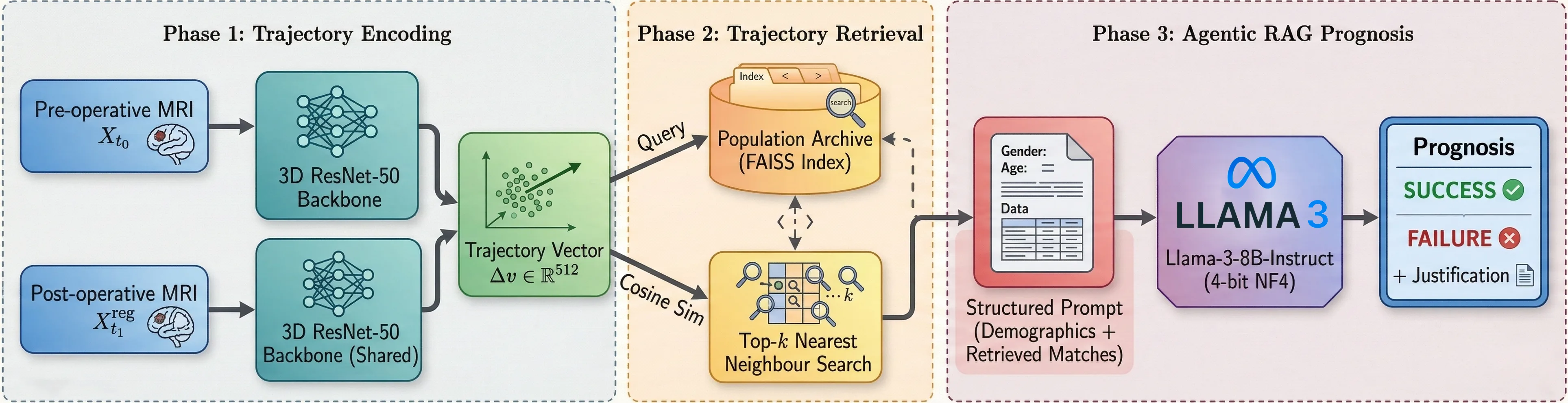
The new approach works like a librarian searching for similar medical histories. The program takes two scans, before and after surgery, and compresses the difference between them into a short code of 512 numbers. It then looks through an archive for cases with a similar code: people whose brains changed in the same way. Based on these examples, the program makes a prediction: did the surgery help, and why.
The accuracy of predictions was rated on a scale from 0 to 1 (the closer to 1, the better). The program scored between 0.834 and 0.905, while the old method, which looks at only one scan, scored 0.793. That's a noticeable step forward, but so far the system has been trained on 268 pairs of scans from an open database. The authors honestly admit: the program might have learned not the improvement itself but simply the location of the surgery — for example, the temple or another area. So this is more of a proof of concept than a ready-to-use hospital tool.
The first step is done: the program can find similar cases and explain its prediction without hallucinations — fabricated facts. If more data from different clinics are added, accuracy will improve, and then the decision about surgery will become more informed.
Original abstract
as written by the authors arXiv:2604.14216
Predicting post-surgical seizure outcomes in pharmacoresistant epilepsy is a clinical challenge. Conventional deep-learning approaches operate on static, single-timepoint pre-operative scans, omitting longitudinal morphological changes. We propose \emph{Neuro-Oracle}, a three-stage framework that: (i) distils pre-to-post-operative MRI changes into a compact 512-dimensional trajectory vector using a 3D Siamese contrastive encoder; (ii) retrieves historically similar surgical trajectories from a population archive via nearest-neighbour search; and (iii) synthesises a natural-language prognosis grounded in the retrieved evidence using a quantized Llama-3-8B reasoning agent. Evaluations are conducted on the public EPISURG dataset ($$N{=}268$$ longitudinally paired cases) using five-fold stratified cross-validation. Since ground-truth seizure-freedom scores are unavailable, we utilize a clinical proxy label based on the resection type. We acknowledge that the network representations may potentially learn the anatomical features of the resection cavities (i.e., temporal versus non-temporal locations) rather than true prognostic morphometry. Our current evaluation thus serves mainly as a proof-of-concept for the trajectory-aware retrieval architecture. Trajectory-based classifiers achieve AUC values between 0.834 and 0.905, compared with 0.793 for a single-timepoint ResNet-50 baseline. The Neuro-Oracle agent (M5) matches the AUC of purely discriminative trajectory classifiers (0.867) while producing structured justifications with zero observed hallucinations under our audit protocol. A Siamese Diversity Ensemble (M6) of trajectory-space classifiers attains an AUC of 0.905 without language-model overhead.
The difference between brain scans before and after surgery is compressed into a code of 512 numbers — somewhat like a fingerprint, but for changes in the brain.
A similar principle, searching an archive of past cases to predict the future, is explored in the movie 'Minority Report', where a system prevents crimes by analyzing the visions of precogs.