How Distant Bands Shuffle the Cards in the Quantum World express
Two sheets of paper slightly offset, and against the light, a moiré pattern appears: dark and light stripes. The same happens with semiconductor layers like molybdenum telluride. Their crystal lattices are slightly rotated relative to each other, and for electrons inside, a new, larger pattern emerges — an artificial "superlattice." In it, particles follow unfamiliar rules.
When electrons fill this lattice to one-third, they tend to arrange into a rigid order — a Wigner crystal. Each sits in its own cell, like a spectator in a movie theater. At two-thirds, the picture changes: there are few empty spots, and it's more convenient to talk about "holes"—the absence of electrons. Holes can also freeze into their own crystal. And between these extremes, a fractional Chern insulator tries to survive — a state where particles flow without resistance but carry only a fraction of charge.
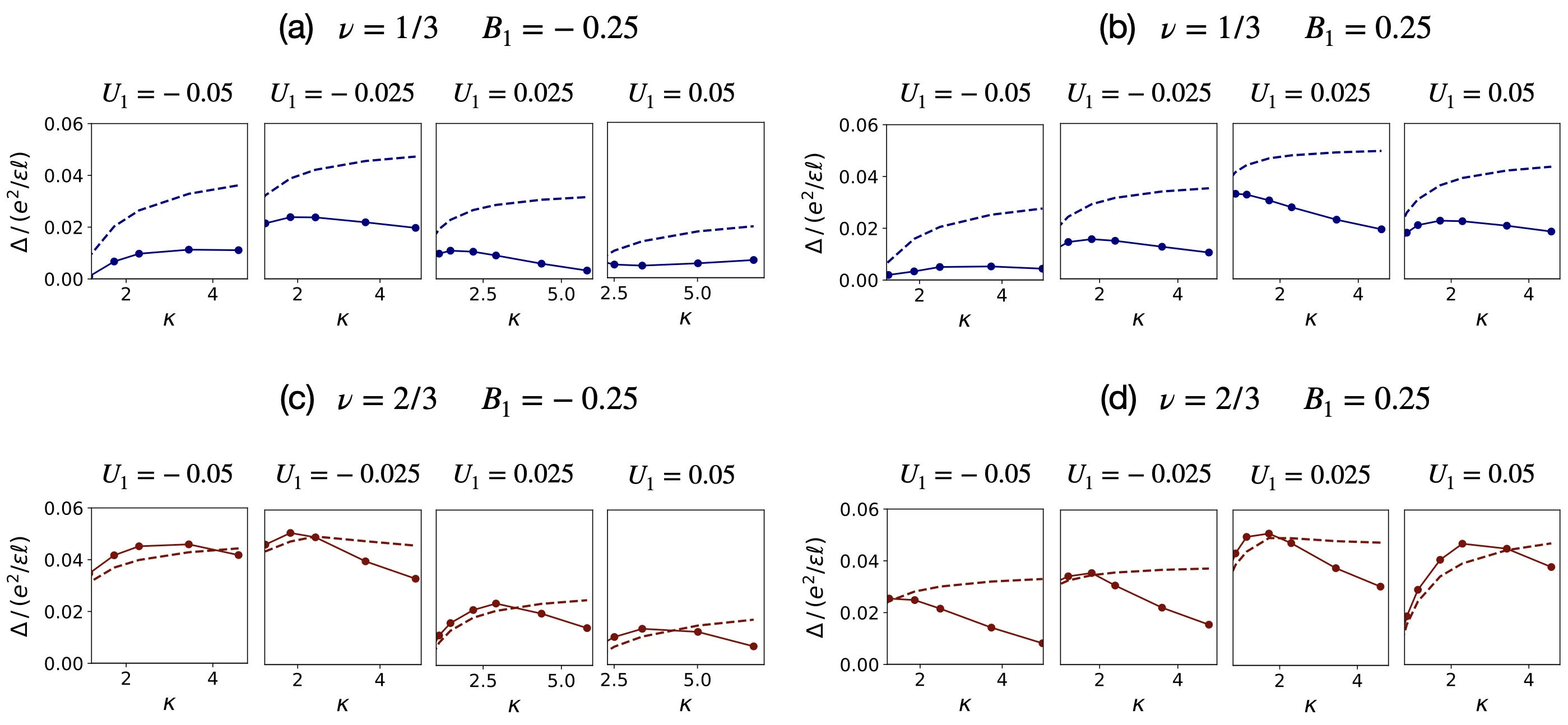
The authors found that "distant relatives" enter the game — energy bands usually considered too high or too low to matter. Their mixing acts selectively: it significantly lowers the energy of the electron crystal and barely touches the hole crystal. As a result, at one-third filling, the electron crystal wins the competition and displaces the fractional insulator. At two-thirds, the hole crystal doesn't get such a head start, and the quantum state survives.
Thus, distant bands, like invisible currents, redistribute forces in the struggle of electronic phases. A material one atomic layer thick turns out to be an arena where the interests of particles and their absence collide, and the outcome is decided by a barely noticeable influence from afar. And again the moiré, the pattern of superimposed layers, reminds us that in the quantum world, even the distant can shuffle all the cards.
The Wigner crystal was predicted almost a hundred years ago, but it was first seen in twisted materials only in 2021—electrons lined up in a perfect lattice, just as Eugene Wigner had long dreamed.
The idea of fractional charge, where a particle is "spread out" over several bodies, resembles the fictional element "lewis" from Neal Stephenson's novel "Anathem"—there, too, quantum states interweave into unimaginable patterns.