Repulsion, in the context of quantumphysics, is a force that pushes particles apart. While gravity is classically attractive, quantum experiments have shown that under certain conditions — such as with negative mass or in curved spacetime — gravity can effectively repel. More commonly, repulsion arises from electrostatic forces between like charges or from the Pauli exclusion principle, which prevents identical fermions from occupying the same quantum state. In the quantum fog of atoms near surfaces, repulsive forces can balance attractive ones, creating stable levitation.
History
The concept of repulsive forces has roots in ancient Greek atomism, but the modern quantum understanding began with Wolfgang Pauli's exclusion principle in 1925. The possibility of repulsive gravity was explored by Hermann Bondi in 1957, and experimental evidence for quantum repulsion effects emerged in the 2000s with advances in cold-atom manipulation.
How it works
At the quantum level, repulsion often emerges from the exchange of force-carrying particles. For example, photons mediate electromagnetic repulsion between like charges, while the Pauli exclusion principle is a purely quantum rule with no classical analog. In the Casimir effect, quantum fluctuations of the vacuum can create either attraction or repulsion between closely spaced surfaces, depending on the geometry and materials. Recent experiments have demonstrated that a carefully engineered quantum superposition can make gravity itself repulsive, by exploiting negative effective mass.
In practice
Repulsive forces are harnessed in magnetic levitation trains, where superconducting magnets create repulsion for frictionless travel, and in quantum technologies like atom traps, where repulsive forces confine ultracold atoms for quantum computing experiments.
Fun fact
In 2023, physicists demonstrated that a cloud of ultracold atoms can be made to repel itself gravitationally, effectively creating a 'negative mass' fluid that accelerates toward a force pushing it away.
A handful of pebbles drops into a pond: each one sends out ripples. If the pebbles are different, the ripples will be different too: some sharp, some smooth. But when you look at the water from a distance and see only a small part of the ripples, all those differences blur together.
Drop a pebble into a pond, and ripples spread across the water. In much the same way, any body, even the tiniest, perturbs the gravitational field around it. In empty, cold space, these perturbations, like ripples on a calm surface, make two nearby objects always repel each other.
Two massive bodies frozen in a quantum superposition resemble a pair of dancers trying to keep a single rhythm while an orchestra blares around them. Each gravitational wave is a musician throwing them off beat.
In 1976, physicists predicted that an electron could do more than just fly past a nucleus: it could slam into it, transferring energy and making the nucleus 'shudder.' They called this effect NEEC — nuclear excitation by electron capture. But for nearly fifty years, no one has managed to observe it in an experiment.
Two balls dropped from different heights fall to the ground with different accelerations. In space, things are more complicated: even emptiness makes bodies move differently.
A massive aluminum cylinder weighing a ton hangs in a vacuum. A gravitational wave, a ripple in spacetime, passes through it, and the bar begins to tremble almost imperceptibly. That trembling can be heard as sound: gravitational waves turn into a phonon — a quantum of sound vibrations.
A lead sphere hangs above another lead sphere. According to the usual laws of gravitation, they attract each other exactly along the vertical — along the line connecting their centers.
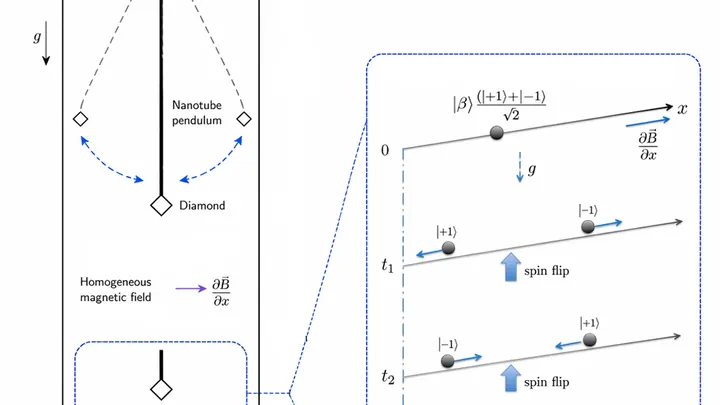
The quantum world loves balance. When a massive particle is forced to split, to go down two paths at once, something must give way in response. That "something" turns out to be the very apparatus that split the particle.
Quantum entanglement — a phenomenon where the states of two or more particles become interconnected regardless of the distance between them — usually links intrinsic properties such as spin or polarization. However, a new experiment has for the first time realized entanglement of the positions of two atoms in space.
Quantum matter rarely treats us to the spectacle of self-motion. Where the classical world teems with starling murmurations, fish schools, and bustling bacteria, quantum thermodynamics long remained serene.
Building a house on sand is a bad idea. In physics, it was long believed that a quantum theory of gravity could not be built on a fixed "sand"—a pre-existing spacetime.
Two floats on the waves. Throw a stone into water, and the ripples will spread, rocking both floats one after another — not simultaneously. In the quantum world, such rocking is called entanglement: particles, like floats, begin moving in sync.
A single particle can be in two places at once — that's superposition. But any interaction, like a shout, instantly 'collapses' this uncertainty. It was long thought that even gravity could interfere.
Gravitational waves are not vibrations of matter, but tremors of spacetime itself, predicted by Albert Einstein. They travel at the speed of light and pass through objects, stretching and squeezing them.
A coffee whirlpool can span two spots in a cup — a blur of swirling liquid. Quantum particles behave similarly: a spacetime whirlpool where they exist in two places at once. But gravity acts as the spoon that stirs the fabric of space and time.
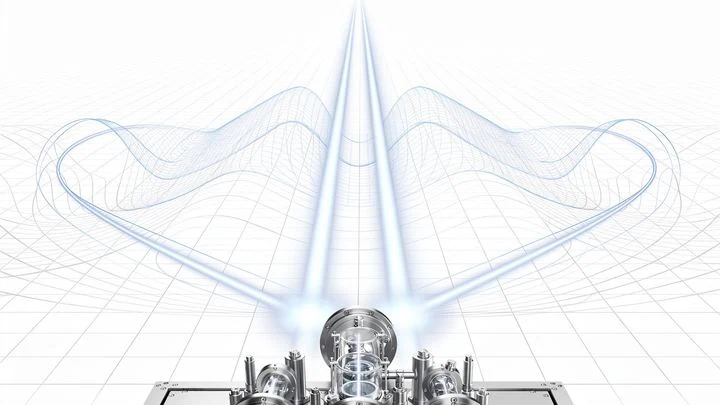
Two parallel streams of atoms, released from Bose condensates, begin their journey in free fall. In the classical picture, their separation remains unchanged — like two skiers gliding down a perfectly smooth slope. But if spacetime is not frozen snow, but a living, rippling membrane, then every tremble of it is transmitted to matter.
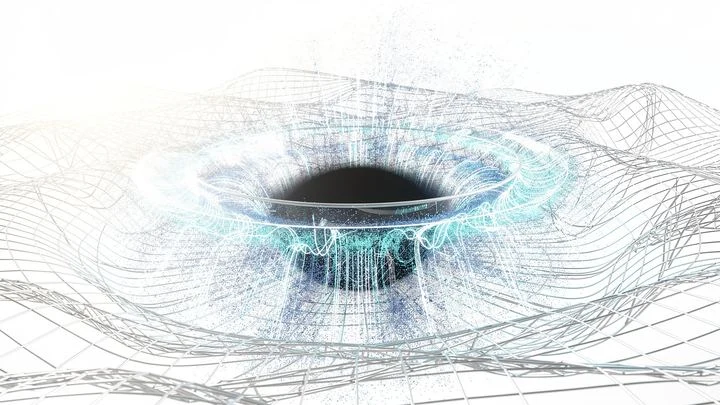
A dying star is not just fading away. In its final moments, the core, starved of fuel, collapses into itself at colossal speed. Classical gravity leaves no choice: if the mass is large enough, a black hole is born — a region from which not even light can escape.
A handful of rice thrown into a glass of water scatters — the grains spread apart. Now imagine each grain propels itself forward with stubborn persistence and bounces off softly upon collision. Such particles are called active: they spend their own energy to move, like bacteria or microscopic robots.
Two balls suspended on threads swing side by side. Each moves on its own, but between them is an invisible thread — the attraction of masses. If gravity is quantum, it could bind them into a single whole: nudge one, and the other responds, even without contact.
Gravity is like a stretched trampoline: massive bodies press into it, making other bodies roll toward them. This shared curvature of space, gravity, affects everyone, but it doesn't convey secret messages.
Two accomplices are interrogated separately: betray or stay silent? If neither knows what the other will do, their choice breaks the classical rule of probability. It’s like riding an old bicycle over bumps — the hard seat jolts you off. The textbook rule, the classical model, fails. The authors of a new study found a simple fix: the cyclist needs a soft saddle.
Schrödinger's cat, according to quantum rules, can be both alive and dead at once. But a table can't pull that off. When a massive object tries to be in two places, its mass curves spacetime so drastically that instead of two points, a single deep depression forms, and the object rolls into it.
The familiar picture: gravity always attracts. But if a mass is in quantum superposition (that is, in two places at once, like an object in a double-exposure photograph) everything flips. Quantum theory allows a particle to be both here and there in a literal sense: its position is described by a wave function smeared across space.
Gravity always pulls — an apple falls down, planets orbit in circles. But by placing a source of gravity in two places at once, you can get the opposite. Physicists have proposed an experiment: a massive body is put into a quantum state, smeared across space like a cloud. Then a tiny particle is shot into that cloud.
The law discovered by Wolfgang Pauli forbids identical particles from occupying the same spot. Hence, in cold matter, a Fermi sea is born: particles, like water, fill energy levels from bottom to top. The shape of the sea's surface — including 'islands' of emptiness — dictates the properties of the whole system.
Two particles can become linked so that a nudge on one instantly reverberates in the other, even if they are separated by galaxies. Einstein called it "spooky action at a distance." Physicists wondered: can gravity itself, a simple mutual attraction, create such a connection?
A quantum particle quantum particle can exhibit backward motion even if its overall direction is forward. Imagine a river: the main current rushes toward the mouth, but individual currents suddenly swirl and momentarily dart against the flow, creating local disorder.
Two massive spheres in the cosmic void. Push one, and the second will feel the push only after a moment: gravitational influence travels, like an echo of a shout in the mountains, with inevitable delay. This is how curved space transmits signals locally, step by step — predicted by Einstein long ago.