In solid-state physics, a hole is a conceptual absence of an electron in a crystal lattice. When an electron is excited to a higher energy band, it leaves behind a vacant state in the valence band. This vacancy behaves as if it were a positively charged particle, moving through the lattice as neighboring electrons hop into the empty spot. The hole is not a physical particle but a quasiparticle—a mathematical convenience that accurately describes the collective motion of many electrons.
History
The concept was introduced in the late 1920s by Rudolf Peierls and Werner Heisenberg, and later formalized by Lev Landau's theory of quasiparticles.
How it works
In a semiconductor or insulator, electrons occupy energy bands. At absolute zero, the valence band is full and the conduction band is empty. When an electron gains enough energy to jump to the conduction band, it leaves a hole in the valence band. An electron from a nearby atom can fill that hole, creating a new hole elsewhere—effectively, the hole moves. Under an electric field, holes drift in the direction opposite to electrons, contributing to electrical current as positive charge carriers.
Plasma is a gas in which electrons are stripped from atoms and roam freely. Sometimes, regions where electrons are almost absent spontaneously appear in such a gas; they are called holes. It is like a whirlpool forming in a stream, pulling everything around it in. But exactly how such a whirlpool is born has long remained a mystery.
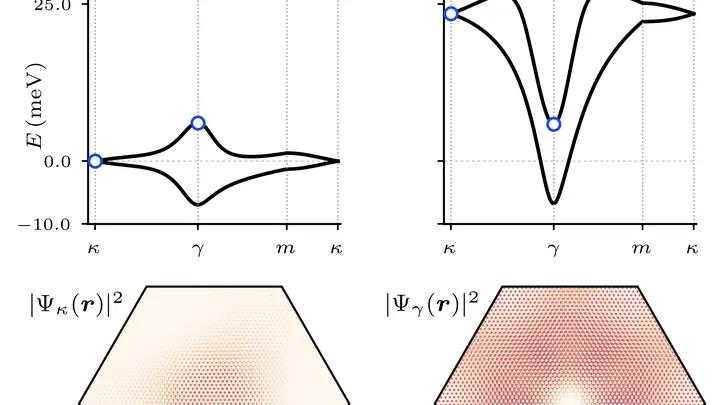
In a crystal, electrons are not distributed randomly. Their waves obey the lattice symmetry, like ripples on water taking the shape of a hoop thrown into it. The new work shows that at high-symmetry points, this ripple must have nodes — places where electron density is strictly zero.
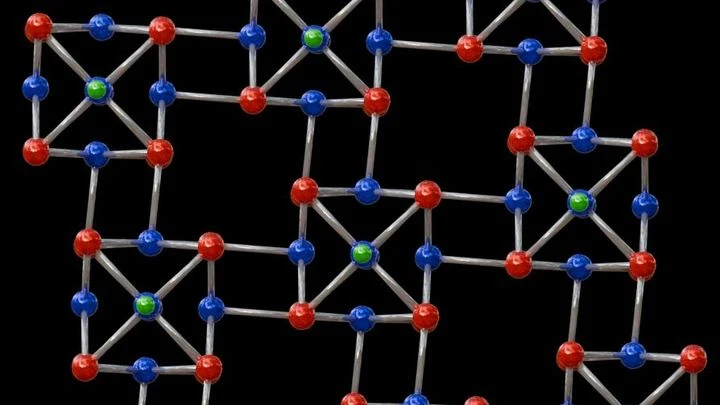
A mosaic of squares and triangles covers the floor without gaps, yet it never settles into a simple repeating pattern. Such a pattern is a quasicrystal — a solid where atoms are arranged not periodically but according to a pattern of several waves of different lengths. These waves are incommensurate with each other, and together they create long-range order.
A honeycomb made not of wax but of atoms is graphene — a flat crystal just one atom thick. Electrons in it are like runners at an intersection: they speed up here, slow down there, but never get stuck at the edge. Physicists call such a sheet "topologically trivial," meaning its edges are perfectly ordinary, with no special properties.
Now, let's knock out a single atom from the honeycomb.
Two thin sheets with honeycomb patterns were stacked and slightly rotated, creating a new pattern — a moiré, like the shimmer of silk. The electrons in the experiment behaved similarly: they arranged themselves into two layers, with one layer rotated exactly 30 degrees relative to the other.
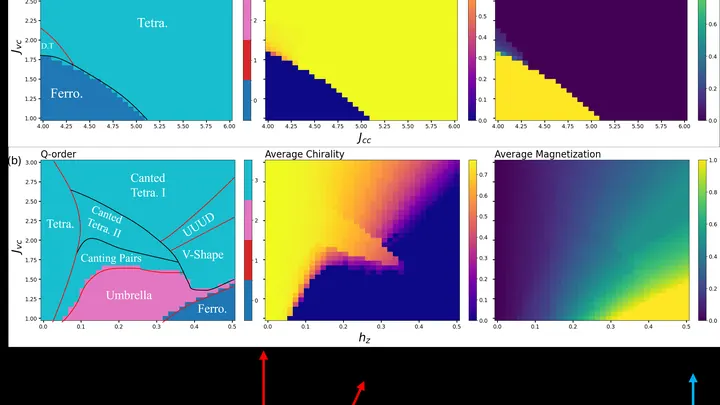
Imagine a triangular grid with tiny magnetic arrows at each node. Electrons, the charge carriers, run across this grid. Usually, the arrows align simply: all pointing the same way (ferromagnet) or alternating in the plane.
A laser strikes the crystal, and it responds with flashes of light, like a bell ringing after a blow. But if the bell is warm, its sound wavers and fades. Same here: the crystal's atoms constantly jitter from heat, and this jitter disrupts the electrons' smooth flight, making the light dim and blurry.
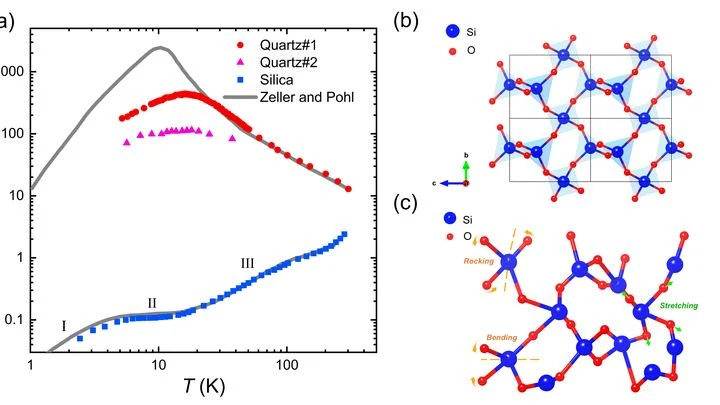
If you push heat through a piece of quartz, it usually goes straight, like water through a pipe. But switch on a magnetic field, and the flow veers slightly sideways, as if the pipe suddenly grew a side branch.
In two-dimensional crystals, electrons and holes, quasiparticles corresponding to the absence of an electron and carrying positive charge, attract each other, forming bound pairs called excitons. When cooled strongly, as thermal fluctuations die down, the motions of many excitons can synchronize, like a coordinated dance.