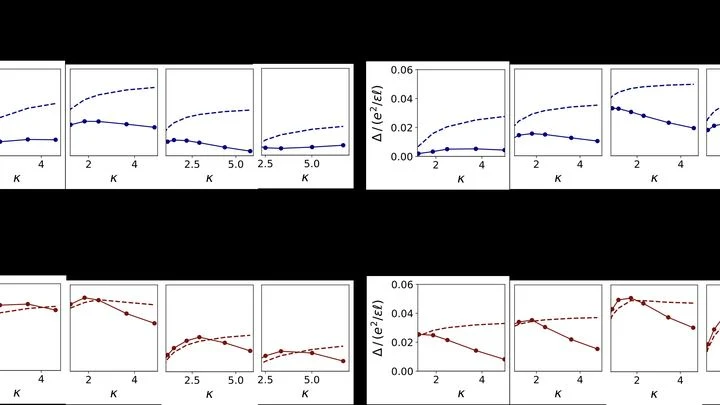
Two sheets of paper slightly offset, and against the light, a moiré pattern appears: dark and light stripes. The same happens with semiconductor layers like molybdenum telluride.
Two sheets of tungsten diselenide (not carbon, but a compound of tungsten and selenium) are rotated relative to each other by a tiny angle, about 5 degrees. This creates a moiré pattern: an enlarged periodic lattice where electrons behave very differently than in a regular crystal.