A moiré pattern is an interference pattern created when two periodic structures (such as grids or lattices) are overlaid with a slight twist or mismatch in spacing. In physics, moiré patterns have become a powerful tool for studying and engineering electronic and optical properties of materials, especially in two-dimensional crystals like graphene. When two layers of graphene are stacked at a small angle, the resulting moiré superlattice can dramatically alter the material's electronic behavior, leading to phenomena like superconductivity and correlated insulating states.
History
The term 'moiré' comes from a French fabric pattern, and the physics application gained prominence after the 2018 discovery of superconductivity in twisted bilayer graphene by Pablo Jarillo-Herrero's group.
How it works
The pattern arises from the beat frequency between the two periodicities: where the structures align, features reinforce; where they misalign, they cancel. In twisted bilayer graphene, the moiré superlattice creates a new, larger periodicity that modulates the electronic potential, producing flat bands near the Fermi level. These flat bands enhance electron-electron interactions, giving rise to exotic quantum states.
In practice
Moiré engineering is used to design quantum materials with tunable properties, potentially enabling new types of transistors, superconducting devices, and quantum simulators.
Fun fact
The twist angle in twisted bilayer graphene is so precise that a rotation of just 1.1 degrees—dubbed the 'magic angle'—is enough to turn a conductor into a superconductor.
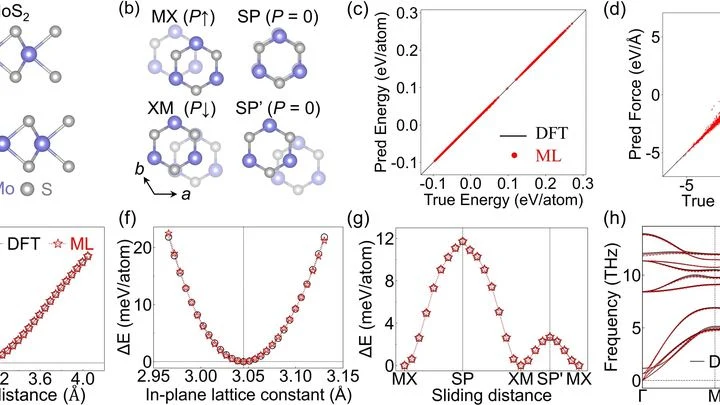
A deck of cards in which each card is slightly rotated cannot lie flat: the backs and faces will never align. But if the cards are flexible, they will start to adjust, shifting by fractions of a millimeter to find the perfect match. Something similar happens inside crystals when two thick layers of MoS2 or MoS2 with WS2 are stacked with a twist of 1–2 degrees.
Two transparent sheets with circles drawn on them. If you stack them exactly, the circles align. But give one sheet a slight twist, and a new pattern emerges: in some places the circles bunch together, in others they spread apart. That's roughly how moiré works — an unexpected pattern born from rotating two periodic structures.
Usually, light does not turn an insulator into a conductor: that requires powerful laser pulses that break the material's structure. But in twisted bilayer graphene at the magic angle, things are different.
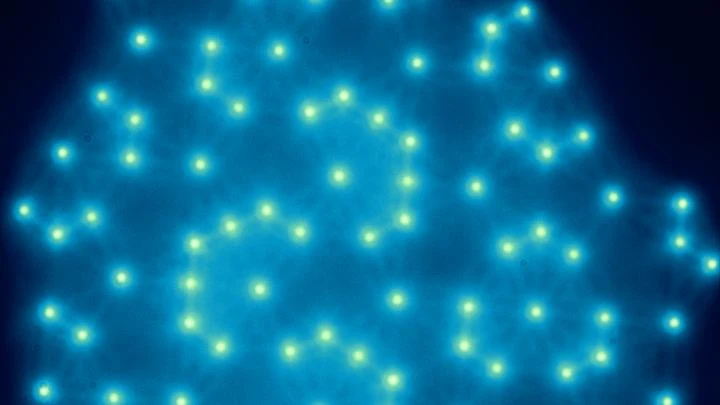
Moiré patterns are familiar to everyone. Two combs with different spacing, placed on top of each other, show dark fringes. Something similar has emerged in time. Physicists took a cloud of Rydberg atoms, particles with unusually large electron orbits, and illuminated it with two lasers.
Graphene, a two-dimensional carbon crystal, has long tantalized physicists with the hope of high-temperature superconductivity. Its electrons obey the relativistic equation of Paul Dirac, racing at tremendous speed, barely noticing each other.
An ionic conductor resembles a crowded bus where passengers (ions) try to squeeze toward the exit. Previously, it was thought that fast exit could be achieved either by a gently swaying bus (soft lattice) or by passengers standing in chaotic order (geometric disorder). The new work shows these are not two different tricks but the same one.
A sheet of paper with square grid, one with diamond grid, and one with honeycomb — three different universes for an ant. Change the sheet, and the rules of movement change. That's roughly how electrons experience the crystal lattice: geometry dictates whether they become little magnets, superconductors, or something else. In ordinary materials, the lattice is as rigid as if engraved.
A switch that knows which way to let current flow. That's how a Josephson diode works — a superconducting bridge where current goes willingly in one direction but meets resistance in the other. In the new study, such a bridge was made from graphene — a sheet of carbon just one atom thick.
Tile a floor with identical triangles, and you get a boring repeating pattern. But what if you want the pattern to never repeat, yet use just one tile? For a long time, mathematicians were sure it couldn't be done: you'd need at least two different shapes. The famous Penrose mosaic is a case in point: rhombi with acute and obtuse angles arrange into an infinitely varied but strictly ordered pattern.
Two sheets of paper stacked together start to creep ever so slightly over each other when heated. That's roughly how layers of molybdenum disulfide, a material one atom thick, behave. At room temperature, they spontaneously slide at a speed of about one meter per second.
Light from thin semiconductor layers can be polarized: its waves oscillate in a single plane. Previously, it was thought that the direction of oscillation was set by how the sample was illuminated.
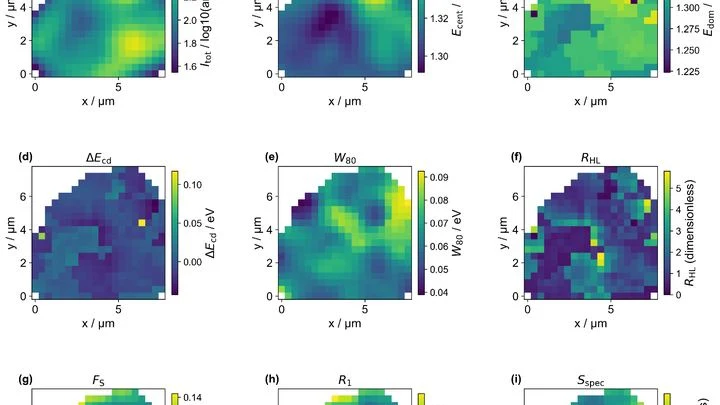
The glow of an ultrathin sandwich made of two semiconductor layers, molybdenum selenide and tungsten selenide, resembles a tangled musical score: many narrow colored lines that merge into a general background. Figuring out which line comes from where is nearly impossible.
The authors did not try to disentangle the lines one by one.
The heart beats steadily, then slips into arrhythmia. The climate holds its familiar rhythm for decades, then shifts to a new state over a single summer. Such regime shifts are like a flick of a switch, but in real data we see only a noisy one-dimensional signal in which the moment of the break is hidden.
A superconductor is a material that, when strongly cooled, loses its electrical resistance: current flows through it without losses. Scientists took a layered crystal of PdTe2, similar to a stack of sheets of paper, and cooled it to temperatures below 1.8 kelvin (that's about -271°C).
A sheet of graphene, a carbon lattice just one atom thick, under a powerful laser beam behaves like a road where a toll barrier suddenly appears. Electrons that were freely racing through the material suddenly hit a forbidden zone: an energy gap they cannot leap across. This was predicted theoretically before, but no one had ever seen it directly.
Two sheets of graphene — carbon film one atom thick — without a twist resemble a harbor clogged with shoals: lithium ions either run aground or rush past without stopping. But a 9.43° twist lays out a perfect fairway. The ion ships dock securely to carbon 'piers' and immediately cast off without losing speed.
A sheet of graphene one atom thick is like a perfectly smooth tablecloth on which electron marbles roll. Place an electric barrier in their path, and usually they'll bounce back. But in graphene, it's different: under certain conditions, electrons pass through the barrier without even noticing it, as if the wall were made of mist.
Quantum particles in a strongly disordered environment behave like dancers executing steps in sync: each knows its own move and never collides with others. This kind of coordinated, frictionless flow, superfluidity, unexpectedly emerged in an experiment on a superconducting quantum chip.