AI learns to look like a doctor express
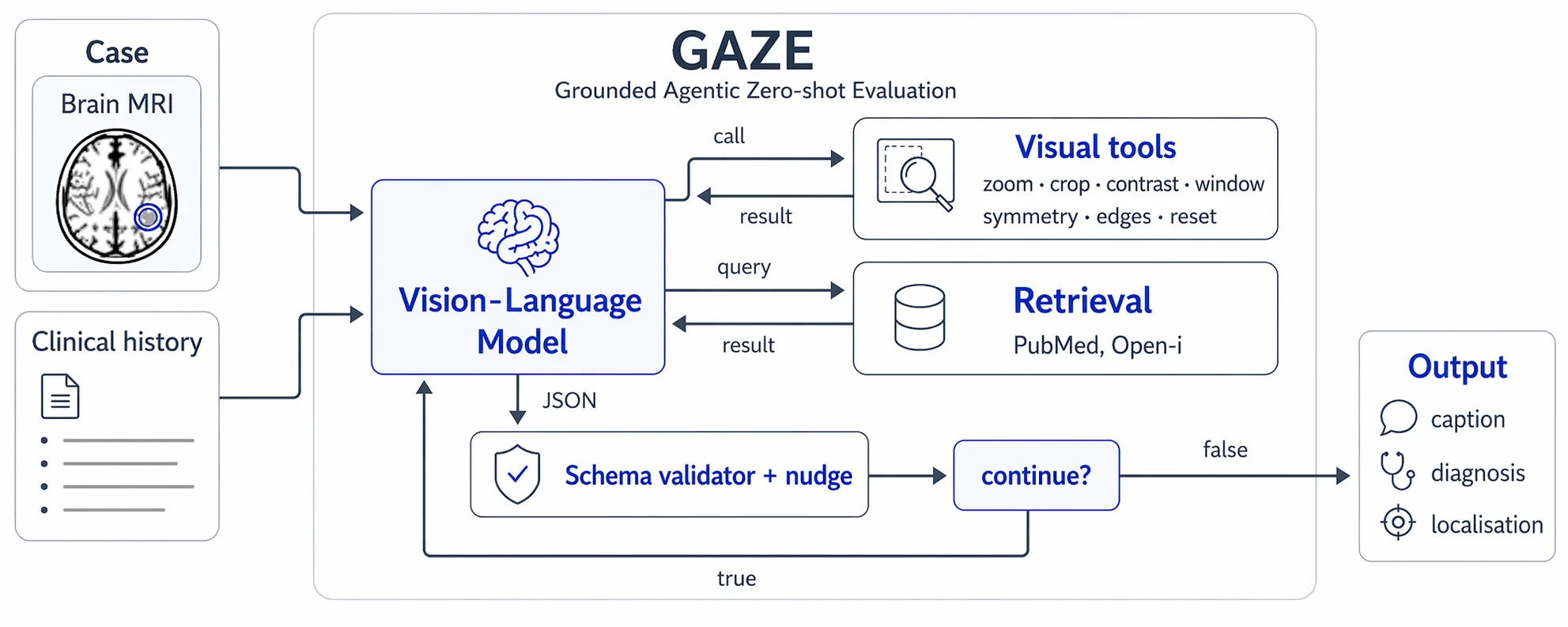
A doctor rarely makes a diagnosis from a single quick look at a scan. They peer, zoom in, compare with an atlas, flip through articles. Until recently, neural networks worked differently: see the image, immediately produce the text. The authors of the new study decided to give the model time and tools.
The neural network GAZE works like a careful radiologist. It can zoom in on a suspicious area, enhance contrast, highlight edges, and also look into the PubMed medical article database and the Open-i image archive. Every step is recorded, so the entire path to the diagnosis can be verified. In a trial with 906 brain MRIs containing 281 rare diseases, GAZE found affected regions in 58% of cases and correctly named the disease in 35%—without special training for this task.
But there is a nuance. When the model actively searches for articles and similar scans, it makes better diagnoses but sometimes outlines lesion boundaries worse. So the authors insist: such systems must be evaluated on three points at once — what it wrote, what diagnosis it made, and how accurately it outlined the affected area. Only then can we tell that the neural network has truly learned to look like a doctor.
On average, the model called its tools almost 12 times per scan — about the same number of actions a radiologist takes when studying a complex case.
In the TV series 'The Good Doctor,' a brilliant physician examines scans over and over until he sees what others missed. GAZE is a step toward that same persistence in machines.