A frame, in cognitive science and artificial intelligence, is an internal model or mental schema that organizes a set of features used to interpret situations. It acts as a template that shapes how incoming information is structured and understood, allowing the brain or an AI system to quickly categorize new experiences based on prior knowledge. Frames are fundamental to perception, memory, and decision-making, as they provide the context that gives raw data meaning.
History
The concept of frames was formalized by Marvin Minsky in his 1974 paper 'A Framework for Representing Knowledge,' building on earlier ideas from psychology about schemas and scripts.
How it works
A frame consists of a network of slots or attributes, each with default values and constraints. When a new situation is encountered, the system matches its features against the frame's slots, filling in missing details with defaults and adjusting the frame to fit the specifics. This process enables rapid inference and prediction, as the frame supplies expectations about what is likely to occur, reducing the computational load of processing every detail from scratch.
In practice
Frames are used in AI for natural language understanding, computer vision, and knowledge representation, enabling systems to interpret ambiguous inputs by applying contextual models.
Fun fact
The brain uses frames so efficiently that it can fill in missing visual information in blind spots without conscious awareness, a phenomenon known as perceptual filling-in.
A jazz trio plays in the dim light of a club. The pianist leads the melody, the bassist holds the rhythm, and the drummer sprinkles out rolls. If you listen only to pairs of musicians, you can catch how the pianist adjusts to the bass or the bass to the drums.
A radiologist looks at an abdominal scan and sees not just organs but their spatial relationships: which kidney is larger, where the tumor lies relative to a vessel. It's like reading a map, where it's not enough to know where a city usually stands; you also need to measure the distance between two points on the ground.
In the Antarctic ice, a ghost particle leaves behind only a faint flash of blue light. The IceCube detector captures these flashes, and from them we need to infer where the particle came from. The PolarBERT model has learned to do this, but what exactly it sees inside has remained a mystery.
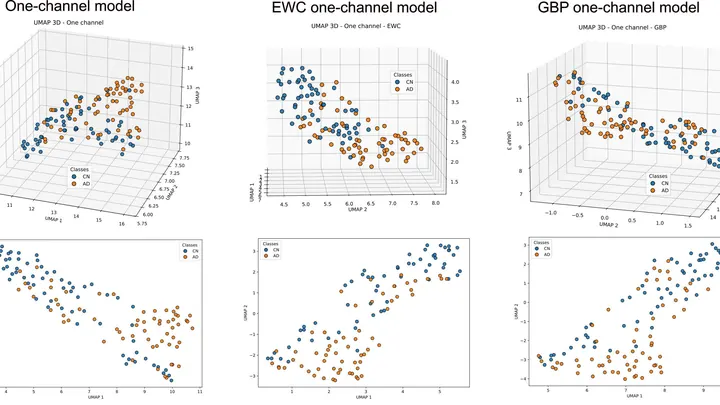
A doctor spends years learning to recognize diseases from brain scans. First, they excel at spotting signs of aging, then they master tumors, and suddenly they start confusing what they knew before. Many neural networks behave much the same way: new knowledge overwrites the old.
A typical tracking program resembles a navigator steering a ship by the stars. But as soon as the sky clouds over, coordinates drift, and entropy (a measure of uncertainty) builds up in the data. The new algorithm gets a ‘co‑pilot’ — a module that monitors how confident the main navigator is.
In boiling soup, molecules collide chaotically and react. But if you measure how their concentrations change, patterns emerge. This is how carbon chemical networks work — mixtures of molecules that spontaneously 'cook' information, turning each reaction into an elementary computation. Previously they were used only for modeling nature.
The modern standard approach to AI training is like a child locked in a library: he remembers millions of books but doesn't know that fire burns and falling hurts.
Assessing image quality is a job for a meticulous inspector with a toolbox. The IQA-T1 neural network acts exactly like that: it doesn't just stare at the picture, but applies either a spectroscope or a light meter.
A child exploring an unfamiliar apartment crawls from object to object and remembers what is visible from each corner. This is how the brain builds a mental map — an internal model of space. The gradCSCG algorithm works on the same principle: it receives a video stream from a camera and independently draws a map of the room, relying only on the changing images.
A robot swarm is like a cloud of fireflies: each moves on instinct to wherever is freer, and chaos turns into order. For a long time, it was a mystery how coherence emerges without communication or commands. The answer came with the creation of the Response Map — a tool that, like an X-ray, illuminates the hidden logic of the machine brain.
Researchers took 16 everyday activities — from washing dishes to squatting — and broke the movements down into elementary components, much like a spectroscope splits light into a spectrum. Comparing three approaches, they found an unexpected key to recognition: a single averaged snapshot is enough. Only nine joints out of dozens carried the crucial information — the rest hardly mattered.
Data analysis on the internet or sensor systems has long resembled trying to conduct an orchestra where each musician is locked in their own booth, and the conductor cannot leave the podium.
The standard way of digitizing speech: taking volume readings thousands of times per second. It's like tasting broth with a teaspoon: each sip is watery, with almost no detail. The data stream swells, though the substance is minuscule.
Scientists proposed first "simmering down" the audio signal.
An experienced detective doesn't calculate a criminal's path using the laws of physics: he checks a file of similar cases. The new prediction method works the same way: instead of complex equations, it has a vast archive of trajectories that have already happened — planetary motions, currency exchange rates, signals from space.
Imagine an old theater in the damp fog. On the stage, a scattering of actors, but only one is caught by the spotlight beam, made to freeze in the bright patch. The rest billow in the dim light, ready to dissolve at any moment.
Gravitational microlensing is a fascinating cosmic effect predicted by Einstein and developed by Zwicky. A massive body passing between us and a distant star bends its light like a lens, creating characteristic magnifications and distortions.
In the courtroom, a string is presented as input. Twelve jurors (computation paths) examine it symbol by symbol. Each can render a 'guilty' (accept) or 'not guilty' verdict. For a conventional nondeterministic automaton (NFA), one 'yes' vote suffices.
Eight hundred participants, firms and workers, enter the market. Each holds a strict preference list in mind. The challenge: pair up so that no one wants a do-over. In mathematics, this is called a game theory with a ban on repeat alliances, and its roots trace back to the work of John von Neumann and Oskar Morgenstern.
On the screen is the result of a complex simulation: two planets collided, a shockwave ripples outward. A couple of clicks in an editor, and harsh shadows soften, noise smooths out, the background darkens. This kind of digital retouching (image editing to enhance appearance) has long been part of the scientist’s toolkit.
Why do some systems, from gene networks to air travel, preserve imprints of the past longer than others? For a long time, network science blamed topology: the number of connections, modularity, spectrum. But two networks with the same skeleton can remember and forget in completely different ways.
In the 1990s, philosopher John Searle devised a thought experiment: a person sits in a room and, without knowing Chinese, follows instructions to produce correct answers in Chinese. From the outside, it seems they understand the language, but inside, it's just mechanical rule-following.
You buy a new kitchen scale, but instead of exact weight, it only shows deviations from some "norm." To find out how much an apple weighs, you first have to weigh dozens of other apples and calculate the average.
Computational studies of material behavior have long suffered from two extremes: either fast but inaccurate models, or accurate but slow physical calculations. Modern programs, trained on data, have nearly resolved this dilemma — now the bottleneck is not computing power, but human routine: setting up simulations and checking results.
Paimon works like an autonomous chef.
Designing machines is like cooking: you need to know exactly where the 'dough' will tear. Old computer simulations check every point on a part for hours, like measuring the entire pot to make sure the handle doesn't fall off.
A supermarket cashier at rush hour doesn't memorize every scanned item: they keep the running total in their head and watch the queue. The brain allocates its resources similarly: the expensive, precise cortex (responsible for deliberation) and the simpler, economical subcortical nuclei (where habits live) work in tandem.
A person looks at a door lock and sees a keyhole. They know that a key is inserted and turned. But if instead of a keyhole there's a touch panel, the familiar frame breaks. The person doesn't just make a mistake: they realize that the usual approach won't work and can say, "There's no place for a key here; a different approach is needed."
Such an honest stop with an explanation is rare for machines.
In a grand courtroom, a meeting is in session. Hundreds of translator-neurons simultaneously hear fragments of phrases, and must piece them into a single coherent picture. This is exactly how large brain networks turn scattered signals from the eyes into a unified object image.
A proofreader checks a manuscript before it goes to print. They don't know every possible mistake, but they know exactly what flawless text looks like. Spotting a strange symbol or a blurred word, they immediately circle it in red. That's roughly how the new program for checking medical images works.
A city is a living system: it consumes resources, produces waste, and its 'circulatory system'—the road network — delivers people and goods to their destinations. But while engineers design transport arteries as rigid geometry of straight lines, nature has spent millions of years perfecting ideal distribution networks.
Engineers are building a car. Some assemble an exact replica of the engine, every piston and spark plug, but the car doesn't move: there's no steering wheel or wheels. Others build a fast self-driving go-kart, but its engine is made of playdough and doesn't resemble a real one. This is roughly the situation in brain science.
An artist paints a picture, glancing at the audience in the hall. If the viewer smiles, the artist adds more red and rounded lines to the canvas; if the viewer frowns, the artist removes blue and sharpens the angles.
You're trying a dish at a restaurant, but you haven't seen the menu. You ask the waiter questions — too salty? what spices?—and from the answers you try to guess what kind of chef prepared it.
A vast hall with a thousand doors, and only one leads to the stars. The rest are locked, and the keys aren't just hidden: they're wrapped in other keys and tangled into a knot. That's the Great Filter in a new reading: not a chain of failures but a tangled hierarchy where each step depends on the previous one nonlinearly.
The Universe's expansion is accelerating, and maybe gravity doesn't work the way we think. Physicists come up with alternative theories, but to test them, they need to calculate how ripples after the Big Bang grew into galaxies. Such calculations involve long equations with hundreds of terms, where it's easy to get lost.
A thermostat keeps a room at 20 degrees. Open a window in winter, and it kicks on the heat to restore equilibrium. The brain does something similar: it constantly predicts what will happen a moment ahead and corrects itself when wrong. That's how it learns.
An orchestra plays without a conductor. Each musician has a score: that's the genes. But the volume and tempo depend on the acoustics of the hall, the mood, and the neighbors on stage. That's roughly how heredity and daily life together shape a teenager's behavior.
Imagine a river that doesn't flow in an open channel but through the inside of a sponge, with its currents shifting from place to place. That's a good way to think about the brain's glymphatic system: a network of ultra-fine channels around blood vessels, through which cerebrospinal fluid seeps into the tissue and washes away the waste that has piled up during the day.
After a game of Scrabble, the board looks like a mosaic: tiles are scattered but form a connected pattern — islands of words in a sea of empty cells. Such a pattern can be described mathematically, but usually that requires complex rules.
The brain constantly juggles tasks: it reacts to a sharp sound, solves an equation, or drifts into daydreams. Scientists have long suspected that switches between different "scenarios" of neural network activity underlie this, but extracting them from the chaos of electrical signals was difficult.