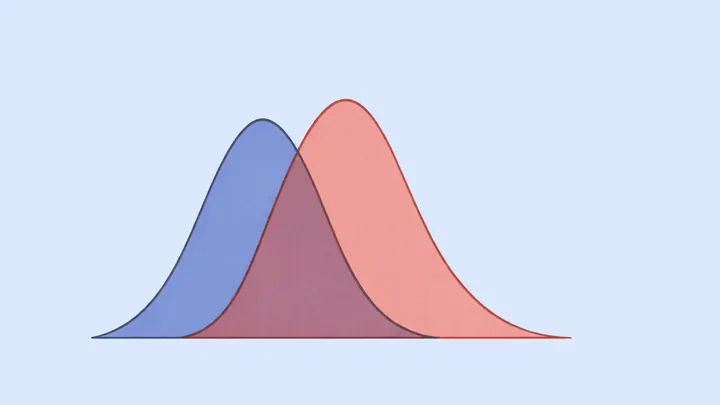
GAN is an architecture of two neural networks playing a minimax game: generator G tries to fool discriminator D by creating plausible data, while D learns to spot fakes. Equilibrium occurs when G reproduces the real data distribution so accurately that D can no longer distinguish—its accuracy drops to random guessing (50%). Like an arms race between a counterfeit bill maker and a bank expert, each side raises the bar.
History
Proposed by Ian Goodfellow et al. (2014) as a way to train generative models without explicitly modeling the data distribution. The idea traces back to adversarial games and minimax theory. They quickly became popular due to their ability to generate realistic images, sound, and video. Subsequent modifications—DCGAN, StyleGAN, CycleGAN—addressed training instability issues and improved quality.
How it works
During training, G and D are updated alternately. The discriminator receives a real sample and the generator's output, computes its loss (logistic loss function). The generator adjusts its weights to maximize the discriminator's error—i.e., to make the fake appear real. Gradients from D flow back through G, shaping the latent representation. Problem: vanishing gradients if D is too strong, so non-standard loss functions (e.g., Wasserstein GAN) are often used.
In practice
Generating photorealistic faces, creating clothing designs, enhancing medical images — anywhere that requires plausibly filling in the details.
Fun fact
The most impressive deepfakes and old film restorations owe their existence to GANs.
In a nine-story building with a thousand rooms on each floor, some people whisper and others shout. Neighbors pass the message along, but if everyone speaks too softly, the message fades by the third floor. If too loudly, by the top floor it becomes an unintelligible roar. Between these extremes, there is a regime where a whisper makes it all the way through without distortion.
Imagine a simultaneous interpreter in a room where two people are speaking: they must keep up with both meaning and intonation, but if the speech is too fast, only a paraphrase remains. That's roughly how scientists feel as the stream of gravitational waves from black hole and neutron star mergers grows, while precise signal calculations lag behind.
Imagine a simultaneous interpreter in a room where two people are speaking: they must keep up with both meaning and intonation, but if the speech is too fast, only a paraphrase remains. That's roughly how scientists feel as the stream of gravitational waves from black hole and neutron star mergers grows, while precise signal calculations lag behind.
Getting lost in a hall of mirrors is easy: every wall reflects another, and you feel like you've been here before. The brain gets similarly confused when surrounded by many similar places. Neurons responsible for the spatial map can fire the same signal for two different corners of a room. This is called spatial ambiguity.
Holding in mind the exact position of a pen as it's slowly moved is a routine task for the brain. For artificial neural networks, it's nearly impossible. Standard recurrent networks like GRU and LSTM tend to break continuous motion into rigid steps: the pen doesn't glide smoothly but jumps from point to point.
Predicting the yield of a chemical reaction is a bit like trying to guess the harvest knowing only the soil composition. Traditionally, chemists have relied on long columns of numbers, quantum descriptors, that describe electron energies but say nothing about molecular shape.
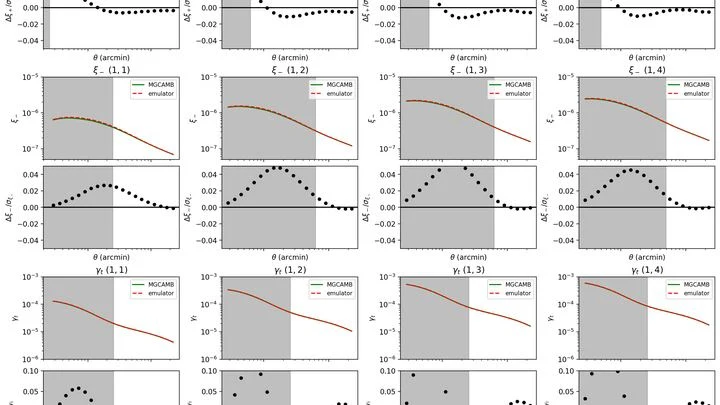
In the vast cosmic ocean, dark matter gathers into clumps and filaments, like plankton in currents. But if gravity doesn't work exactly as Einstein said, these patterns change — barely noticeably, like ripples from an invisible wind. You can spot such ripples by comparing sky maps with computer simulations.
A basin of wet sand. You press in one corner, and water starts moving. But how exactly? Instead of an even circle, it might spread in tongues, linger in some spots, and rush through others. Underground, the same thing happens: oil, water, or gas migrate through rocks not by the textbook, but following the chaos of fractures and heterogeneities.
By 2025, large language models like GPT are no longer just chatting: they're helping scientists run experiments. But the same tool could fall into the wrong hands. A team of researchers built a digital proving ground to find out.
When two phones try to create a shared secret key from random properties of radio waves, interference makes their measurements imprecise. It's like two people looking at a reflection in a fogged-up window: each sees a blurry silhouette, and there's no way to make out a common picture.
Models that turn text into audio are good at recreating single sounds, but get confused when the script has several in a row. For example, the script might call for a ring, then footsteps, then a door slam. The generator might shuffle events, so the listener hears footsteps before the ring.
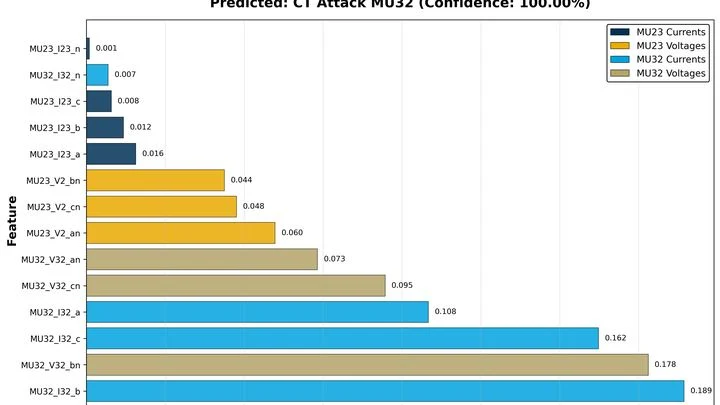
Solar panels and wind turbines, unlike old-school generators, connect through inverters, opening new loopholes for hackers: you can quietly falsify sensor readings or spoof GPS timestamps. To defend, engineers combined two approaches — an ultra-fast guardian and a thoughtful detective.
In a kitchen with gas burners, each heats differently. If the cook moves the pots, food may burn. Just so in a wireless network: the antenna-burners and user-pots require precise placement. Ordinary neural networks don’t distinguish positions, treating all burners as identical. So they struggle to estimate signal quality or adjust transmission.
In the depths of space, gravity is mastering the art of disguise. For a quarter century, astrophysicists have been trying to decipher the nature of dark energy, which makes the Universe expand at an accelerating rate.
Active noise cancellation creates 'anti-sound' to neutralize noise. But ordinary systems are blind: they don't know where the sound is coming from. In rooms with an echo, it's like boxing with a blindfold on — you're canceling blindly.
A robot swarm is like a cloud of fireflies: each moves on instinct to wherever is freer, and chaos turns into order. For a long time, it was a mystery how coherence emerges without communication or commands. The answer came with the creation of the Response Map — a tool that, like an X-ray, illuminates the hidden logic of the machine brain.
A cook who learns to cook from hand-drawn pictures risks ruining every dish. The same trap awaits computer vision: models need thousands of labeled images, but collecting them manually is expensive and tedious. Synthetic frames solve the problem, but only if they look real.
The railway overhead contact line resembles a galaxy: energy flows through it like gravity, with trains becoming planets. The more trains draw current simultaneously, the stronger the voltage fluctuations — gravitational waves ripple through the system, threatening blackouts.
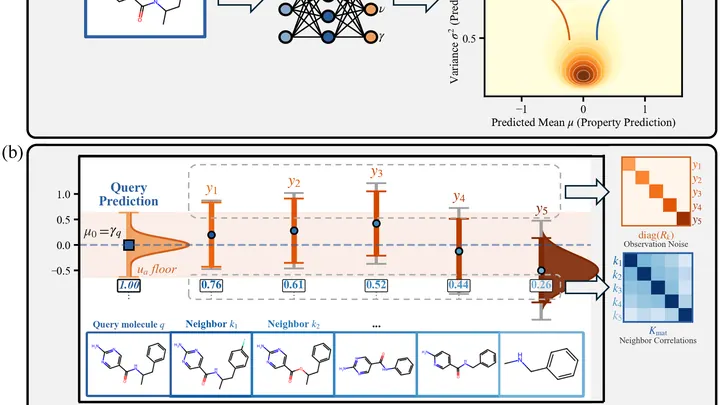
Predicting the properties of a new molecule is like guessing the flavor of an unfamiliar dish. The program works like an experienced chef: it “tastes” similar molecules whose properties are already known, and based on their “flavor,” it refines its guess.
The float in a toilet tank is an ideal controller: sensing the water level, it instantly brings the system into equilibrium without looking back at the past. Engineers applied this principle to neural networks.
A large neural network like Whisper masters hundreds of languages and resembles the standard model of the universe: everything is balanced. But training on a rare language disrupts this equilibrium — it turns into a black hole, pulling in all training resources. The network starts forgetting the other languages.
The universe rewrites its history again and again. Where ordinary astronomy sees only a point, a black hole, gravitational waves peel back thin layers of the past, like an ancient palimpsest. The idea that black holes can grow by devouring each other, and their offspring can enter new unions, has been discussed by astrophysicists for half a century.
The 120 residents of Montelago are not people but digital characters. Each, besides a name and biography, has three hidden coordinates: trust in municipal authorities, assessment of source credibility, perceived adequacy of information. These numbers are known to the creators but not to the system itself.
A tiny dust particle in a supersaturated solution sprouts into a large crystal in seconds. Neighboring particles remain invisible. A similar process was recently discovered in communities of language agents.
The LIGO and Virgo detectors catch gravitational waves from mergers of black holes and neutron stars. But among the cosmic signals, their sensitive arms are constantly crossed by shadows — short-lived noise artifacts, glitches, that stage a true shadow theater.
The immune system is like a tireless editor, revising antibody drafts to make them stickier to viruses and bacteria. This process is called antibody maturation: random typos (mutations) arise in the genes, and natural selection keeps those that improve target capture.
X-ray detectors work like honeycombs: particles flash here and there in hexagonal cells. Conventional algorithms stretch these combs onto a square grid, creating ghostly polarization artifacts. Scientists used a neural network that lives by the rules of the hive — it processes the hexagonal structure directly, preserving the natural pattern.
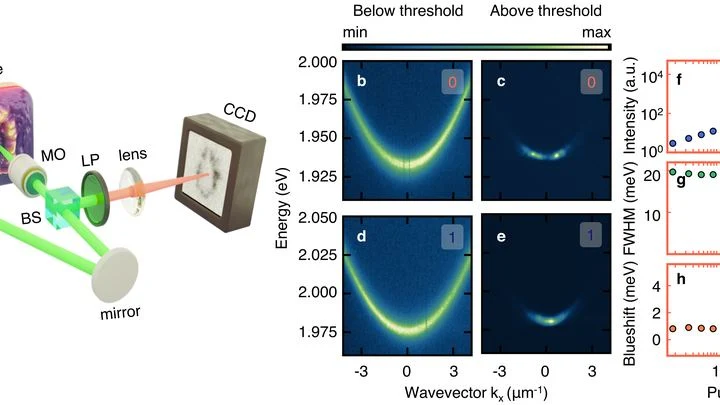
Generative neural networks that create images typically rely on digital randomness. But a team of researchers built a system where randomness is born not in code, but in a tiny optical cavity filled with an organic dye.
A dance of hundreds of particles: some pairs spin slowly and gracefully, others twitch in a frantic rhythm. To understand the essence of the dance, you need to watch the slow movements: they are the main choreography of the system. In molecular science, such slow movements are called 'slow modes,' and they determine how a protein folds into a ball or how a drug binds to its target.
You buy a new kitchen scale, but instead of exact weight, it only shows deviations from some "norm." To find out how much an apple weighs, you first have to weigh dozens of other apples and calculate the average.
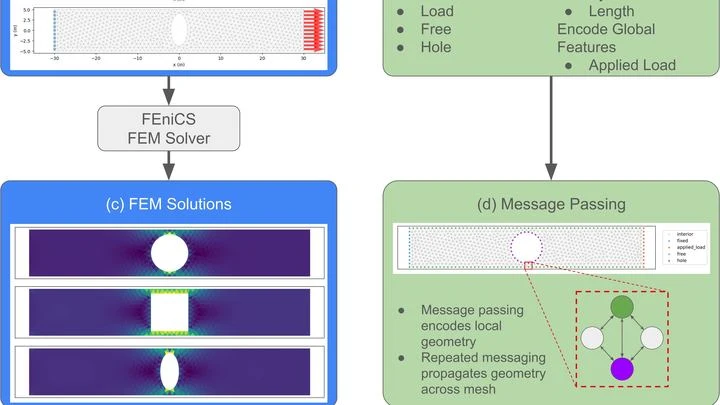
Designing machines is like cooking: you need to know exactly where the 'dough' will tear. Old computer simulations check every point on a part for hours, like measuring the entire pot to make sure the handle doesn't fall off.
The universe sometimes resembles a pot of boiling water. With enough heat, liquid turns to vapor: that's a phase transition. Something similar could have happened in the early universe: a field filling space suddenly changed its state, like water becoming gas.
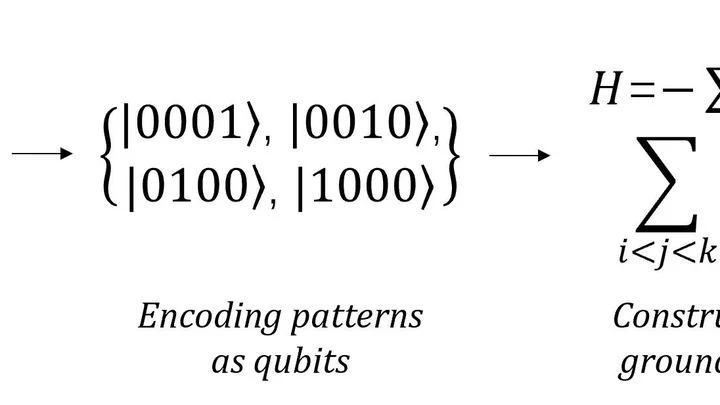
Conventional neural networks learn from thousands of examples, burning hours and gigawatts. Physicists have found a quantum workaround. As early as Max Planck showed the discreteness of energy, today this allows generation without training.
Two ultra-dense stars spiral around each other and eventually collide. This dance lasts only moments, but it sends powerful ripples through space — gravitational waves. After the merger, a rapidly spinning blob remains, ringing like a bell, and that ring carries information about what the stars were made of.
In the ocean of bank transactions, fraud is rarer than neutron stars in space, just 0.1% of all operations. A conventional detector gets used to the clean flow and loses vigilance.
Enter Q-SYNTH, a hybrid system with a quantum generator. It creates plausible fake transactions itself, drawing on scraps of real data.
A mosaic of large colored tiles. Each tile is the average precipitation over an entire month for an area the size of a small country. For a general understanding, the picture is fine, but if you need to know whether a downpour hit a specific city yesterday, it's useless.
When black holes collide, the very fabric of spacetime trembles. That rumble, gravitational waves, gets picked up by detectors, but decoding the signal used to take hours of computer simulation.
The symphony plays, but a barely perceptible wrong note has crept into the score. This is roughly how physicists search for deviations from general relativity in the 'sounds' of the universe — gravitational waves from merging black holes.
Every carbon atom in a molecule carries a passport — the energy with which its deepest electrons sit in their orbitals. This energy is sensitive to neighbors: add an oxygen nearby or a double bond, and the number in the passport changes. Chemists have long measured such energies with X-rays, but calculating each new molecule takes hours of machine time.
Searching for a new material is like looking for a needle in a haystack, but here the haystack is millions of possible atomic combinations. In the past, scientists spent years trying out options in the lab, relying on intuition and luck. Now, artificial intelligence is stepping in, learning to 'understand' the language of crystals.