Fuzzy-nova: A Quantum Wave Dissolving Black Holes ✦
Original: "Fuzzy-novae"
A model inspired by loop quantum gravity shows that a black hole can eject all its mass in a quantum burst — a “fuzzy nova.”
Links in the knowledge graph 1
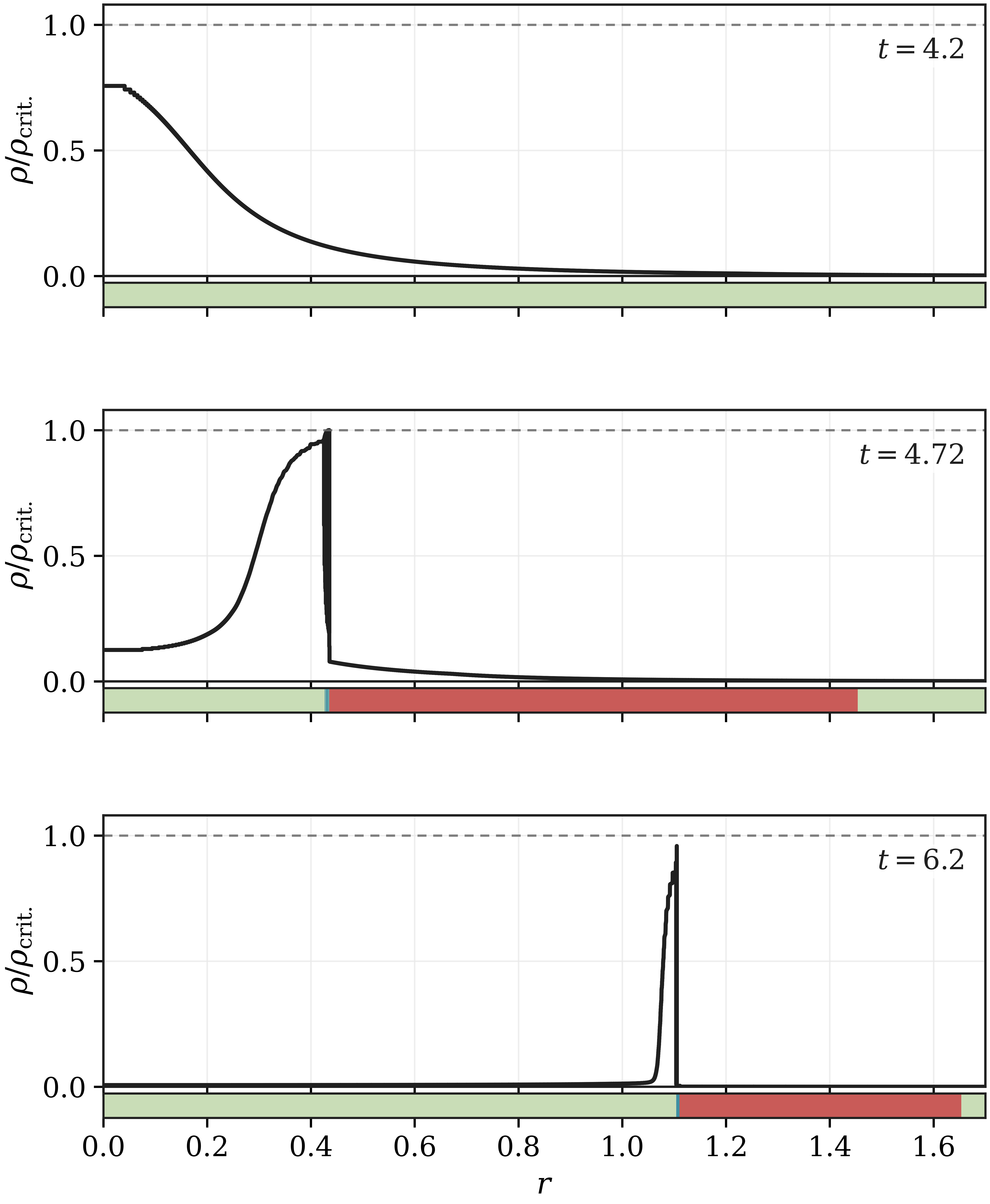
A star dies, collapses into a black hole — and falls silent forever. But the quantum world abhors loss: calculations show that the star doesn’t go mute, but lets out a scream frozen at the horizon. A quantum wave, a “fuzzy nova,” eventually melts the gravitational shackles and hurls matter outward. Someday telescopes will hear this explosive whisper — and the event horizon will no longer be the edge of silence.
🎯 The name “fuzzy-nova” alludes to the quantum fuzziness of spacetime at Planck scales. By the way, the critical density at which the bounce occurs is just 0.41 of the Planck density; if you squeezed an entire mountain down to the size of an atomic nucleus, you wouldn’t even come close to that number.
\dot{r}^2 = \frac{2Gm(R)}{r} \left(1 - \frac{\rho(R,t)}{\rho_{\text{crit}}}\right)
The classical energy of the shell is multiplied by the factor (1 − ρ/ρ_crit), which vanishes at the critical density, causing a bounce.
Scientists
Stephen HawkingJacob BekensteinAlbert EinsteinFritz ZwickyVera RubinBernhard Riemannblack hole
supernova
stellar evolution
numerical simulation
spacetime curvature
gravity
quantum information
gravitational wavesLaws
Hawking radiationgravitational lensingBekenstein-Hawking entropyEinstein field equationsequivalence principleChandrasekhar limit