Fuzzy-nova: A Quantum Wave Dissolving Black Holes ✛ ✎ ✦
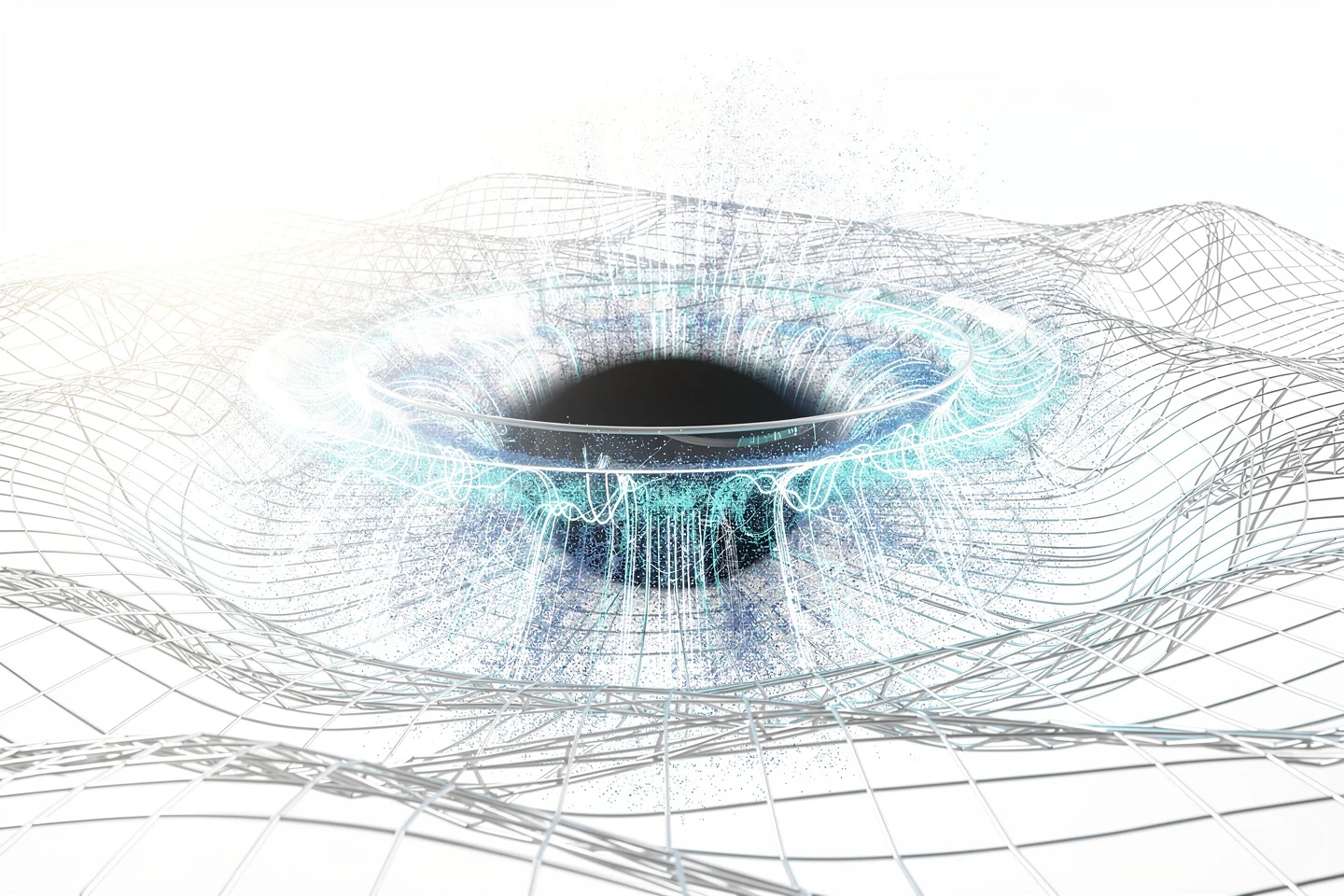
A dying star is not just fading away. In its final moments, the core, starved of fuel, collapses into itself at colossal speed. Classical gravity leaves no choice: if the mass is large enough, a black hole is born — a region from which not even light can escape. Penrose showed that inside there inevitably hides a singularity — a point where spacetime curvature becomes infinite and the predictive power of theories goes to zero. To an outside observer, the star seems to go mute: its final “scream” is forever locked by gravity. But quantum theory refuses to accept this.
Imagine: that scream is not an acoustic shock, but a quantum tremor of space, frozen at the horizon. In the new study, physicists turn to the ideas of Carlo Rovelli and loop quantum gravity: at the microscopic, Planck scale, the very fabric of space becomes “fuzzy,” blurry. When the density of collapsing matter nears a critical value — about 0.41 of the fantastic Planck density — gravity suddenly stops being just an attraction. A correction term appears in the equations, a factor (1 − ρ/$ρ_{crit}$) multiplying the gravitational force. At the limit, this factor vanishes, and the collapse turns into a powerful bounce. Thus a fuzzy-nova is born — a quantum wave of matter-geometry.
This wave doesn’t just bounce back — it spreads like ripples on a pond from the center through all layers of the star, sweeping away matter. Numerical simulations confirm that the emerging anti-trapped region (analogous to a white hole) allows matter to exit along timelike trajectories in finite time. When the front reaches the event horizon, the black hole dissolves without a trace. The information about what the star was made of is not lost — it returns in the form of this grand burst. Thus, the information paradox that has tormented physicists for half a century is resolved.
The near-term prospects are breathtaking. If fuzzy-nova is real, then explosions may be occurring in space that astronomers have yet to identify. Once the wave density drops below the Planck scale, a flash will occur — possibly in the form of gravitational waves or gamma-ray bursts detectable by existing instruments. Maybe the signals are already lying in archives among unexplained transients. Perhaps we have been looking at fuzzy-nova signatures for years, mistaking them for noise. The model opens a window into quantum gravity, where the finales of massive stars become a laboratory for testing the deepest laws of nature. The frozen scream finds its voice.
The name “fuzzy-nova” alludes to the quantum fuzziness of spacetime at Planck scales. By the way, the critical density at which the bounce occurs is just 0.41 of the Planck density; if you squeezed an entire mountain down to the size of an atomic nucleus, you wouldn’t even come close to that number.