How Black Holes Vanish Without a Trace ✛ ✎ ✦
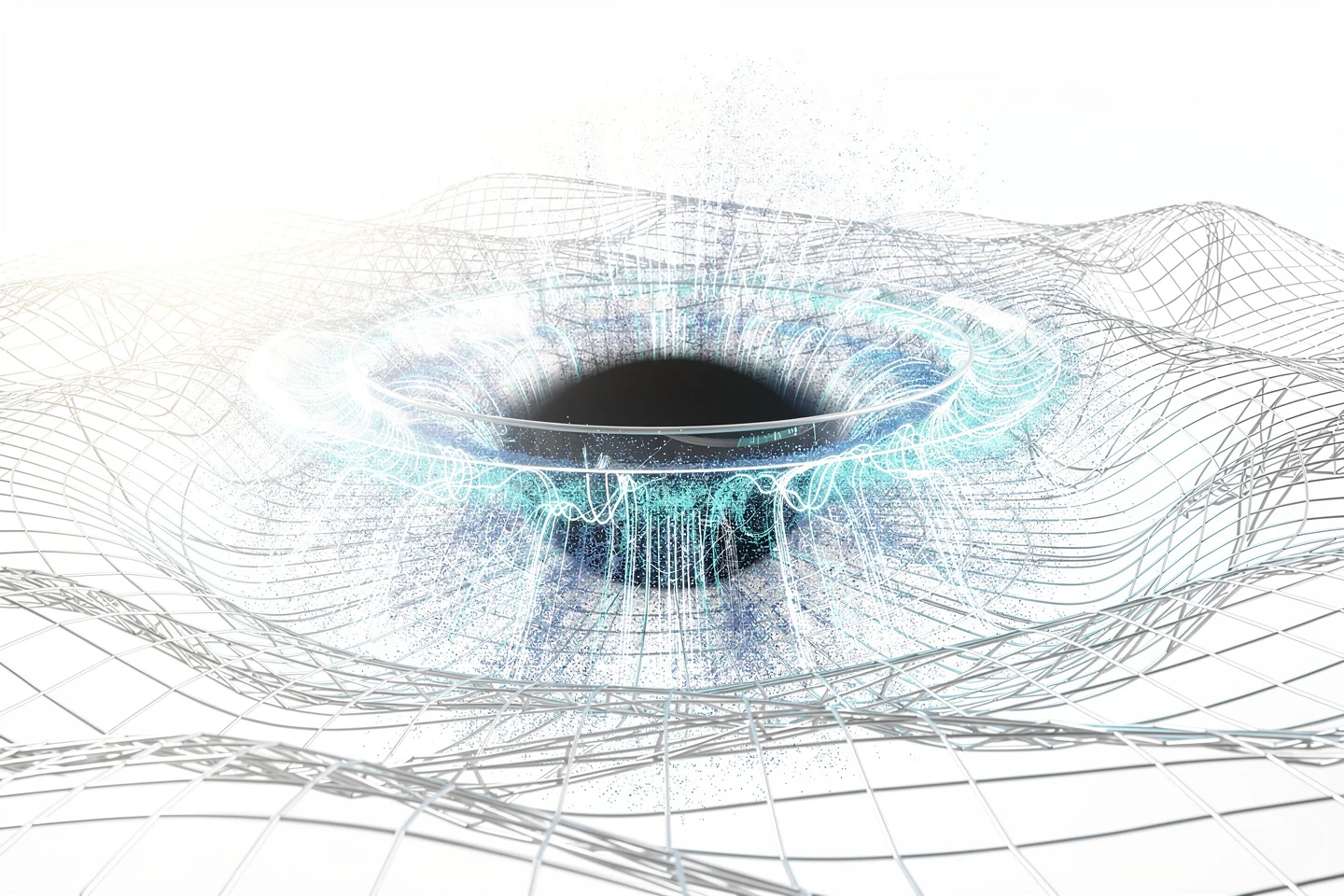
When the life of a massive star comes to an end, its core collapses inward. According to the classical picture described by Roger Penrose, the collapse leads to a black hole — a region where spacetime curves so much that not even light can escape. Stephen Hawking showed that holes emit radiation and evaporate, but quantum information about what fell into them seems to be erased — a paradox arises.
A new model, drawing on the ideas of loop quantum gravity, proposes a different ending. If we account for the quantum properties of gravity, an internal 'spring' of matter prevents infinite collapse: at a critical density, it sharply repels the material, creating a shock wave — a fuzzy-nova. Calculations show that the wave breaks through and ejects all the mass in a short time, returning information to the Universe. The flash could be detected by gravitational waves or gamma radiation.
Remarkably, the bounce occurs at a density nearly two and a half times lower than the Planck limit — the final frontier beyond which the very fabric of space tears apart. The black hole vanishes before reaching that singular point: it never becomes 'bottomless,' but instead disappears in a bright flash.
The bounce happens at a density about two and a half times lower than the Planck density — the ultimate threshold where spacetime 'rips' and ceases to obey familiar laws.