Fuzzy-Novae: Quantum Ejection of Matter from Black Holes ✛ ✎ ✦
Context
The detection of gravitational waves and the direct observation of the shadow of supermassive black holes in galaxy centers have reinforced the reality of these objects. However, the internal dynamics of collapsing matter remain a mystery: Einstein's equations inevitably lead to singularities, where spacetime curvature becomes infinite, as shown by Roger Penrose. Moreover, quantum effects predicted by Stephen Hawking give rise to the information paradox—a violation of unitarity in evolution. Resolving these issues requires a consistent merger of gravity and quantum theory, and could also shed light on the final stages of massive stars' lives.
Methods
The authors developed a model based on the Lemaître–Tolman–Bondi equation, which describes a spherically symmetric dust cloud. A quantum correction inspired by loop quantum gravity imposes a local curvature bound: a factor (1 − ρ/$ρ_{crit}$) is added to the shell's evolution, where ρ is the local density and $ρ_{crit}$ ≈ 0.41 of the Planck density. This turns the classical system of ordinary differential equations into a nonlinear partial differential equation linking adjacent layers. The solution employed numerical simulations using a mass-adapted finite volume scheme, where each cell corresponds to a fixed mass, and bounce of a shell is triggered when ρ ≥ 0.9999 $ρ_{crit}$. This approach ensures exact mass conservation and prevents artificial smearing of Planck-scale peaks.
Results
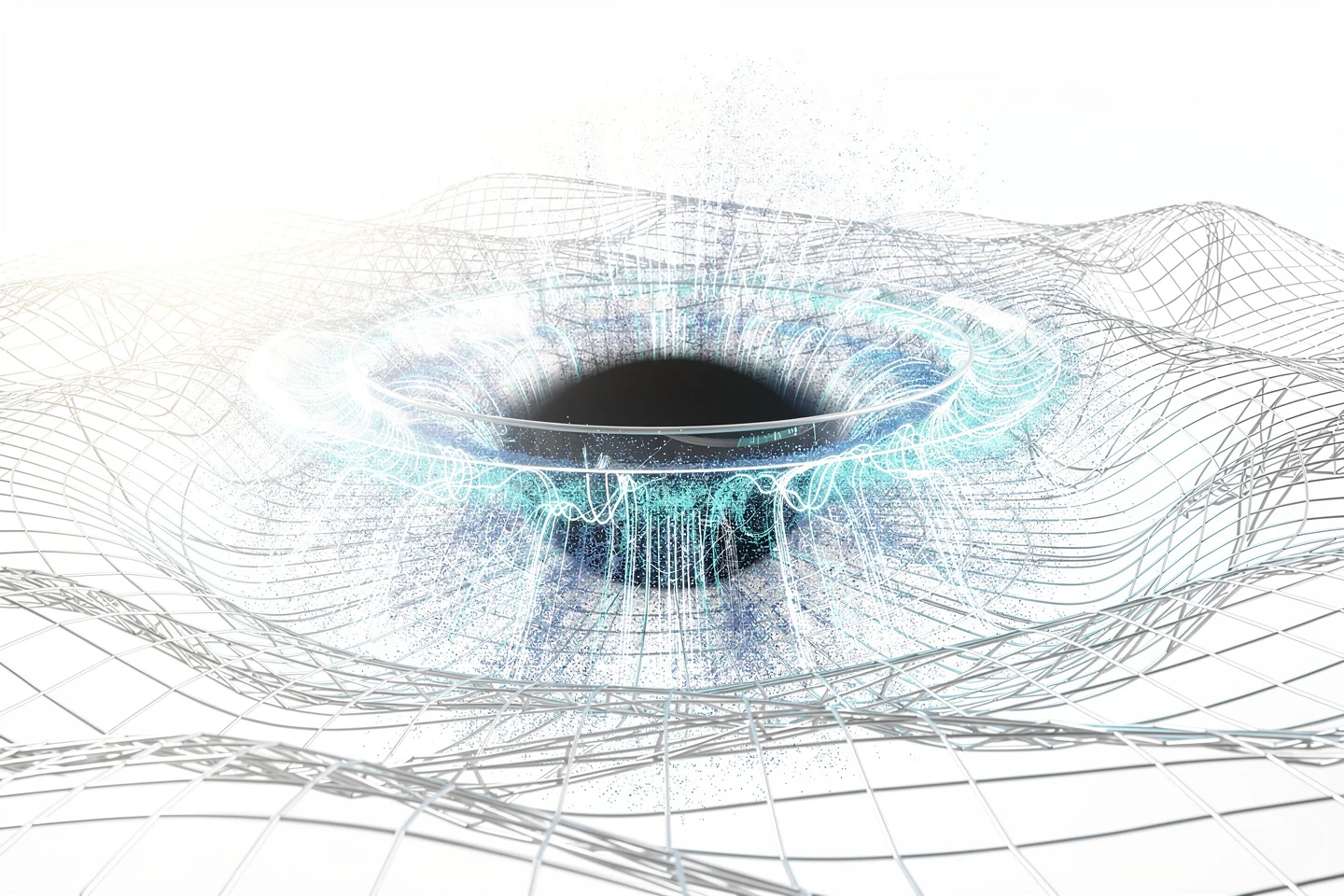
Simulations showed that as the core contracts, the local density reaches the critical value, and quantum repulsion causes a bounce. Unlike previous models where shells evolved independently, here the interaction through density gradients produces a stable outgoing wave of matter and geometry—dubbed fuzzy-nova ('fluffy nova'). In the wave zone, a local anti-trapped region forms (analogous to a white hole), allowing matter to move outwards along timelike trajectories. When the front reaches the event horizon, the black hole dissolves completely in a finite time, and all the information encoded in the matter is returned to the external observer—offering a potential solution to the information paradox. Numerical tests confirmed the absence of instabilities and causality violations: the group velocity of matter always remains subluminal, though the wave's phase velocity can be superluminal.
Implications
This result challenges the long-held belief that nothing can escape from a macroscopic black hole along a timelike path, even in the quantum-gravity regime. The model demonstrates that local quantum repulsion can 'flip' light cones and allow causal information outflow. It not only eliminates the central singularity and shell-crossing singularities, but also bypasses known instabilities (mass inflation, Eardley instability) that plague competing theories. Since the vacuum sector of the model remains classical, the solution is free of inner Cauchy horizons.
Future development
Future work will include accounting for matter pressure and investigating multimessenger signals emerging when the wave exits the opaque regime. Once the fuzzy-nova's density drops below the Planck scale, it will start radiating, possibly as gravitational waves and gamma-ray bursts—such phenomena might already be detectable by existing instruments or hidden in archives of unexplained transients. On the theoretical side, effective equations need to be derived from the canonical theory or group field theory, and the dynamics tested on covariant spin networks. It will also be interesting to study the wave's behavior when its radial thickness becomes Planckian—there, the graininess of spacetime may become apparent.
Impact
The work opens a new observational window into quantum gravity, linking Planck-scale physics with astrophysical explosions. The results will influence the development of quantum cosmology, high-energy physics, and even quantum information science.
Next steps
Key next steps include optimizing the numerical code to simulate the collapse of larger masses (to confirm the shortened black hole lifetime compared to the Page time) and detailed calculations of light curves for future observations.
Key open problems
The model directly addresses the singularity problem in general relativity, the information paradox, and the question of the quantum nature of the event horizon. The success of the local curvature-limiting mechanism calls for a reassessment of the role of vacuum fluctuations in black hole evaporation.
The knowledge machine's view
This section is addressed to the author of the paper and their colleagues. Neighbouring works were found by meaning-based search across our archive, not by word overlap. We do not review: we show the field around the work.
What the work does
The authors construct a model of dust cloud collapse with a quantum correction that bounds curvature, and numerically show that instead of a singularity, a bounce occurs, generating an outgoing wave of matter-geometry (fuzzy-nova) that dissolves the black hole and returns information.
Where its strength is
The model demonstrates a concrete mechanism by which local quantum repulsion flips light cones and allows matter to escape the black hole along timelike trajectories, preserving causality.
Where it could go next
- It might be interesting to compare the model's predictions with observational signatures: nearby in the archive there is an analysis of how primordial black holes affect the expansion rate of the universe, which could constrain fuzzy-nova parameters.based on: Cosmic Hot Tap: How Primordial Black Holes Rewrite the Speed of the Universe arXiv:2607.18528v1
- There is also work on gravitational waves from evaporating black holes; perhaps one should consider what gravitational-wave signature fuzzy-nova leaves and how to search for it in detector data.based on: Black Holes Evaporate, but Gravitational Waves Remember arXiv:2606.09804
- The archive also contains a model of a black hole without a singularity with a different mechanism; comparing approaches could clarify which features of fuzzy-nova are universal for quantum-gravitational collapses.based on: How a Black Hole Is Born Without a Singularity arXiv:2607.16590
Worth trying
- Check whether the model yields predictions for black hole shadows that are distinguishable from classical ones, using the approach from the work on fuzzy mass.
- Assess how fuzzy-nova manifests in the spectra of quasars illuminating halos, by analogy with the analysis of the cosmic searchlight.
- Calculate quasinormal modes for the resulting object and compare with predictions for black holes without singularities.
Why this may matter
If the fuzzy-nova mechanism is realized in nature, it offers a natural resolution to the information paradox and changes our view of the final stages of collapse, which could be tested by future observations.
Nearby works in our archive
- Black Holes Born from Nothing, Then Diesimilarity 0.67
- How Quantum Black Holes Shed Their Weightsimilarity 0.67
- Cosmic Hot Tap: How Primordial Black Holes Rewrite the Speed of the Universesimilarity 0.67
- Black Holes Evaporate, but Gravitational Waves Remembersimilarity 0.66
- How a Black Hole Melts Before Your Eyessimilarity 0.66
- A Black Hole Rings Differently If There's No Singularity at Its Coresimilarity 0.66
- How a Black Hole Is Born Without a Singularitysimilarity 0.66
The closest work in the archive sits at 0.67 by meaning — the usual level for our corpus.
The name 'fuzzy-nova' plays on the word 'fuzzy', alluding to the quantum 'smearing' of spacetime at Planck scales. Curiously, the outgoing wave's phase velocity can exceed the speed of light, just like the spot from a spinning lighthouse beam, this doesn't contradict relativity, since energy and information transfer is governed by the group velocity.
Key numbers
- critical bounce density: 0.41 of the Planck density (≈5.16×10⁹⁶ kg/m³)
- numerical bounce precision: ρ ≥ 0.9999 ρ_crit
- stellar mass in simulations: on the order of the Planck mass (≈2.18×10⁻⁸ kg)