Teaching AI to Design Drugs Without Compromises express
An engineer building a bridge cannot strengthen one beam without affecting the load on adjacent ones. Drug development works similarly: a molecule must fit snugly into the 'pocket' of a target protein, like a key in a lock, while also being safe, stable, and convenient to administer. The trouble is that these two requirements, binding affinity and drug-likeness, often pull in opposite directions. Make a molecule 'stickier,' and it becomes toxic or stops dissolving.
Modern algorithms based on large language models can iterate through molecular variants, but they act almost blindly: they change one fragment at a time and check the outcome. The authors of the new study measured how often such a single step improves both properties at once. It turned out — rarely. Much more often, improving one metric comes at the cost of the other. This is like repairing something blindly: you turn a screw at random, not knowing what's inside.
The solution proposed by the researchers follows this logic. Their system PROBE (from the English 'to probe') starts not with optimization but with reconnaissance. It breaks the molecule into editable regions and builds a map of the pocket: where joint improvement is possible, where goals conflict, and where clearly bad fragments sit. Then, control 'injections'—trial substitutions — are made, and based on the system's response, something like an instruction manual for the assembler is compiled. Next, three agents come into play: one handles binding affinity, the second handles drug-likeness, and the third ensures their edits don't interfere with each other. They act in turn, consulting the map and the instructions.
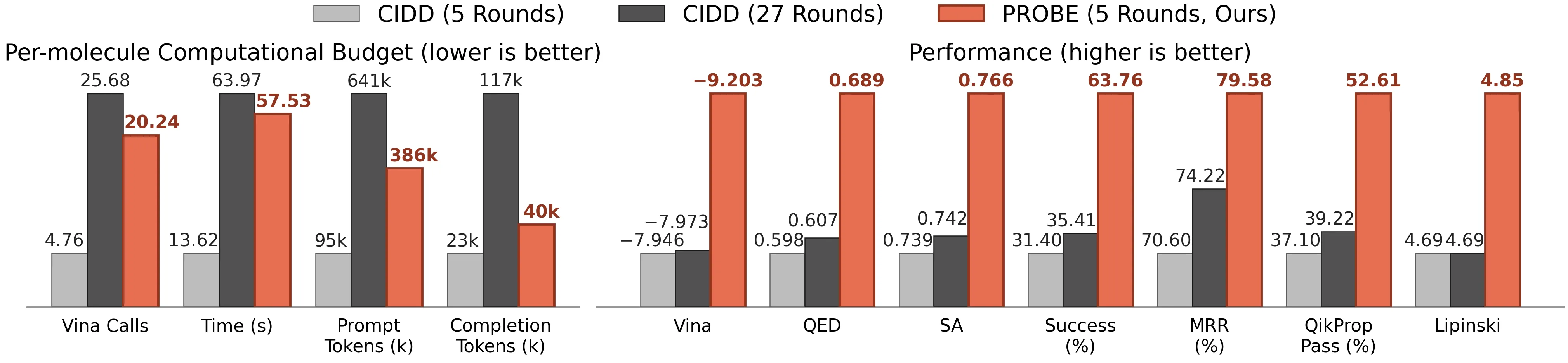
On the standard benchmark of target proteins CrossDocked2020, this approach yielded the best results among comparable methods and, importantly, significantly reduced the number of steps where improvement in one aspect dragged down another. The bridge no longer wobbles with every change.
A target protein in the body is often compared to a lock, and a drug to a key. But in reality, the 'lock' is not rigid: it slightly changes shape upon binding, and a good 'key' must be able to adapt to that.
In Peter Watts's cult novel 'Blindsight,' the crew of a ship encounters an alien life form whose biochemistry is built on entirely different principles. To understand it, they must literally 'probe' the alien metabolism blindly — much like PROBE probes a protein pocket.