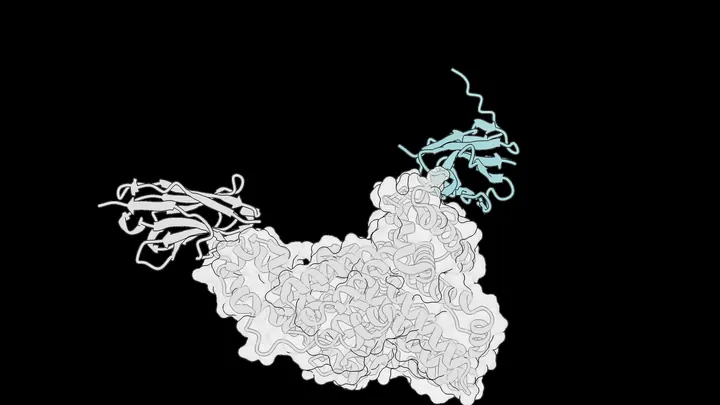
Drug design is the rational, target-driven process of discovering new medications. Instead of blindly screening thousands of random molecules, researchers start with a specificbiological target — usually a protein whose malfunction causes a disease — and then search for molecules that will bind to it and modulate its activity. This approach transforms drug discovery from a lottery into an engineering discipline, where knowledge of the target's structure and dynamics guides every decision.
History
The concept emerged in the 1980s with the rise of structure-based drug design, pioneered by researchers like Irving Kuntz and Peter Goodford, who developed early computational tools for docking and binding-site analysis.
How it works
The process begins with identifying and characterizing the target, often using structural biology to obtain its 3D shape. Computational methods then screen large chemical libraries, scoring candidate molecules for their predicted binding affinity and specificity. Modern approaches incorporate machine learning to explore 'chemical space' — the vast universe of possible molecules — and to predict how modifications to a lead compound will affect its properties. The best candidates are synthesized and tested experimentally, with the results feeding back into the next round of design.
In practice
Used in virtually all modern pharmaceutical research, from designing HIV protease inhibitors to developing targeted cancertherapies and COVID-19 antivirals.
Fun fact
The chemical space of possible drug-like molecules is estimated to contain more than 10^60 compounds — more than the number of atoms in the observable universe.
A drop of blood on filter paper preserves not only cells but also a record of what has been happening to the body over the past few months. That record is not in the genes but on them: the chemical marks cells attach to DNA change with food, stress, illness and age. Scientists have learned to read this archive tape to reconstruct a picture of health without repeated trips to the lab.
Hunting for a new material is like cooking without a recipe: you try, try again, and often throw things out. Previously, scientists manually flipped through papers and tested compositions one by one. Now there's a "robot chef" that reads the literature itself, mixes components, and checks what came out.
Inside every cell, things are constantly meeting and parting. Some pairs hold tight, like Velcro, while others barely touch, like pollen on the wind. These fleeting touches, where the binding strength is comparable to a grain of salt dissolving in a glass of water, govern many of the cell's signals and decisions.
A jazz ensemble: at first, a cacophony of random notes. Then — a catchy riff that plays over and over. Such is the riddle of the origin of life — only in the language of chemistry.
A protein in a cell is not a rigid part but rather a soft glove that can grasp different objects. Until now, protein designers worked like sculptors, crafting a key for a single lock: one target, one shape. But life is more complex: sometimes a protein needs to recognize two different viruses at once or change its contours depending on its neighbors.
In any city project, residents' behavior is a invisible force that determines success. One skeptical neighbor can slow down solar panel installation across an entire block: their caution triggers a rise in disorder.
When biologists measure the activity of thousands of genes, they usually just see a list of coincidences, like two ingredients in a soup that often end up together. The standard method looks for such pairwise connections but doesn't show who influences whom.
A new approach, like a detector of dark matter, uncovers hidden threads of causation.
Cooking a complex dish requires a clear recipe: first chop, then sauté, add spices at just the right moment. Chemical transformations also follow step-by-step recipes — mechanisms where atoms of carbon and hydrogen rearrange in a strict order.
Previously, neural networks often invented nonexistent steps, like a whimsical cook swapping salt for sugar.
Imagine a fleet of many ships, resembling a galaxy — a vast stellar system where every element follows the overall dynamics. From time to time, one ship breaks down, exploding like a supernova — a catastrophic event that can disrupt the integrity of the entire formation. If the damaged unit isn't replaced in time, the fleet loses combat capability.
Think of a massive cookbook: each recipe is a protein, and the finished dish is its job in the cell. To whip up a complex treat, you often need to mix several ingredients and let them 'set' into the right shape. Until now, scientist-chefs could only guess how someone else's recipes would fold.
Imagine an audition for a symphony orchestra, where out of hundreds of hopefuls, only those whose instruments sound pure and withstand the furious crescendo remain. In the world of materials, computers have learned to generate 'atomic scores'—thousands of virtual crystals that promise to become the foundation for quantum chips or superconductors.
Creating a material with desired properties is an art that long relied on intuition and luck. Nature gives no hints: dozens of elements in the periodic table, and the number of their combinations tends to infinity. Previously, materials scientists resembled alchemists, trying everything in a row, or relied on statistical models that lost power beyond the known.
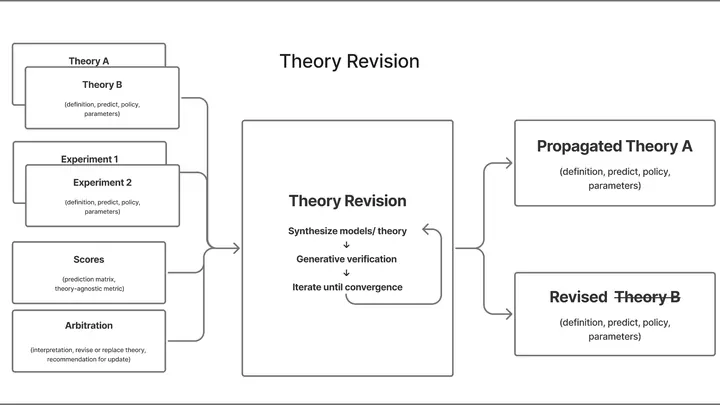
A closed loop: the machine proposes an idea, tests it on people, sees the failures, and spawns a new, more accurate guess. That's how AutoCog works — an automatic cognitive scientist. Previously, in the science of thinking (cognitive science), the hardest part, coming up with a theory, was done only by humans.
An engineer tunes an antenna: pull one segment, the frequency drifts; change the angle, the gain drops. Developing therapeutic peptides (short protein chains) works much the same way.
In the watery environment, vortices batter the mechanical fish. The AI agent, like an experimental chef, ran simulations, tried out 'recipes' of movements, and improved the program. Each experiment was like spectroscopy: the agent broke down behavior into elements, uncovering patterns. At first, the fish only paddled in one direction.
For a long time, we only saw proteins in their final form — like photographs of dancers frozen in a beautiful pose. Programs like AlphaFold learned to predict that pose from a chain of carbon links. But the real magic is how a protein finds this shape faster than you can blink, performing a swift dance.
An engineer building a bridge cannot strengthen one beam without affecting the load on adjacent ones. Drug development works similarly: a molecule must fit snugly into the 'pocket' of a target protein, like a key in a lock, while also being safe, stable, and convenient to administer.
A person looks at a door lock and sees a keyhole. They know that a key is inserted and turned. But if instead of a keyhole there's a touch panel, the familiar frame breaks. The person doesn't just make a mistake: they realize that the usual approach won't work and can say, "There's no place for a key here; a different approach is needed."
Such an honest stop with an explanation is rare for machines.
Molecules float in a test tube. Their abundance (say, the concentration of some protein) becomes the input signal. And the output isn't just a cloudy solution but a clear yes-or-no answer.
The authors build a chemical cascade that does exactly that.
In a car, the steering, brakes, and accelerator gradually fail. At first, you can still swerve around a pothole, but each year the maneuver takes more effort. At some point, even a perfect road becomes impassable — the car no longer obeys the driver.
That's exactly how the authors describe aging: not as the accumulation of rust or wear and tear, but as the loss of "controllability" of the body.
Inside every cell, life is bustling: tiny protein machines tirelessly haul cargo, read genes, and fix errors. But their work is far from perfect: they often 'spin their wheels,' take backward steps, or get stuck in futile cycles. It's like a city traffic jam where cars dart around aimlessly, burning fuel.
A protein in a cell is like a tiny machine: each has its own precise blueprint and its own task. Some proteins cut molecules, others carry oxygen, and still others capture light. To build such a mechanism from scratch, you need to solve two problems at once: decide what job it will do and how it will fold into the right knot. If the knot goes wrong, the machine jams or breaks.
Searching for a new material is like looking for a needle in a haystack, but here the haystack is millions of possible atomic combinations. In the past, scientists spent years trying out options in the lab, relying on intuition and luck. Now, artificial intelligence is stepping in, learning to 'understand' the language of crystals.
The microbial community in the gut is like an orchestra: what matters is not only the musicians but how they play together. When disease strikes, it's not just the lineup of microbes that changes: their interconnections shift too. Researchers built interaction networks of microbial genes in healthy and sick individuals.
A lab assistant carefully follows every step of an experiment, but at the end, writes in the report what they wanted to write before they even started. That's how modern language models behave when given scientific research tasks.
A protein is like a chain of amino-acid beads that folds into a precise shape, and that shape dictates how the protein works in a cell. Protein designers swap beads to achieve the desired form, but the number of possibilities is enormous.
In a lab where crystals are studied, a technician stares at a screen covered in bright spots and slowly rotates the sample, trying to get the spots to form a symmetric pattern. It's like tuning an old radio: you turn the knob until the static gives way to a clear signal. Now, a machine can turn that knob.
Scientists have created a program that learns to align crystals without any knowledge of how those spots work.
The nose is an amazing instrument. A single coffee molecule entering a nostril can awaken a memory of a morning kitchen. Another, nearly identical in shape, smells like rotten eggs.
Capsids are protein boxes that viruses use to carry their genetic material. In gene therapy, these boxes serve as couriers: you put a desired gene inside, and the outside retains the ability to enter cells.
When a typical computer searches for a law of nature from data, it tries to guess a complete formula in one go. It's like a cook who, without knowing the recipe, dumps all the ingredients into a pot at once and hopes for soup. Most often, the result is an inedible mess: the formula is long but meaningless, and it fails on new data.
Science is like a city where residents pave the streets themselves. Where paths are already worn, new houses go up, while untouched vacant lots go unnoticed — not because building there is impossible, but because no one ever looks.
A medicinal chemist is like a detective searching for the right compound among millions of suspects. Modern neural networks speed up the search but behave like a witness who says "it's him" and refuses to elaborate. In pharma, such secrecy is dangerous: a spurious correlation could send a toxic compound to the next stage of trials.
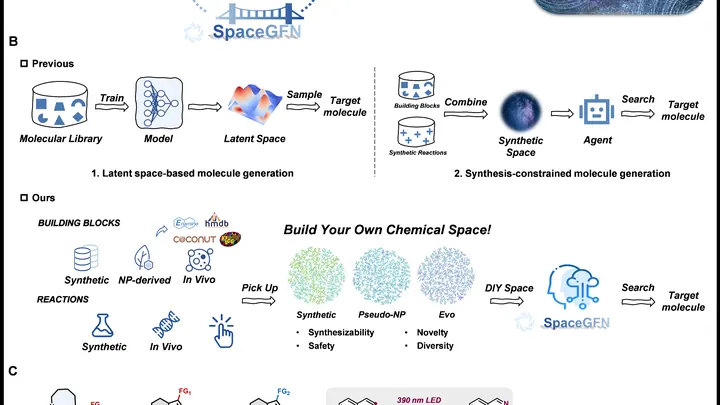
Previously, generative models for drug discovery worked like an artist painting without choosing a canvas. They learned from existing molecules and simply produced similar ones, without considering how the space of possible compounds is organized. SpaceGFN changes the approach: now chemical space is a construction set where the user specifies the parts and the assembly rules.
You can edit a cell perfectly, and it still turns out useless. The gene is fixed exactly as planned, yet the cell behaves unpredictably: it drifts, changes fate, loses safety. It's like fixing one gear in a watch, but the watch still runs wrong because the whole mechanism is out of sync.
Previously, a cell was viewed as a list of independent parts.
Proteins are chains of amino acids, and they often contain repeated chunks. Sometimes the repeats are exact, like the same phrase said twice. Sometimes they come with typos: a couple of letters swapped, but the meaning is the same. These repeats matter: they help the protein fold into the right shape and do its job.
A bacterium in a drop of water is looking for food. Around it, there's a chemical gradient: more food molecules on one side, fewer on the other. How should it move to reach the tasty spot fastest? It could steer smoothly, like a cyclist dodging a puddle. Or, like a bacterium, it could periodically stop, tumble, and swim off in a random direction.
A crystal that inside resembles a sponge with a labyrinth of pores turns out to be capable of performing computations. The material, named DUT-8, consists of metal nodes and organic linkers forming an intricate lattice. Under the influence of different gases, this lattice slightly changes shape, like a house of cards that rearranges with a gentle breath.
A drop of ink in a glass of water spreads out on its own. But if the ink were made of tiny motors, they wouldn't just spread: they'd crawl, jostle, and cluster into swarms. Such self-propelled particles are called active. You can assemble them into molecules like beads on a bracelet. And here's the surprise: the order of beads on the bracelet changes everything.
When chemists see how concentrations of substances change, they need to figure out which reactions are behind those changes. It's like trying to reconstruct a recipe from photos of plates at different stages of a meal. Previously, this often involved derivatives — instantaneous rates of concentration change.
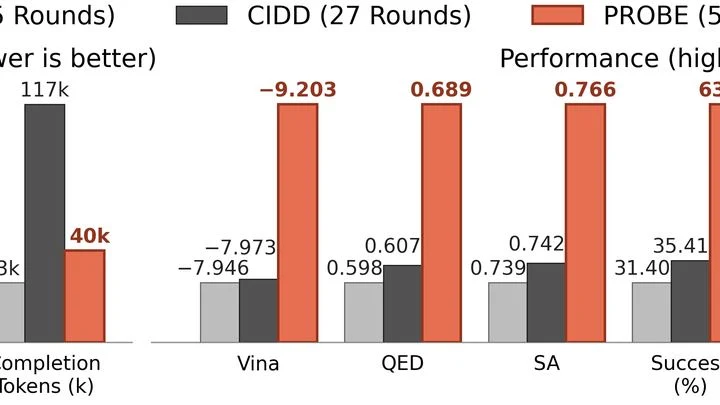
A chemist searching for a new drug is like a cook without a recipe: they have a list of desired properties but millions of possible ingredients. Each trial is costly and time-consuming, so you need to experiment wisely.
The new program SEISMO acts like a chef who tastes the dish after every step and immediately decides what to add next.